Confused about theirs vs there’s? You’re not alone. These two words sound similar, but they mean completely different things and using the wrong one can quietly weaken your writing. If you’re a student, content creator, or just someone who wants to write clearly, this guide will help you master the difference with ease.
In this friendly, practical article, you’ll learn exactly what each word means, when to use it, and how to avoid common mistakes. By the end, you’ll feel confident using both in everyday writing without second-guessing yourself.
Quick Answer
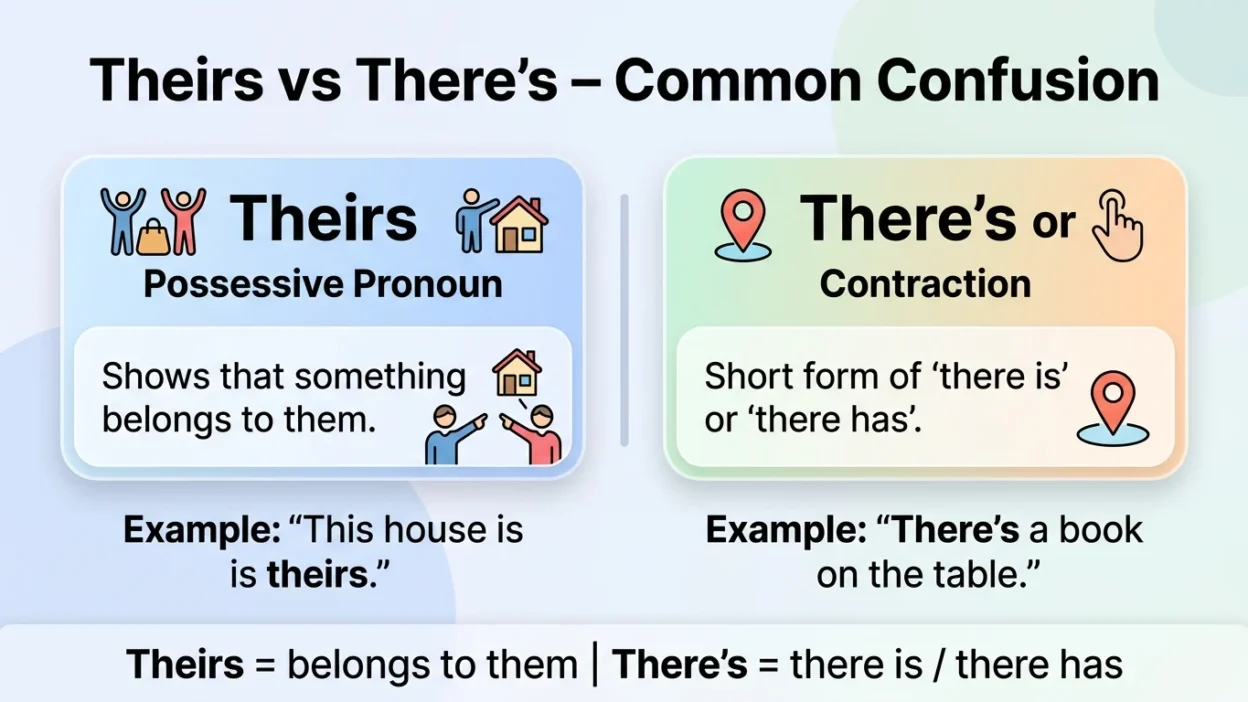
- Theirs = a possessive pronoun (shows ownership)
👉 Example: The house is theirs. - There’s = contraction of “there is” or “there has”
👉 Example: There’s a problem here.
Tip: If you can replace it with “there is”, use there’s. Otherwise, it’s likely theirs.
What Does “Theirs” Mean?
Theirs is a possessive pronoun, which means it shows ownership or belonging. It replaces a noun to avoid repetition.
Examples:
- This car is theirs, not ours.
- That decision was completely theirs.
- The credit for the project is theirs.
Key Insight:
You use theirs when talking about something that belongs to them, without repeating the noun.
✔ Correct: The books are theirs.
❌ Incorrect: The books are there’s.
What Does “There’s” Mean?
There’s is a contraction, which means it’s a shortened form of:
- There is
- There has
Examples:
- There’s a cat on the roof. (There is)
- There’s been a mistake. (There has)
- There’s no reason to worry.
Key Insight:
If you can expand there’s into “there is” or “there has”, then it’s correct.
✔ Correct: There’s a solution.
❌ Incorrect: The solution is there’s.
Theirs vs There’s: Key Differences
| Feature | Theirs | There’s |
| Type | Possessive pronoun | Contraction |
| Meaning | Belonging to them | There is / There has |
| Usage | Shows ownership | Introduces something |
| Example | The choice is theirs | There’s a problem |
Common Mistakes (And How to Avoid Them)
Mixing up theirs vs there’s usually happens because they sound alike. Let’s clear up the most common errors.
1. Using “there’s” to show possession
❌ The car is there’s.
✔ The car is theirs.
👉 Remember: There’s never shows ownership.
2. Using “theirs” in place of “there is”
❌ Theirs a dog outside.
✔ There’s a dog outside.
👉 Try expanding it: “There is a dog outside.” Makes sense? Then use there’s.
3. Confusing with “their” or “there”
This is a bigger family of confusion:
- Their = possessive adjective (their house)
- There = place or position (over there)
- There’s = there is / has
- Theirs = belonging to them
Easy Trick:
- Ownership → theirs
- Location or existence → there’s
Real-Life Examples for Clarity
Seeing words in context makes everything clearer.
Using “Theirs”
- The responsibility is theirs, not ours.
- That idea was theirs from the start.
- These shoes are theirs.
Using “There’s”
- There’s something I need to tell you.
- There’s been a delay in the schedule.
- There’s no doubt about it.
American vs British English
Good news there’s no difference between theirs vs there’s in American and British English. Both forms are used the same way in:
- Grammar rules
- Meaning
- Everyday writing
The only variation might be in style preferences (like formal vs informal tone), but the usage stays consistent.
When to Use Each (Quick Decision Guide)
Ask yourself:
- Am I showing ownership? → Use theirs
- Can I say “there is” instead? → Use there’s
Example:
- The final decision is ___. → theirs ✔
- ___ a mistake in the report. → there’s ✔
FAQs
1. Is “there’s” ever used for possession?
No. There’s never shows ownership. It only means there is or there has.
2. Can “theirs” be used before a noun?
No. You don’t say “theirs car”. Instead, say “their car”.
Theirs replaces the noun entirely.
3. Is “there’s” informal?
It’s slightly informal because it’s a contraction, but widely accepted in both spoken and written English.
4. Why do people confuse theirs and there’s?
Because they sound the same (homophones), but their meanings and grammar are different.
5. Can “there’s” mean “there are”?
Technically no, but in casual speech, people sometimes use it that way:
There’s many reasons… (informal)
6. What’s the easiest way to remember the difference?
Think:
- Theirs = belonging
- There’s = there is
7. Is “theirs” plural or singular?
It can be both, depending on context. It refers to something owned by one or more people.
8. Are these words important for SEO writing?
Yes. Correct grammar improves readability, trust, and user experience key factors in SEO and E-E-A-T.
Final Summary
Understanding theirs vs there’s comes down to one simple idea: ownership versus existence. Theirs shows that something belongs to someone, while there’s introduces something or indicates that something exists. Even though they sound identical, their roles in a sentence are completely different.
If you pause for a second and ask, “Am I talking about possession or saying ‘there is’?”, you’ll almost always choose the right word. With practice, it becomes automatic and your writing becomes clearer, more confident, and more professional.
Actionable Takeaway
Next time you write, do this quick check:
- Replace the word with “there is”. If it works → use there’s
- If you’re talking about ownership → use theirs
Practice with a few sentences daily, and you’ll eliminate this mistake for good.

Noah Jacob is the administrator of SpellPeak, responsible for managing website operations, content coordination, and platform performance. He ensures smooth functionality, security, and reliability while supporting the team in delivering a seamless, user-focused experience and maintaining high standards of quality across the site.