
If you’ve ever paused while writing and wondered whether to use patients or patient’s, you’re not alone. These two forms look almost identical, but they serve completely different purposes and using the wrong one can subtly change your meaning.
The good news? Once you understand the difference between plural nouns and possessive forms, this confusion becomes easy to fix. In this guide, you’ll learn exactly when to use patients vs patient’s, with clear examples, common mistakes, and practical tips you can apply right away.
Quick Answer
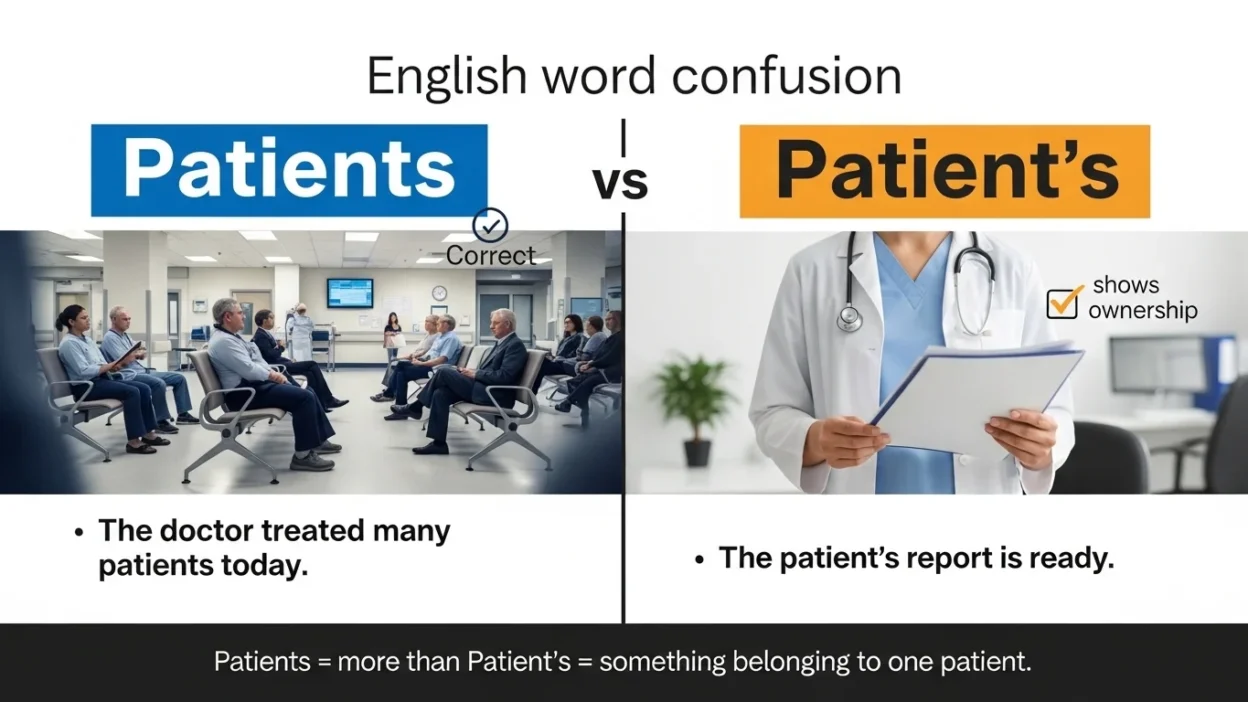
- Patients = plural form of patient (more than one person receiving medical care)
- Patient’s = singular possessive form (something belongs to one patient)
Example:
- The doctor treated several patients.
- The patient’s condition improved overnight.
Understanding the Meaning of Patients vs Patient’s
Let’s break it down simply so it sticks.
What Does “Patients” Mean?
Patients is the plural form of patient. It refers to more than one person receiving medical care or treatment.
Examples:
- The hospital admitted three new patients today.
- Nurses are caring for older patients.
- The clinic serves hundreds of patients every week.
👉 Think: Patients = many people
What Does “Patient’s” Mean?
Patient’s is the singular possessive form. It shows that something belongs to one patient.
Examples:
- The patient’s room is on the second floor.
- The doctor reviewed the patient’s report.
- We monitored the patient’s heart rate closely.
👉 Think: Patient’s = something belongs to one person
Patients vs Patient’s: Key Differences
Here’s a quick comparison to make things crystal clear:
| Word | Type | Meaning | Example |
| Patients | Plural noun | More than one patient | The hospital treated many patients. |
| Patient’s | Singular possessive | Something belonging to one patient | The patient’s file is missing. |
When to Use “Patients”
Use patients when you are talking about more than one person receiving care.
Common Contexts:
- Hospitals and clinics
- Healthcare reports
- General discussions about medical care
Examples:
- Doctors must communicate clearly with their patients.
- These patients require special attention.
- The waiting area was full of patients.
When to Use “Patient’s”
Use patient’s when you want to show ownership or relationship involving one patient.
Common Contexts:
- Medical records
- Personal belongings
- Conditions or symptoms
Examples:
- The patient’s symptoms worsened overnight.
- The patient’s family was informed immediately.
- We updated the patient’s medical history.
Don’t Forget: What About “Patients’”?
There’s one more form worth knowing:
- Patients’ = plural possessive (something belongs to multiple patients)
Examples:
- The patients’ rights must be protected.
- The patients’ records were stored securely.
👉 Quick tip:
- Patients’ = many people + ownership
Common Mistakes to Avoid
Even experienced writers mix these up. Here are the most common errors and how to fix them.
1. Using “Patient’s” Instead of “Patients”
❌ The hospital treated many patient’s.
✅ The hospital treated many patients.
👉 Rule: No apostrophe for simple plurals.
2. Forgetting the Apostrophe for Possession
❌ The patient condition improved.
✅ The patient’s condition improved.
👉 Rule: Add ’s to show ownership.
3. Confusing Singular and Plural Possession
❌ The patients room is ready.
✅ The patient’s room is ready. (one patient)
✅ The patients’ room is ready. (shared by multiple patients)
4. Overusing Apostrophes
❌ All patient’s must register.
✅ All patients must register.
👉 Apostrophes are not used to make words plural.
Easy Memory Trick
Here’s a simple way to never mix them up again:
- Patients = many (no apostrophe)
- Patient’s = owns something (has ’s)
If you can replace it with “belongs to,” you need patient’s.
Example:
- The patient’s chart → the chart belongs to the patient ✔️
American vs British English Differences
Good news there’s no difference between American and British English when it comes to patients vs patient’s.
Both follow the same grammar rules:
- Plurals do not use apostrophes
- Possessives require apostrophes
However, you may notice slight differences in related medical terms or spelling (e.g., “hospitalisation” vs “hospitalization”), but this does not affect these forms.
Real-Life Usage Examples
Seeing these in context helps reinforce the difference:
- The doctor explained the procedure to all patients.
- The patient’s recovery was faster than expected.
- Nurses checked the patients’ vital signs regularly.
- Each patient’s needs were carefully considered.
- The clinic focuses on improving outcomes for its patients.
FAQs
1. Is “patients” ever possessive?
No. Patients is only plural. For possession, use patients’ or patient’s depending on context.
2. What is the difference between patient’s and patients’?
- Patient’s = one person owns something
- Patients’ = multiple people own something
3. Can I use “patient’s” for more than one person?
No. That would be incorrect. Use patients’ instead.
4. Why is there no apostrophe in “patients”?
Because it’s just a plural noun, not showing possession.
5. How do I quickly check if I need an apostrophe?
Ask: “Does something belong to someone?”
- Yes → use ’s
- No → just plural (patients)
6. Is this mistake common in professional writing?
Yes, especially in healthcare and academic writing where these words appear frequently.
7. Which form is used in medical reports?
All forms are used depending on context:
- Patients (general reference)
- Patient’s (individual ownership)
- Patients’ (group ownership)
8. Does pronunciation change?
No, all forms are pronounced similarly. The difference is only in writing.
Final Summary
Understanding patients vs patient’s comes down to one simple idea: plural vs possession. Use patients when talking about more than one person, and use patient’s when something belongs to one individual. If multiple people own something, then patients’ is the correct form.
This distinction may seem small, but it makes your writing clearer, more professional, and more trustworthy especially in healthcare, academic, or formal contexts. Paying attention to these details strengthens both your grammar and your credibility.
Actionable Takeaway
Next time you write, pause and ask yourself:
- Am I talking about more than one person? → use patients
- Does something belong to one person? → use patient’s
- Does something belong to many people? → use patients’
Practice with real sentences, and this will quickly become second nature.

Noah Jacob is the administrator of SpellPeak, responsible for managing website operations, content coordination, and platform performance. He ensures smooth functionality, security, and reliability while supporting the team in delivering a seamless, user-focused experience and maintaining high standards of quality across the site.