If you’ve ever paused mid-sentence wondering whether to write cue or que, you’re not alone. These two words look similar, sound alike, and often confuse even confident writers. But here’s the good news: once you understand their meanings and contexts, the confusion disappears quickly.
In this guide, you’ll learn the exact difference between cue vs que, when to use each one, and how to avoid common mistakes. If you’re writing professionally or casually, this article will help you use both words correctly and confidently.
Quick Answer:
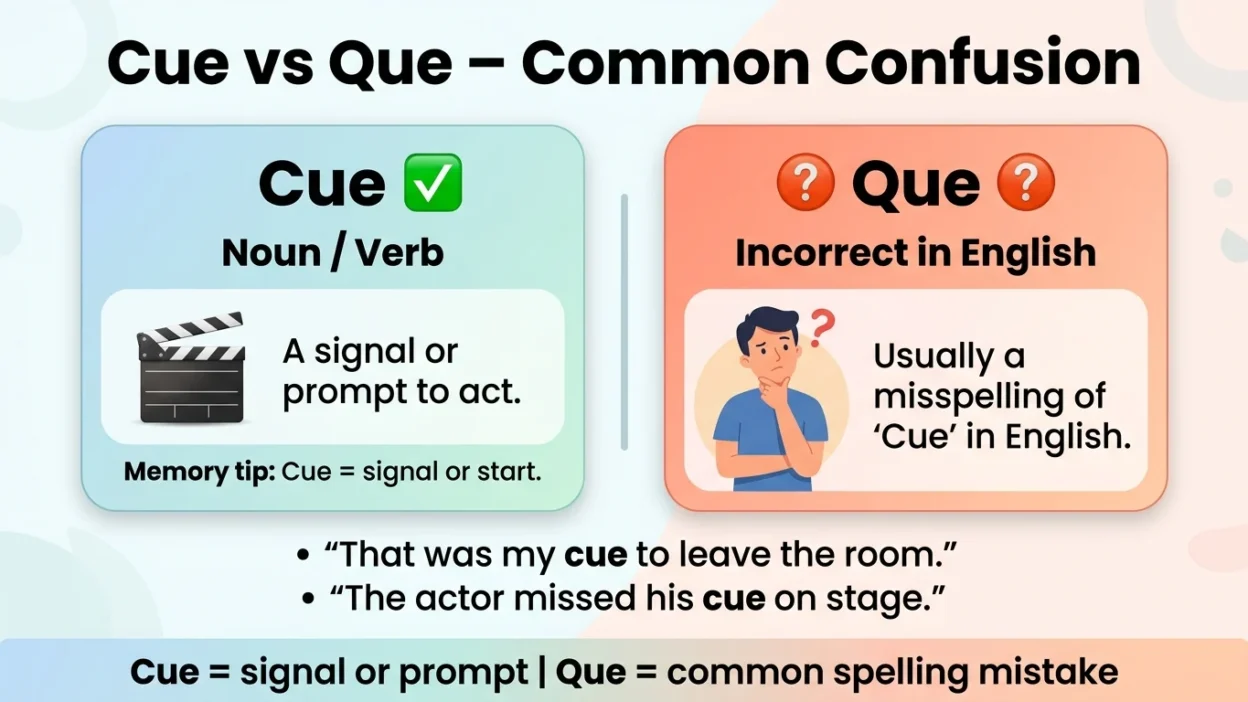
- Cue is an English word meaning a signal, prompt, or hint to act or speak.
- Que is not a standard English word. It usually appears in Spanish, French, or as a common misspelling of “cue” or “queue.”
👉 In most English writing, you should use “cue,” not “que.”
What Does “Cue” Mean?
The word cue is commonly used in English, especially in contexts like acting, music, and everyday communication.
Key Meanings of Cue:
- A signal or prompt to begin an action
- A hint or reminder
- A starting point for something
Examples of “Cue” in Sentences:
- That was my cue to leave the meeting.
- The actor waited for his cue before speaking.
- Her smile was my cue to continue talking.
Related Terms (LSI Keywords):
- signal
- prompt
- hint
- trigger
- indication
In modern usage, “cue” is also popular in storytelling or casual writing:
- Cue the dramatic music.
- Cue awkward silence.
What Does “Que” Mean?
The word que is not part of standard English vocabulary, but it does exist in other languages.
Common Uses of “Que”:
- In Spanish, que means “that,” “which,” or “what”
- In French, que often means “that”
Examples in Other Languages:
- Spanish: ¿Qué quieres? (What do you want?)
- French: Je pense que oui. (I think that yes.)
In English Writing:
Using que is usually incorrect unless:
- You are writing in another language
- You are quoting a foreign phrase
- You are using stylized or informal internet slang (rare and not recommended for formal writing)
👉 Many people mistakenly type “que” when they actually mean cue or queue.
Cue vs Que: Key Differences
Here’s a simple comparison to make things crystal clear:
| Feature | Cue | Que |
| Language | English | Spanish/French |
| Meaning | Signal, prompt, hint | That/which/what (non-English) |
| Usage | Common in writing/speaking | Rare in English |
| Correct in English? | ✅ Yes | ❌ Usually no |
Common Mistakes and How to Avoid Them
1. Using “Que” Instead of “Cue”
❌ That was my que to speak.
✅ That was my cue to speak.
This is the most common error. Always double-check your spelling when referring to a signal or prompt.
2. Confusing “Cue” with “Queue”
Even though this article focuses on cue vs que, many writers also confuse queue.
- Cue = signal
- Queue = line or sequence
Examples:
- She waited in a queue. (line)
- He took that as a cue to respond. (signal)
3. Autocorrect Errors
Sometimes devices change “cue” to “que,” especially if multilingual settings are enabled. Always proofread before publishing.
When Should You Use “Cue”?
Use cue in these situations:
- When describing a signal or prompt
- In storytelling or narration
- In performance contexts (theater, film, music)
- In casual expressions
Example Scenarios:
- The music started—that was our cue to dance.
- He didn’t pick up on the social cues.
- Cue laughter from the audience.
When Is “Que” Acceptable?
Use que only if:
- You are writing in Spanish or French
- You are quoting or translating
- You are intentionally using a foreign phrase
Otherwise, avoid it in English writing.
American vs British English Differences
Good news: there’s no difference between American and British English when it comes to cue vs que.
- Both use cue in the same way
- Both consider que incorrect in standard English writing
However, British English may more commonly use queue in everyday contexts (like waiting in line), which can increase confusion.
Memory Trick to Remember the Difference
Here’s a simple way to remember:
- Cue = “C” for “Clue” or “Call to action”
- Que = “Q” for “Question in another language”
If you’re writing in English and not asking a Spanish question, you probably need cue.
Real-Life Usage Examples
Correct Usage:
- His silence was my cue to stop talking.
- She missed her cue during the play.
- Cue the applause!
Incorrect Usage:
- That was my que to respond. ❌
- He gave me a que to start. ❌
Why This Confusion Happens
There are a few reasons why people mix up cue vs que:
- Similar pronunciation
- Influence of other languages
- Typing speed and autocorrect
- Lack of awareness
Understanding the context is the key to getting it right.
FAQs
1. Is “que” ever correct in English?
Only when used in foreign phrases or multilingual writing. Otherwise, it’s considered incorrect.
2. What does “cue” mean in simple words?
It means a signal or prompt to do something.
3. Why do people write “que” instead of “cue”?
Usually due to spelling confusion or influence from Spanish or French.
4. Is “cue” formal or informal?
It works in both formal and informal writing.
5. What is the difference between cue and queue?
Cue = signal; Queue = line or sequence.
6. Can I use “que” in casual texting?
You might see it online, but it’s still technically incorrect in English.
7. How do I remember the correct spelling?
Think: Cue = Clue (both start with “C”).
8. Is “cue” used in professional writing?
Yes, especially in communication, storytelling, and performance contexts.
Final Summary
Understanding the difference between cue vs que is simpler than it seems. Cue is the correct English word used to describe a signal, prompt, or indication. It’s widely accepted in both formal and informal writing.
On the other hand, que belongs to other languages like Spanish and French and is generally incorrect in English unless used intentionally in a foreign context.
The confusion often comes from similar spelling and pronunciation, but once you know the meanings, the distinction becomes clear.
If you’re writing in English and referring to a signal or prompt, always choose cue. Avoid using “que” unless you’re specifically writing in another language.
Actionable Takeaway
Next time you’re unsure, pause and ask yourself: Am I referring to a signal or prompt? If yes, go with cue. Build the habit of proofreading your writing and watching out for common mix-ups like cue, que, and queue.
Mastering small differences like this can significantly improve your clarity, professionalism, and confidence in writing. Keep practicing, and soon it will feel natural.

Noah Jacob is the administrator of SpellPeak, responsible for managing website operations, content coordination, and platform performance. He ensures smooth functionality, security, and reliability while supporting the team in delivering a seamless, user-focused experience and maintaining high standards of quality across the site.