It’s easy to mix up cord and chord they sound exactly the same, but their meanings are completely different. If you’ve ever hesitated while writing one of these words, you’re not alone. This guide will help you clearly understand the difference so you can use each word with confidence.
If you’re writing about music, electricity, or emotions, knowing when to use cord vs chord can instantly improve your clarity and professionalism. Let’s break it down in a simple, practical way.
Quick Answer
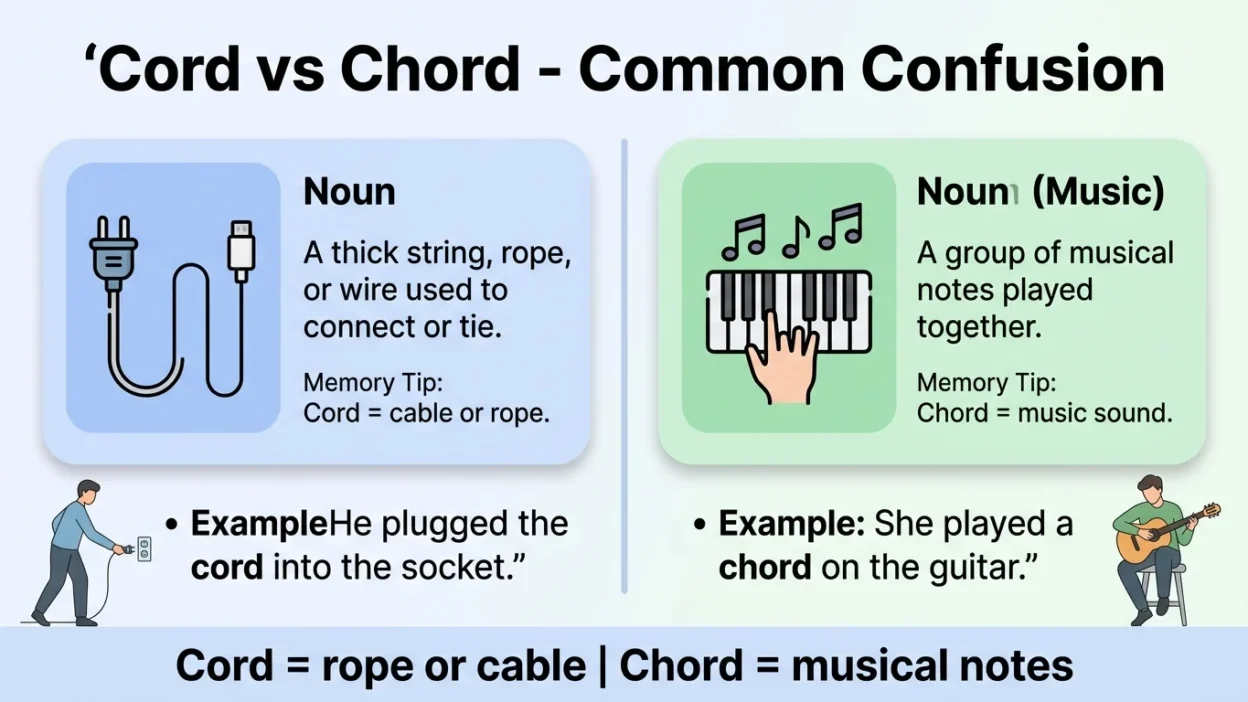
- Cord = a rope, wire, or string (physical object)
- Chord = a group of musical notes played together or something that evokes emotion
👉 Think of it this way:
- Cord = connection you can touch
- Chord = connection you can hear or feel
What Does “Cord” Mean?
The word cord refers to a physical object usually something long, thin, and flexible like a rope, cable, or string.
Common meanings of “cord”:
- A wire or cable (e.g., power cord, extension cord)
- A rope or string used for tying or binding
- A unit of measurement for firewood (in some contexts)
Examples of “cord” in sentences:
- I plugged the charger into the cord behind the desk.
- She tied the package securely with a strong cord.
- Be careful not to trip over that extension cord.
Related words (LSI keywords):
- cable
- wire
- rope
- string
- power line
What Does “Chord” Mean?
The word chord is most commonly used in music and emotions.
Main meanings of “chord”:
- Music: A combination of two or more musical notes played together
- Figurative: Something that creates an emotional response
Examples of “chord” in sentences:
- He played a beautiful chord on the piano.
- That song really struck a chord with me.
- She learned basic guitar chords in her first lesson.
Related words (LSI keywords):
- harmony
- musical notes
- melody
- tone
- emotional connection
Cord vs Chord: Key Differences
| Feature | Cord | Chord |
| Meaning | Physical object (rope, wire) | Musical notes or emotional impact |
| Usage context | Electricity, tying, cables | Music, feelings, expressions |
| Example | Power cord, rope cord | Guitar chord, strike a chord |
| Easy memory tip | “C” for Cable | “Ch” for Harmony |
Common Mistakes to Avoid
Even fluent English speakers mix these up. Here are some common errors and how to fix them:
❌ Incorrect:
- This song really struck a cord with me.
✔️ Correct: - This song really struck a chord with me.
❌ Incorrect:
- The guitar cords sound amazing.
✔️ Correct: - The guitar chords sound amazing.
❌ Incorrect:
- Plug in the power chord.
✔️ Correct: - Plug in the power cord.
Why this happens:
Because cord and chord are homophones (words that sound the same), people often rely on sound instead of meaning.
Memory Tricks to Remember the Difference
Simple tricks can make this stick forever:
- Cord = Cable → Both start with “C”
- Chord = Choir → Both relate to music
- Chord = Heart → Emotional connection
American vs British English Differences
Good news there’s no difference between American and British English for these words. Both cord and chord are spelled and used the same way in:
- 🇺🇸 American English
- 🇬🇧 British English
However, pronunciation remains identical in both accents, which is why confusion happens so often.
When to Use Cord vs Chord in Writing
Here’s a quick guide based on context:
Use “cord” when:
- Talking about electronics (power cord, charging cable)
- Referring to physical materials (rope, string)
- Describing something you can touch or see
Use “chord” when:
- Discussing music theory (piano chords, guitar chords)
- Talking about emotions or impact (strike a chord)
- Writing about sound or harmony
Real-Life Examples for Better Understanding
Everyday usage:
- The vacuum cleaner cord is too short.
- That movie struck a chord with audiences worldwide.
In music:
- Learn basic guitar chords like C, G, and D.
- The singer held a powerful chord during the performance.
In emotional context:
- His speech struck a deep chord with the crowd.
- The story touched a chord in my heart.
FAQs
1. Are cord and chord interchangeable?
No, they have completely different meanings. One is physical (cord), and the other relates to music or emotion (chord).
2. Why do people confuse cord and chord?
Because they are pronounced the same, making them classic homophones.
3. What does “strike a chord” mean?
It means something resonates emotionally or feels personally meaningful.
4. Is “chord” only used in music?
No, it’s also used metaphorically to describe emotional impact.
5. Can “cord” be used figuratively?
Rarely. It’s mostly used for physical objects.
6. What is a vocal cord?
A vocal cord (correct spelling: cord) refers to tissue in the throat that helps produce sound.
7. How do I remember chord vs cord quickly?
Use this:
- Cord = Cable
- Chord = Choir
8. Is “chord” ever used for wires?
No, using “chord” for wires is incorrect.
Final Summary
Understanding the difference between cord vs chord comes down to one key idea: physical vs musical/emotional. A cord is something you can touch like a wire, rope, or cable while a chord is something you hear or feel, such as a musical harmony or an emotional connection.
Although they sound identical, their meanings are far apart. By focusing on context and using simple memory tricks like cord = cable and chord = choir, you can avoid common mistakes and write with confidence.
Actionable Takeaway
Next time you write, pause for a second and ask:
👉 Am I talking about something physical or something musical/emotional?
- If it’s physical → cord
- If it’s musical or emotional → chord
Practice with a few sentences daily, and soon this confusion will disappear completely.

Ethan William is the author behind SpellPeak, passionate about clear communication and meaningful language. He writes to help readers express ideas with confidence, simplicity, and impact. His work focuses on clarity, learning, and empowering individuals and businesses through thoughtful, practical content. He values creativity, consistency, and ethical digital publishing worldwide.