Have you ever paused mid-sentence wondering whether to write die or dye? You’re not alone. These two words sound exactly the same, yet they carry completely different meanings one about life itself, and the other about color and creativity. It’s a small spelling difference, but it can completely change what you’re trying to say.
In this guide, you’ll learn the clear difference between die vs dye, along with easy examples, common mistakes, and simple tips to remember the correct usage every time. If you’re writing casually or professionally, this will help you avoid embarrassing mix-ups and boost your confidence.
Quick Answer: Die vs Dye
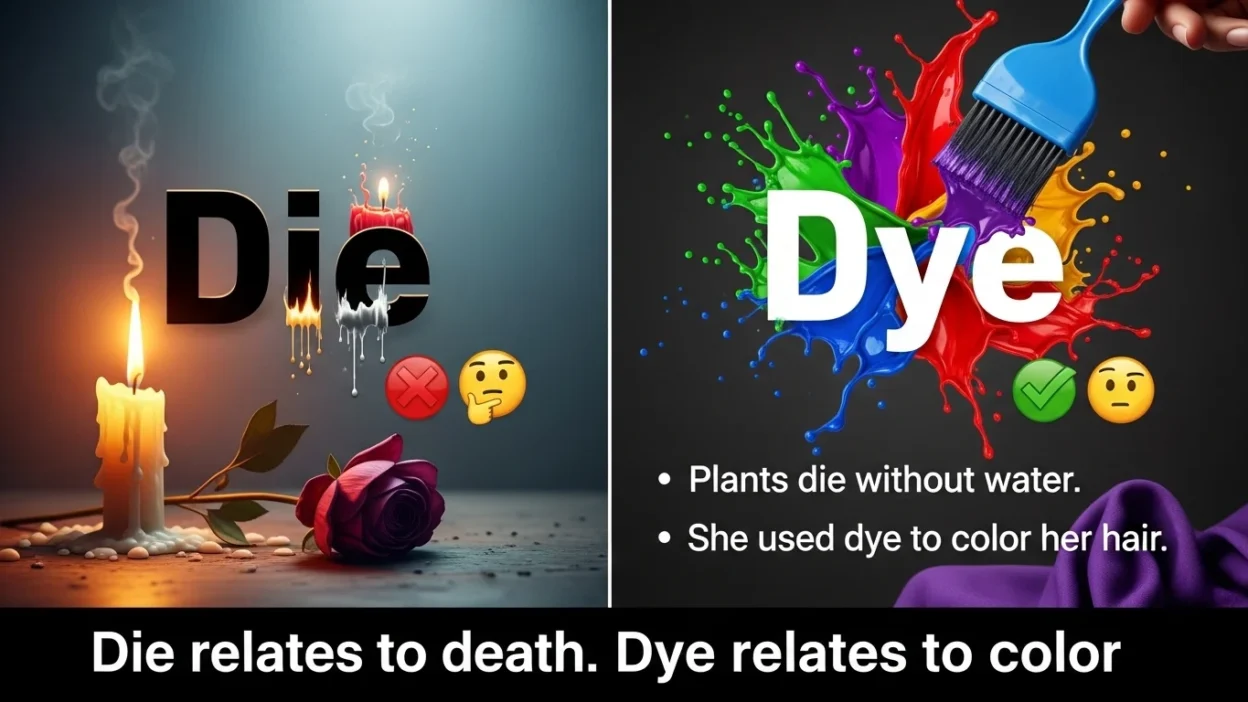
- Die = to stop living or to pass away
- Dye = to color something (like hair, fabric, or materials)
👉 Example:
- “Plants will die without water.”
- “She wants to dye her hair blue.”
What Does “Die” Mean?
The word die is a verb that refers to the end of life. It’s commonly used when talking about people, animals, plants, or even metaphorical situations (like ideas or trends fading away).
Common Uses of “Die”
- To stop living:
- “The old tree will die without care.”
- To express strong emotion (informal):
- “I would die for a slice of that cake!”
- To fade or disappear:
- “The noise slowly died down.”
Verb Forms of “Die”
- Present: die
- Past: died
- Present participle: dying
✔ Notice: “dying” keeps the “y” because of pronunciation rules.
What Does “Dye” Mean?
Dye is both a noun and a verb. It refers to adding color to something, especially fabrics, hair, or materials.
Common Uses of “Dye”
- As a verb:
- “She wants to dye her dress red.”
- As a noun:
- “This fabric needs a natural dye.”
Related Contexts
- Hair coloring
- Textile and fashion industries
- Art and crafts
Die vs Dye: Key Differences
Here’s a simple comparison to make things crystal clear:
| Feature | Die | Dye |
| Meaning | To stop living | To color something |
| Part of Speech | Verb | Verb & Noun |
| Context | Life, death, fading | Hair, fabric, materials |
| Example | “Flowers die in winter.” | “She will dye her hair.” |
Easy Trick to Remember the Difference
A simple memory trick can help:
- Die = Death → both start with “D”
- Dye = Color → think of “Y” as a splash of color
Once you connect “die” with death and “dye” with coloring, it becomes much easier to remember.
Examples in Everyday Sentences
Using “Die”
- “Fish can die without clean water.”
- “His phone battery is about to die.”
- “Old traditions sometimes die out.”
Using “Dye”
- “I want to dye my hair black.”
- “They use plants to dye clothes naturally.”
- “This blue dye is very strong.”
Common Mistakes to Avoid
Even native speakers mix these up sometimes. Here are the most frequent errors:
❌ Incorrect: “My phone is about to dye.”
✔ Correct: “My phone is about to die.”
❌ Incorrect: “She will die her hair blonde.”
✔ Correct: “She will dye her hair blonde.”
❌ Incorrect: “The flowers dye quickly without water.”
✔ Correct: “The flowers die quickly without water.”
Why These Mistakes Happen
- Both words sound identical (homophones)
- Fast typing or autocorrect errors
- Lack of clarity in meaning
Die vs Dye in Idioms and Expressions
“Die” in Expressions
- Die out = disappear completely
- “Some species may die out soon.”
- Never say die = don’t give up
- Die down = become less intense
“Dye” in Context
- Mostly literal, related to coloring
- Rarely used in idioms
American vs British English
Good news—there is no difference between American and British English when it comes to die vs dye.
- Both use die for death
- Both use dye for coloring
✔ Spelling and meaning remain exactly the same across regions.
Why Knowing the Difference Matters
Understanding die vs dye isn’t just about grammar—it affects clarity and professionalism.
In Writing
- Avoid confusion in emails, essays, and blogs
- Improve readability and trust
In Daily Communication
- Prevent awkward or unintended meanings
- Speak and write more confidently
Related Words and Synonyms
For “Die”
- Pass away
- Perish
- Expire
- Fade
For “Dye”
- Color
- Tint
- Stain
- Pigment
Using these synonyms can add variety and richness to your writing.
FAQs
1. Is “die” always related to death?
Mostly yes, but it can also mean something fading or stopping, like “The music died.”
2. Can “dye” be used figuratively?
Rarely. It’s usually used in a literal sense related to coloring.
3. Why do “die” and “dye” sound the same?
They are homophones—words that sound alike but have different meanings and spellings.
4. What is the past tense of “dye”?
The past tense is dyed.
Example: “She dyed her hair yesterday.”
5. How do I remember which one to use?
Think: die = death, dye = color.
6. Can “dye” be a noun?
Yes. Example: “This dye is made from plants.”
7. Is “dying” related to “dye”?
No. “Dying” is the present participle of “die,” not “dye.”
8. Do spell checkers catch this mistake?
Not always, because both words are correctly spelled context matters.
Final Summary
Understanding the difference between die vs dye is simple once you focus on their meanings. Die relates to life ending or something fading away, while dye is all about adding color to objects like hair, fabric, or materials. Even though they sound identical, their uses are completely different, and mixing them up can lead to confusion.
By remembering the quick trick die = death, dye = color you can easily choose the correct word every time. Practice with real-life examples, stay mindful while writing, and soon this common confusion will no longer slow you down.
Actionable Takeaway
Next time you write, pause for a second and ask yourself:
👉 “Am I talking about life ending or adding color?”
- If it’s about life or fading → use die
- If it’s about coloring → use dye
This small habit can instantly improve your writing clarity and accuracy.

Noah Jacob is the administrator of SpellPeak, responsible for managing website operations, content coordination, and platform performance. He ensures smooth functionality, security, and reliability while supporting the team in delivering a seamless, user-focused experience and maintaining high standards of quality across the site.