If you’ve ever typed “very” when you meant “vary” (or the other way around), you’re not alone. These two words look almost identical, but they have completely different meanings and mixing them up can quietly change the entire meaning of your sentence.
In this guide, you’ll quickly understand the difference between vary vs very, see real-life examples, and learn simple tricks to remember them forever. Whether you’re writing emails, blog posts, or social media captions, this will help you sound clear, confident, and professional.
Quick Answer
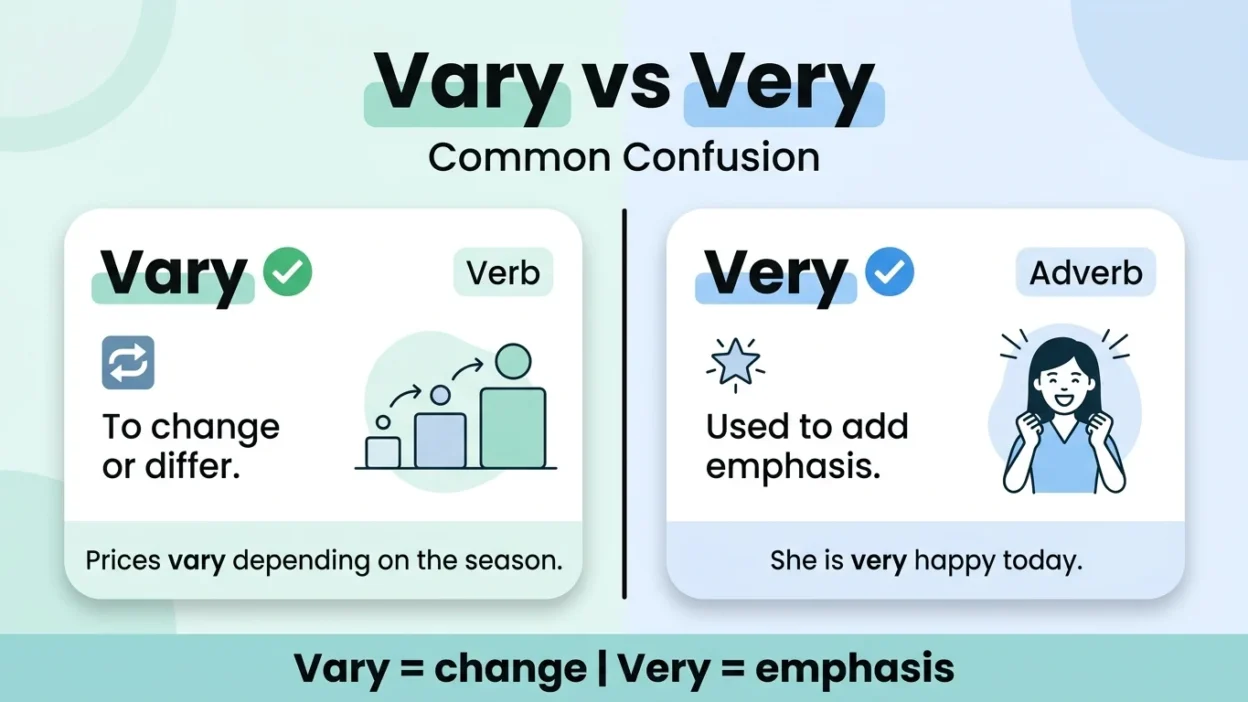
- Vary = to change or differ
- Very = extremely or to a high degree
👉 Example:
- Prices vary depending on the season.
- This is very important.
What Does “Vary” Mean?
Vary is a verb. It means to change, differ, or become different over time or in different situations.
Simple Explanation:
When something doesn’t stay the same, it varies.
Examples:
- Prices vary from store to store.
- Results may vary based on experience.
- The weather can vary throughout the day.
- Opinions vary on this topic.
Related Words (LSI Keywords):
- differ
- change
- fluctuate
- shift
- alter
What Does “Very” Mean?
Very is an adverb. It means extremely or to a high degree. It is used to emphasize adjectives or other adverbs.
Simple Explanation:
When you want to make something stronger, you use very.
Examples:
- She is very happy today.
- This task is very easy.
- He runs very fast.
- That movie was very interesting.
Related Words (LSI Keywords):
- extremely
- highly
- really
- quite
- exceptionally
Vary vs Very: Key Differences
Here’s a quick comparison to make things crystal clear:
| Feature | Vary | Very |
| Part of Speech | Verb | Adverb |
| Meaning | To change or differ | Extremely / to a high degree |
| Usage | Describes change | Adds emphasis |
| Example | Results vary | Very good |
Easy Trick to Remember
- Vary = Change → both have the letter “A”
- Very = Extreme → both relate to intensity
👉 If you’re talking about difference, use vary
👉 If you’re adding strength, use very
Common Mistakes (And How to Fix Them)
Even fluent English speakers mix these up. Let’s fix the most common errors.
❌ Incorrect:
- Prices very depending on demand.
✔️ Correct: Prices vary depending on demand.
❌ Incorrect:
- She is vary happy today.
✔️ Correct: She is very happy today.
❌ Incorrect:
- Results may very from person to person.
✔️ Correct: Results may vary from person to person.
Why These Mistakes Happen:
- Both words look similar
- Typing quickly leads to errors
- Pronunciation can sound close in some accents
When to Use “Vary” in Sentences
Use vary when talking about differences, changes, or fluctuations.
Common Sentence Patterns:
- vary by (Prices vary by region)
- vary from…to (Temperatures vary from cold to hot)
- vary depending on (Results vary depending on effort)
Examples:
- Costs vary depending on location.
- Skills vary from beginner to advanced.
- Quality may vary by brand.
When to Use “Very” in Sentences
Use very to emphasize adjectives or adverbs.
Common Patterns:
- very + adjective (very tall, very fast)
- very + adverb (very quickly, very slowly)
Examples:
- This is very important information.
- She speaks very clearly.
- That was very kind of you.
American vs British English Differences
Good news there’s no difference between American and British English when it comes to vary vs very.
- Both use vary and very in the exact same way
- Spelling and meaning remain identical
- Pronunciation may slightly differ by accent, but usage stays consistent
Real-Life Examples for Better Understanding
Using “Vary”:
- Salaries vary based on experience and location.
- The intensity of the workout can vary each day.
- Customer preferences vary widely.
Using “Very”:
- This is a very useful guide.
- He is very talented.
- The weather is very cold today.
FAQs
1. Is “vary” the same as “very”?
No. Vary means to change, while very means extremely.
2. Can “vary” be used as an adjective?
No. It is always a verb. For adjectives, use words like different or varied.
3. Is “very” always used before adjectives?
Mostly yes, but it can also modify adverbs (e.g., very quickly).
4. Why do people confuse vary and very?
Because they look similar and are often mistyped, especially in fast writing.
5. Can I replace “very” with better words?
Yes! Instead of “very big,” try:
- huge
- massive
- enormous
6. Is “varying” correct?
Yes. It’s the present participle of vary:
- Prices are varying widely.
7. Can “very” be removed from sentences?
Often yes. Removing it can make writing stronger:
- “very good” → “excellent”
8. Is it wrong to use “very” too much?
Yes. Overusing “very” can make writing sound weak or repetitive.
Summary
Understanding vary vs very is simpler than it first appears. One is about change (vary), and the other is about intensity (very). Once you recognize their roles verb vs adverb you’ll avoid one of the most common English mistakes with ease.
The key is practice and awareness. Pay attention to your sentence: are you describing a difference or adding emphasis? That single question will guide you to the correct word every time.
Actionable Takeaway
Next time you write:
- Pause and ask: Am I describing change or emphasis?
- Replace weak phrases like “very good” with stronger alternatives
- Double-check sentences where “vary” or “very” could be confused
With just a little attention, you’ll instantly improve your writing clarity and confidence.

Mia Elizabeth is a contributing author at SpellPeak, passionate about thoughtful writing and clear communication. She creates engaging, well-researched content that helps readers learn and connect with ideas easily. Her work emphasizes clarity, creativity, and practical value, supporting meaningful digital experiences and accessible knowledge sharing worldwide.