English can be confusing, especially when two words sound exactly alike but mean completely different things. One common pair that causes mistakes is sew vs sow. Even native English speakers sometimes mix them up in writing because both words are pronounced the same way.
If you’ve ever wondered whether to write “sew a dress” or “sow a dress,” you’re in the right place. This guide explains the meaning of each word, when to use it, common grammar mistakes, pronunciation tips, and easy examples to help you remember the difference forever.
Quick Answer
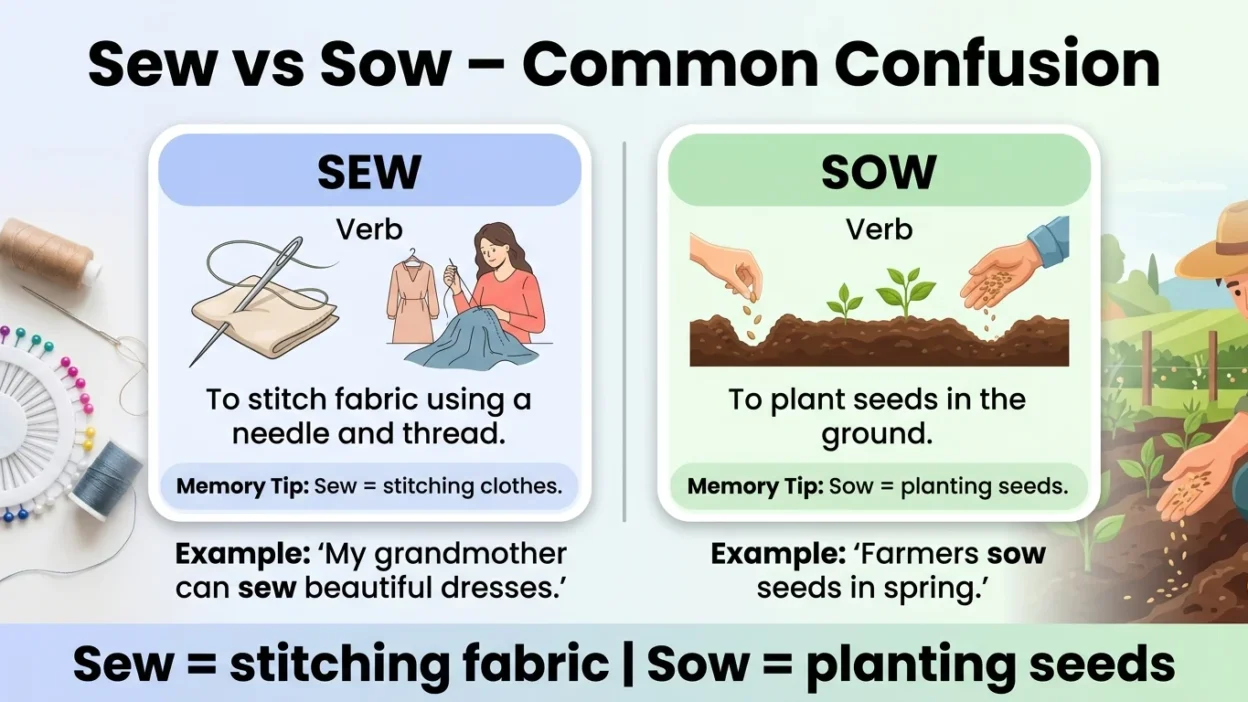
- Sew means to join fabric or material using a needle and thread.
- Sow means to plant seeds in the ground.
Simple Memory Trick
- Sew = stitching clothes
- Sow = planting seeds
Even though they sound alike, their meanings are completely unrelated.
What Does “Sew” Mean?
The word sew is a verb connected to stitching, tailoring, repairing fabric, or making clothes.
Definition of Sew
To join or repair something using a needle and thread.
Examples of Sew in Sentences
- My grandmother can sew beautiful dresses.
- I need to sew a button back onto my shirt.
- She learned how to sew using a sewing machine.
- He likes to sew handmade bags as a hobby.
Common Contexts for “Sew”
You’ll often see the word sew used in:
- Fashion
- Tailoring
- Embroidery
- Fabric repair
- DIY crafts
- Sewing machines
Related Words
- Sewing
- Sewed
- Sewn
- Seam
- Stitch
What Does “Sow” Mean?
The word sow usually refers to planting seeds in soil so plants can grow.
Definition of Sow
To plant seeds in the ground.
Examples of Sow in Sentences
- Farmers sow wheat during the spring.
- It’s time to sow vegetable seeds in the garden.
- They carefully sowed corn across the field.
- You should sow grass seeds before the rainy season.
Common Contexts for “Sow”
The word sow is commonly used in:
- Gardening
- Agriculture
- Farming
- Nature
- Crop production
Related Words
- Sowing
- Sowed
- Sown
- Seeds
- Harvest
Sew vs Sow: Side-by-Side Comparison
| Feature | Sew | Sow |
| Meaning | To stitch fabric | To plant seeds |
| Category | Sewing & clothing | Gardening & farming |
| Pronunciation | “soh” | “soh” |
| Example | Sew a shirt | Sow seeds |
| Past Tense | Sewed | Sowed |
| Past Participle | Sewn/Sewed | Sown/Sowed |
Why Do People Confuse Sew and Sow?
The main reason people confuse sew vs sow is because they are homophones. Homophones are words that sound the same but have different meanings and spellings.
For example:
- Sew → stitching
- Sow → planting
When listening to spoken English, you cannot tell which word is being used without context.
Example
“I want to sow tonight.”
Without context, this sentence sounds unclear. Does the speaker mean:
- Plant seeds?
- Stitch clothes?
Context matters.
Easy Trick to Remember Sew vs Sow
Here’s a simple memory technique:
Sew = Needle and Thread
The word sew contains the letters “ew”, which you can connect with fabric or clothing work.
Sow = Seeds in Soil
The word sow contains “ow”, which you can associate with the outdoors or farming.
Another easy reminder:
- You sew shirts.
- You sow seeds.
Common Mistakes with Sew and Sow
Many learners accidentally use the wrong spelling in writing. Here are some of the most common mistakes.
Incorrect:
- I will sow my torn jacket tonight.
Correct:
- I will sew my torn jacket tonight.
Incorrect:
- Farmers sew rice in the spring.
Correct:
- Farmers sow rice in the spring.
Incorrect:
- She enjoys sowing dresses.
Correct:
- She enjoys sewing dresses.
Sew and Sow Pronunciation
Both words are pronounced exactly the same:
/soʊ/
They rhyme with:
- Go
- Flow
- Snow
Because the pronunciation is identical in American and British English, spelling becomes especially important in writing.
American vs British English Differences
There is no major spelling or pronunciation difference between sew and sow in American English and British English.
In Both American and British English:
- Sew = stitching
- Sow = planting
Pronunciation also remains nearly identical across both dialects.
However, accent differences may slightly change the vowel sound depending on the region, but the meaning and spelling stay the same.
Verb Forms of Sew and Sow
Understanding verb forms can help you avoid grammar mistakes.
Sew Verb Forms
| Tense | Form |
| Base Verb | Sew |
| Past Tense | Sewed |
| Past Participle | Sewn/Sewed |
| Present Participle | Sewing |
Examples
- She sewed a pillow yesterday.
- The dress was beautifully sewn.
Sow Verb Forms
| Tense | Form |
| Base Verb | Sow |
| Past Tense | Sowed |
| Past Participle | Sown/Sowed |
| Present Participle | Sowing |
Examples
- The farmer sowed corn last week.
- Seeds were sown across the field.
Sew vs Sow in Everyday English
Both words are commonly used in daily conversations, but in very different situations.
When You Use “Sew”
You use sew when talking about:
- Clothes
- Fashion design
- Repairing fabric
- Craft projects
- Tailoring
Example
“My mother taught me how to sew by hand.”
When You Use “Sow”
You use sow when discussing:
- Gardening
- Farming
- Nature
- Crops
- Planting
Example
“We plan to sow tomatoes this weekend.”
Idioms and Figurative Meaning of Sow
Interestingly, sow can also have a figurative meaning.
“You Reap What You Sow”
This famous expression means:
Your actions create future consequences.
Example
- If you treat people kindly, you will reap what you sow.
In this phrase, sow symbolizes planting actions that later produce results.
The word sew is usually more literal and less commonly used figuratively.
Best Practices
- Use sew for stitching or clothing.
- Use sow for planting or agriculture.
- Double-check homophones before publishing content.
- Read sentences aloud to confirm meaning.
Clear word choice improves:
- Readability
- SEO quality
- User trust
- Grammar accuracy
FAQs
Is it sew or sow a dress?
The correct phrase is sew a dress because sewing relates to stitching fabric.
Is sow used for clothes?
No. Sow is related to planting seeds, not clothing or fabric.
Do sew and sow sound the same?
Yes. They are homophones and are pronounced exactly alike.
What is the past tense of sew?
The past tense of sew is sewed.
What is the past tense of sow?
The past tense of sow is sowed.
What does “reap what you sow” mean?
It means your actions eventually bring consequences or results.
Can sew and sow be interchangeable?
No. Their meanings are completely different even though they sound alike.
Is there a pronunciation difference in British English?
No significant difference exists. Both words are pronounced similarly in British and American English.
Final Thoughts:
Understanding the difference between sew vs sow is easier once you connect each word to its real-world meaning. Sew belongs to the world of stitching, tailoring, and fabric, while sow belongs to farming, gardening, and planting seeds. Although the pronunciation is identical, the spelling changes everything.
These kinds of English homophones can be tricky, but with practice and context, you’ll quickly learn to choose the correct word naturally. Whenever you write, simply remember: you sew clothes and sow seeds. That small distinction will help you avoid one of the most common English spelling mistakes.
Actionable Takeaway
Before using either word, ask yourself:
- Am I talking about fabric or stitching? → Use sew
- Am I talking about seeds or planting? → Use sow
This quick mental check can instantly improve your grammar and writing accuracy.

Mia Elizabeth is a contributing author at SpellPeak, passionate about thoughtful writing and clear communication. She creates engaging, well-researched content that helps readers learn and connect with ideas easily. Her work emphasizes clarity, creativity, and practical value, supporting meaningful digital experiences and accessible knowledge sharing worldwide.