Many writers struggle with comma vs semicolon because both punctuation marks connect ideas, pause sentences, and shape meaning. Yet they are not interchangeable. Using the wrong one can make writing confusing, awkward, or grammatically incorrect.
The good news is that understanding commas and semicolons is much easier than it seems. Once you learn their core purpose and a few simple rules, you can instantly improve your grammar, clarity, and writing confidence.
If you are writing essays, blog posts, emails, or professional documents, mastering these punctuation marks will make your sentences smoother and more polished.
Quick Answer
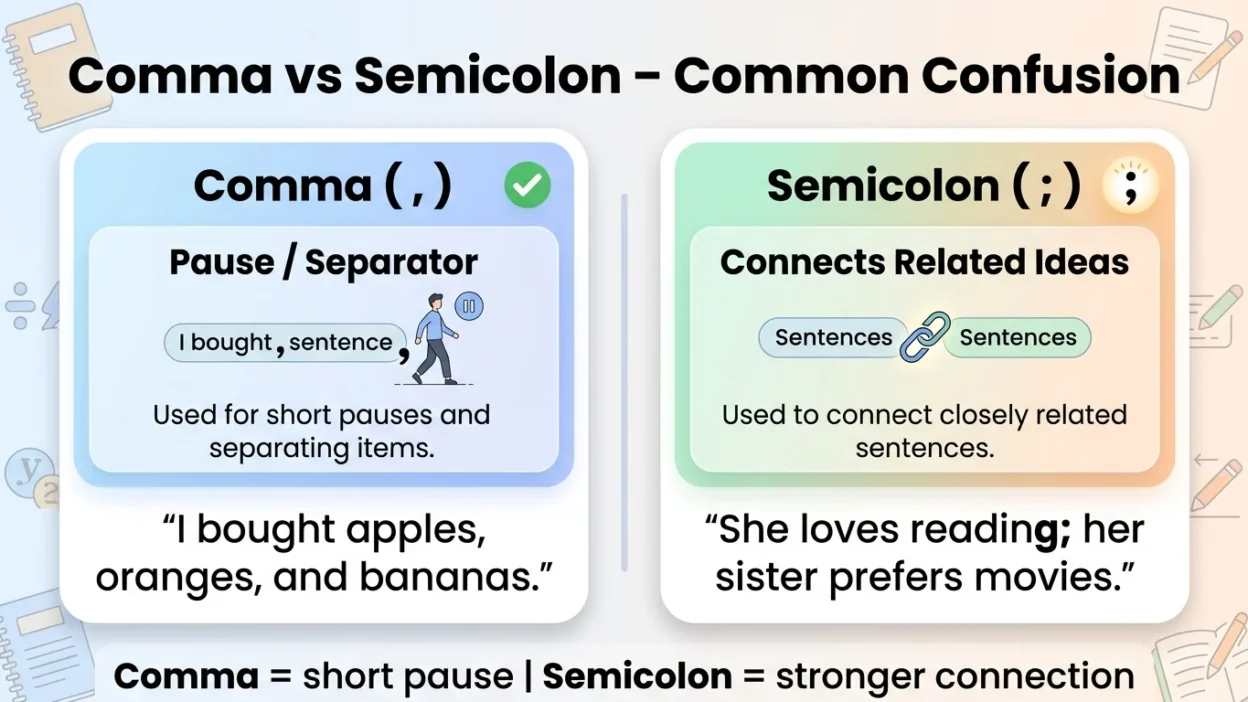
A comma (,) creates a short pause and separates items, phrases, or clauses within a sentence.
A semicolon (;) connects two closely related independent clauses without using a conjunction like “and” or “but.”
Example:
- Comma: I wanted coffee, but I ordered tea.
- Semicolon: I wanted coffee; I ordered tea instead.
In simple terms:
- Use a comma for lighter separation.
- Use a semicolon for stronger separation between related complete thoughts.
What Is a Comma?
A comma is one of the most common punctuation marks in English grammar. It helps organize sentences and improve readability.
Commas are used to:
- Separate items in a list
- Join clauses with conjunctions
- Add pauses for clarity
- Separate introductory words or phrases
- Set off nonessential information
Examples of Commas
- I bought apples, oranges, bananas, and grapes.
- She was tired, so she went to bed early.
- After dinner, we watched a movie.
- My brother, who lives in London, is visiting soon.
Commas make writing easier to read and prevent misunderstandings.
What Is a Semicolon?
A semicolon connects two related independent clauses. An independent clause is a complete sentence that can stand alone.
Semicolons show a stronger connection than a period but a clearer separation than a comma.
Examples of Semicolons
- I studied all night; I still felt unprepared.
- The weather was terrible; however, the event continued.
- She loves painting; her sister prefers music.
Semicolons are often used in formal writing, academic essays, and professional communication.
Comma vs Semicolon: Key Difference
The main difference between a comma and a semicolon is the strength of separation.
| Feature | Comma | Semicolon |
| Symbol | , | ; |
| Purpose | Creates a small pause | Connects related complete sentences |
| Used With Conjunctions | Yes | Usually no |
| Strength | Weaker separation | Stronger separation |
| Common Use | Lists, pauses, clauses | Linking independent clauses |
Simple Comparison
- Comma: The movie was long, but it was entertaining.
- Semicolon: The movie was long; it was entertaining.
Both sentences are correct, but the punctuation changes the flow and tone.
When to Use a Comma
Understanding comma rules is essential for clear writing.
1. Use Commas in Lists
Separate three or more items in a series.
Example:
- We packed clothes, snacks, water bottles, and blankets.
This is called the serial comma or Oxford comma.
2. Use Commas Before Coordinating Conjunctions
Use a comma before conjunctions like:
- and
- but
- so
- yet
- or
Example:
- She wanted pizza, but she ordered pasta instead.
3. Use Commas After Introductory Phrases
Example:
- Before leaving, he checked the doors.
4. Use Commas for Extra Information
Example:
- My teacher, who loves history, recommended the book.
When to Use a Semicolon
Semicolons are less common but very useful.
1. Connect Related Independent Clauses
Example:
- I enjoy reading novels; my sister prefers documentaries.
Each part could stand alone as a sentence.
2. Use Before Transitional Words
Semicolons often appear before words like:
- however
- therefore
- nevertheless
- moreover
Example:
- The test was difficult; however, most students passed.
3. Separate Complex List Items
When list items already contain commas, semicolons improve clarity.
Example:
- We visited Paris, France; Rome, Italy; and Madrid, Spain.
Common Mistakes With Commas and Semicolons
Many grammar mistakes happen because writers confuse these punctuation marks.
1. Comma Splice
A comma splice occurs when two complete sentences are joined only with a comma.
Incorrect:
- I love coffee, I drink it every morning.
Correct:
- I love coffee, and I drink it every morning.
- I love coffee; I drink it every morning.
2. Using a Semicolon With Fragments
A semicolon should connect complete sentences.
Incorrect:
- Because I was tired; I went home.
Correct:
- Because I was tired, I went home.
3. Overusing Semicolons
Too many semicolons can make writing sound overly formal or unnatural.
Better:
Use periods and commas naturally instead of forcing semicolons everywhere.
Comma vs Semicolon Examples
Here are practical examples to help you understand the difference clearly.
| Incorrect | Correct |
| I was hungry, I made a sandwich. | I was hungry; I made a sandwich. |
| She likes tea; and coffee. | She likes tea and coffee. |
| We went shopping; but the mall was closed. | We went shopping, but the mall was closed. |
| The project was delayed, however, we finished it. | The project was delayed; however, we finished it. |
American vs British English Differences
In most cases, comma and semicolon rules are the same in both American and British English. However, there are small style differences.
Oxford Comma
American English often prefers the Oxford comma.
American English:
- Red, white, and blue
British English sometimes omits it.
British English:
- Red, white and blue
Semicolon usage is generally consistent across both writing styles.
Why Proper Punctuation Matters
Correct punctuation improves:
- Clarity
- Readability
- Professionalism
- Writing flow
- Reader understanding
A misplaced comma or semicolon can completely change meaning.
Example:
- Let’s eat, Grandma.
- Let’s eat Grandma.
That single comma makes a huge difference.
Tips to Remember the Difference
Here are simple ways to remember comma vs semicolon rules.
Think of the Pause Length
- Comma = short pause
- Semicolon = longer pause
Check for Complete Sentences
If both sides can stand alone as sentences, a semicolon may work.
Look for Conjunctions
If you use words like “and,” “but,” or “so,” you usually need a comma instead of a semicolon.
FAQs
Is a semicolon stronger than a comma?
Yes. A semicolon creates a stronger separation between ideas than a comma.
Can a semicolon replace a period?
Sometimes. A semicolon can connect two closely related sentences instead of separating them completely with a period.
Can I use a semicolon before “however”?
Yes. This is one of the most common semicolon rules.
Example:
- She was exhausted; however, she kept working.
What is a comma splice?
A comma splice happens when two independent clauses are incorrectly joined with only a comma.
Are semicolons formal?
Semicolons are often seen in formal or academic writing, but they can also improve creative and professional writing.
Do British and American English use semicolons differently?
Not significantly. The main punctuation difference usually involves the Oxford comma rather than semicolons.
Should I avoid semicolons?
No. Semicolons are useful when used correctly. The key is moderation and clarity.
Can a semicolon separate list items?
Yes, especially when the list items already contain commas.
Example:
- Attendees came from Lahore, Pakistan; Delhi, India; and Dubai, UAE.
Final Thoughts :
Understanding comma vs semicolon can instantly improve your grammar and writing style. Commas help organize information and create natural pauses, while semicolons connect closely related complete thoughts. Both punctuation marks have unique purposes, and using them correctly makes your writing clearer and more professional.
The easiest way to decide between them is to check your sentence structure. If you are separating simple items or using conjunctions, choose a comma. If you are linking two related complete sentences without a conjunction, use a semicolon. With practice, these rules become natural and much easier to apply in everyday writing.
Actionable Takeaway
The next time you write, pause and check your sentence connections. Ask yourself:
- Is this a short pause or a strong connection?
- Are both parts complete sentences?
- Am I using a conjunction?
Using this quick checklist will help you confidently choose between a comma and a semicolon every time.

Noah Jacob is the administrator of SpellPeak, responsible for managing website operations, content coordination, and platform performance. He ensures smooth functionality, security, and reliability while supporting the team in delivering a seamless, user-focused experience and maintaining high standards of quality across the site.