If you’ve ever typed bussing and wondered whether it should actually be busing, you’re not alone. These two words confuse writers, students, bloggers, and even native English speakers because both spellings appear online and in print. The confusion becomes even stronger when autocorrect accepts both forms.
The good news is that both bussing and busing can be correct but they are used differently depending on meaning, style preference, and regional English rules. In this guide, you’ll learn the exact difference, when to use each spelling, common mistakes to avoid, and easy examples that make everything clear.
Quick Answer
Busing is the more common modern spelling when talking about transporting people by bus.
Bussing is usually used when referring to clearing tables in restaurants or, less commonly, as an alternative spelling of busing.
Simple Rule:
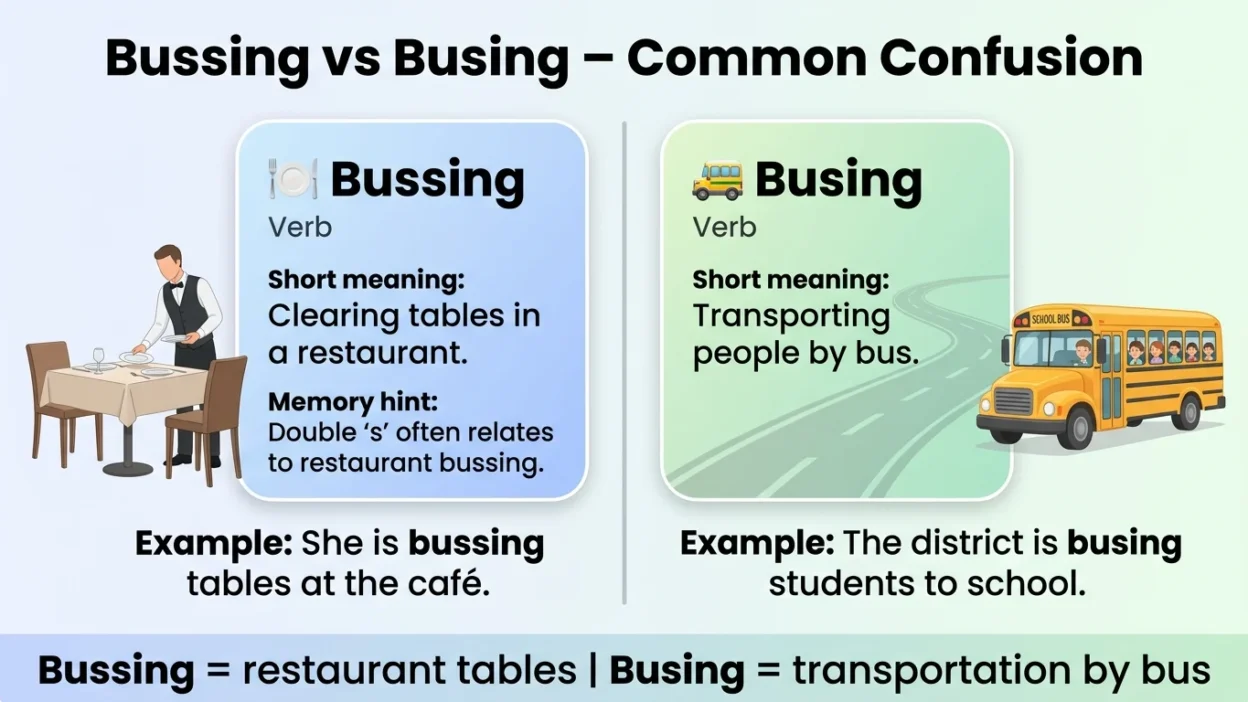
- Busing = transportation by bus
- Bussing = clearing tables in restaurants
What Does “Busing” Mean?
The word busing comes from the noun bus. As a verb, it means transporting people by bus from one place to another.
It is commonly used in:
- School transportation
- Public transportation
- Organized travel
- Educational policies
Examples of Busing
- The district is busing students to nearby schools.
- Employees are being bused to the event venue.
- The city improved its public busing system.
In modern American English, busing is generally the preferred spelling for transportation-related meanings.
What Does “Bussing” Mean?
Bussing most often refers to cleaning or clearing tables in restaurants. A person who performs this task is called a busser.
Examples of Bussing
- She spent weekends bussing tables at a local café.
- The restaurant hired extra staff for bussing duties.
- He started his hospitality career by bussing tables.
Although some dictionaries also accept bussing as a variant spelling of busing, this version is less common for transportation contexts today.
Bussing vs Busing: Key Difference
Here’s the easiest way to remember the difference.
| Word | Meaning | Common Usage |
| Busing | Transporting people by bus | Schools, transit, travel |
| Bussing | Clearing restaurant tables | Hospitality industry |
Why Do People Confuse Bussing and Busing?
The confusion happens because English spelling rules are inconsistent. Normally, when adding -ing to a word ending in a consonant, the consonant may double.
For example:
- Run → Running
- Sit → Sitting
So many people naturally assume:
- Bus → Bussing
However, English evolved differently in this case. Over time, busing became the preferred simplified spelling for transportation-related contexts.
Meanwhile, bussing stayed popular in restaurant terminology because it visually connects with the word busser.
American English vs British English
American English
In American English:
- Busing is strongly preferred for transportation.
- Bussing is more common in restaurant settings.
British English
British English sometimes uses:
- bussing
- buses
- bused
However, usage varies depending on the publisher or style guide.
In modern global English, busing is usually the safest choice when discussing transportation.
Examples of Bussing vs Busing in Sentences
Seeing both words in real sentences makes the difference much easier to understand.
Examples Using “Busing”
- The government expanded its school busing program.
- Parents complained about long busing routes.
- Workers were bused to the construction site.
Examples Using “Bussing”
- Teenagers were bussing tables after school.
- The café manager trained staff on proper bussing procedures.
- He earned tips while bussing at a busy restaurant.
Common Mistakes People Make
Many writers accidentally use the wrong spelling because the words sound identical.
Mistake #1: Using “Bussing” for School Transportation
❌ The district is bussing students across town.
✅ The district is busing students across town.
Mistake #2: Using “Busing” for Restaurant Work
❌ She was busing tables all night.
✅ She was bussing tables all night.
Mistake #3: Assuming One Spelling Is Always Wrong
Neither spelling is completely incorrect. Context matters.
Which Spelling Should You Use?
If you’re unsure, follow this simple guideline.
Use “Busing” When:
- Talking about transportation
- Writing formal or academic content
- Discussing school systems
- Referring to buses and transit
Use “Bussing” When:
- Talking about restaurant work
- Referring to clearing tables
- Discussing hospitality jobs
This distinction improves clarity and helps your writing appear more professional.
Grammar and Pronunciation
Interestingly, both words are pronounced exactly the same:
/BYOO-sing/
Because the pronunciation does not change, readers rely entirely on spelling and context to understand meaning.
That’s why choosing the correct version matters.
History of the Word
The word bus originally came from the Latin word omnibus, meaning “for all.” Over time, omnibus was shortened to bus.
As English speakers turned bus into a verb, different spellings emerged:
- bused
- bussed
- busing
- bussing
Eventually, style guides and dictionaries began favoring busing for transportation because it looked cleaner and simpler.
However, the restaurant industry continued using bussing due to the related word busser.
Is “Bussing” Ever Correct for Transportation?
Technically, yes.
Some dictionaries still recognize bussing as a valid variant of busing. However, it is much less common in modern professional writing.
If your audience is American or international, using busing for transportation is usually the better option.
Easy Memory Trick
Here’s a quick trick to remember the difference:
“Bus” + transportation = “Busing”
Think of the actual vehicle.
“Busser” + restaurant = “Bussing”
Think of restaurant staff clearing tables.
This small memory shortcut helps many learners avoid mistakes instantly.
Related Words and Synonyms
Related Transportation Terms
- School transport
- Public transit
- Shuttle service
- Student transportation
- Bus routes
Related Restaurant Terms
- Busser
- Clearing tables
- Table service
- Restaurant staff
- Food service duties
FAQs
Is busing the correct spelling?
Yes. Busing is the preferred spelling when referring to transportation by bus.
Is bussing a real word?
Yes. Bussing is commonly used in restaurant contexts for clearing tables.
What is a busser?
A busser is a restaurant worker who clears and resets tables.
Why do some people spell it bussing?
People often follow common English doubling rules or use the restaurant-related spelling.
Which spelling is more common in American English?
American English strongly prefers busing for transportation.
Can I use bussing for school transportation?
You can, but it is less common and may look outdated or incorrect to some readers.
Is there a pronunciation difference?
No. Both words are pronounced the same way.
Which spelling should students use in essays?
Students should generally use busing when discussing transportation topics.
Final Summary
The difference between bussing and busing comes down to context. In modern English, busing is mainly associated with transportation, especially school and public transit systems. On the other hand, bussing is commonly connected with restaurant work and clearing tables.
Although both spellings exist, choosing the right one makes your writing clearer and more professional. If you’re discussing buses, travel, or student transportation, use busing. If you’re talking about restaurant duties, use bussing. Keeping this distinction in mind will help you avoid one of the most common English spelling mistakes.
Actionable Takeaway
Before using either word, ask yourself one question:
Am I talking about transportation or restaurant work?
- Transportation → busing
- Restaurant tables → bussing
That simple check will help you choose the correct spelling every time.

Matthew Benjamin is a contributing author at SpellPeak, dedicated to clear, engaging, and purposeful writing. He focuses on creating informative content that helps readers understand complex ideas with ease. His work emphasizes accuracy, creativity, and practical value, supporting better communication and thoughtful digital learning for a global audience.