
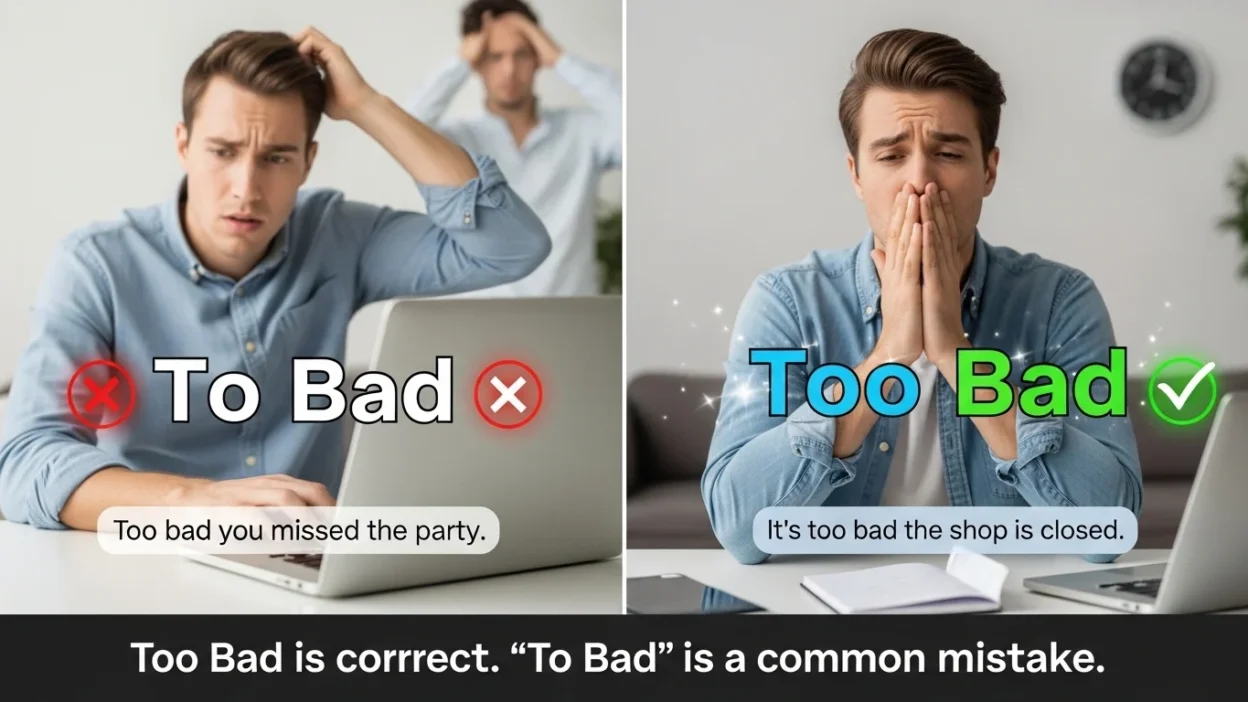
Have you ever paused while writing and wondered whether to use “to bad” or “too bad”? You’re not alone. This is one of the most common word confusion mistakes in English, especially for learners and even native speakers typing quickly.
The good news? Once you understand the simple rule behind it, you’ll never mix them up again. In this guide, we’ll break down the difference in a clear, friendly way with examples, mistakes to avoid, and practical tips you can use instantly.
Quick Answer
- “Too bad” is correct and commonly used. It means unfortunate, sad, or disappointing.
- “To bad” is usually incorrect and only appears in rare cases where “to” and “bad” are separate words (not a phrase).
👉 Quick tip: If you mean “unfortunately,” use too bad.
What Does “Too Bad” Mean?
“Too bad” is an informal expression used to show disappointment, sympathy, or mild regret.
Common meanings:
- Something unfortunate happened
- A situation is disappointing
- You feel sympathy for someone
Examples:
- It’s too bad you missed the party.
- That’s too bad I was hoping to see you.
- It’s too bad the weather ruined our plans.
👉 Think of “too” as meaning “very” or “excessively”, which helps you remember the correct form.
What About “To Bad”? Is It Ever Correct?
In most cases, “to bad” is incorrect as a phrase.
However, it can appear accidentally when:
- “to” is used as a preposition or part of an infinitive
- “bad” is used as an adjective separately
Rare correct example:
- He went to bad neighborhoods to study crime patterns.
Notice here:
- “to” = direction
- “bad” = describing neighborhoods
👉 This is not the same as the phrase “too bad.”
Key Differences Between “To Bad” and “Too Bad”
| Feature | Too Bad | To Bad |
| Correct usage | ✅ Yes | ❌ Usually incorrect |
| Meaning | Unfortunate, disappointing | No standalone meaning |
| Grammar role | Phrase | Separate words |
| Common usage | Very common | Rare |
| Example | That’s too bad! | (Incorrect: That’s to bad) |
Easy Trick to Remember the Difference
Use this simple rule:
👉 If you can replace it with “very unfortunate”, then use too bad.
Example:
- That’s too bad → That’s very unfortunate ✅
If the sentence doesn’t make sense with “very,” then rethink your usage.
Common Mistakes to Avoid
Here are the most frequent errors people make:
❌ Incorrect:
- That’s to bad you can’t come.
- It’s to bad we missed the train.
✅ Correct:
- That’s too bad you can’t come.
- It’s too bad we missed the train.
Why this happens:
- Confusion between “to” and “too”
- Fast typing or autocorrect mistakes
👉 Remember:
- “To” = direction or purpose
- “Too” = extra, very, or also
Real-Life Examples for Better Understanding
Everyday conversations:
- “You failed the test?” → “Oh, that’s too bad.”
- “I can’t join the trip.” → “That’s too bad, we’ll miss you.”
Workplace:
- It’s too bad the project got delayed.
- That’s too bad, but we’ll try again next week.
Casual tone:
- Too bad! You missed all the fun.
- Well, that’s too bad but life goes on!
American vs British English
Good news there’s no difference between American and British English here.
- “Too bad” is used the same way in both.
- The meaning, spelling, and tone remain consistent.
👉 This makes it easier to learn no regional confusion!
Related Words and LSI Keywords
To strengthen your understanding, here are similar expressions:
- unfortunately
- sadly
- what a pity
- that’s a shame
- disappointing
- regrettable
Example:
- That’s too bad → That’s a shame
- It’s too bad → It’s unfortunate
FAQs
1. Is “to bad” ever correct?
Yes, but only when “to” and “bad” are separate words, not as a phrase. This is rare.
2. Why do people confuse “to” and “too”?
Because they sound the same in speech (homophones), leading to spelling mistakes in writing.
3. Can I use “too bad” in formal writing?
It’s better for informal or conversational tone. In formal writing, use:
- “unfortunate”
- “regrettable”
4. Does “too bad” always show sympathy?
Not always. Sometimes it can sound neutral or even slightly sarcastic depending on tone.
5. Is “too bad” rude?
It depends on context. It can be polite, but in some cases, it may sound dismissive.
6. What is the difference between “too bad” and “so bad”?
- Too bad = unfortunate
- So bad = very bad
7. Can “too bad” be used in positive sentences?
No, it usually expresses something negative or disappointing.
8. What’s the easiest way to remember this?
If you mean “unfortunately,” always use “too bad.”
Final Summary
Understanding the difference between “to bad vs too bad” is actually very simple once you know the rule. “Too bad” is the correct and commonly used phrase to express disappointment or something unfortunate. On the other hand, “to bad” is almost always a mistake unless the words are used separately in a sentence.
The key is to remember that “too” means “very” or “excessively,” which fits perfectly in expressions like “too bad.” With a little practice and awareness, you can easily avoid this common mistake and write with more confidence and clarity.
Actionable Takeaway
Next time you write:
- Pause and ask: Do I mean “unfortunately”?
- If yes → use too bad ✅
- If not → double-check your sentence
👉 Practice tip: Try writing 3 sentences using “too bad” today to lock it in your memory.

Ethan William is the author behind SpellPeak, passionate about clear communication and meaningful language. He writes to help readers express ideas with confidence, simplicity, and impact. His work focuses on clarity, learning, and empowering individuals and businesses through thoughtful, practical content. He values creativity, consistency, and ethical digital publishing worldwide.


