Many English learners and even native speakers confuse accept vs except because the words sound very similar. However, their meanings are completely different. Using the wrong one can completely change the meaning of your sentence and make your writing unclear.
If you have ever paused while writing and wondered whether to use accept or except, you are not alone. In this guide, you will learn the exact difference between these commonly confused words, how to remember them easily, practical examples, common mistakes, and simple grammar tips you can use every day.
Quick Answer
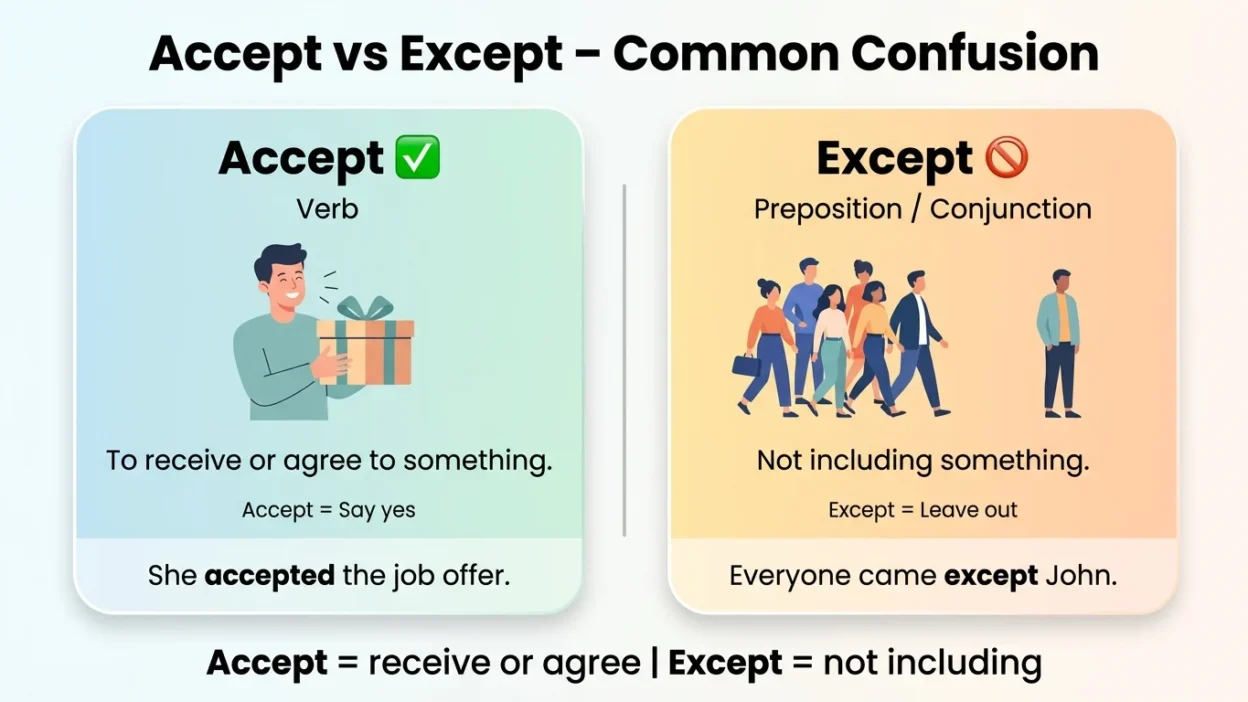
- Accept means to receive, agree to, or say yes to something.
- Except means excluding something or leaving something out.
Simple Examples:
- I accept your apology.
- Everyone came except John.
A quick memory trick:
- Accept = Receive
- Except = Exclude
What Does “Accept” Mean?
The word accept is a verb. It refers to willingly receiving, approving, believing, or agreeing to something.
Common Uses of Accept
You can use accept when talking about:
- Accepting an invitation
- Accepting a gift
- Accepting responsibility
- Accepting payment
- Accepting an offer
Examples of Accept in Sentences
- She decided to accept the job offer.
- We happily accept credit cards.
- He could not accept the truth.
- I accept your apology.
- The university did not accept his application.
Synonyms of Accept
Here are some related words and phrases:
- Receive
- Approve
- Agree to
- Take
- Admit
- Acknowledge
These related terms help strengthen SEO relevance and improve understanding for readers searching for grammar help and vocabulary explanations.
What Does “Except” Mean?
The word except is usually used as a preposition or conjunction. It means excluding someone or something.
Common Uses of Except
You use except when:
- Leaving something out
- Mentioning exclusions
- Creating exceptions
- Separating one thing from a group
Examples of Except in Sentences
- Everyone attended the meeting except Sarah.
- I like all fruits except bananas.
- The store is open every day except Sunday.
- No one knew the answer except the teacher.
- Everything was correct except the last question.
Synonyms of Except
Related words include:
- Excluding
- Apart from
- Other than
- Leaving out
- With the exception of
Accept vs Except: Key Difference
The easiest way to understand accept vs except is to focus on their meanings and functions in a sentence.
| Word | Meaning | Part of Speech | Example |
| Accept | To receive or agree to something | Verb | I accept your invitation. |
| Except | Excluding or leaving out | Preposition/Conjunction | Everyone came except Ali. |
Easy Memory Trick for Accept vs Except
A simple memory trick can help you avoid confusion forever.
Accept = Add
Both words begin with “A.”
When you accept something, you are adding it into your life.
Example:
- I accept the award.
Except = Exclude
Both words begin with “Ex.”
When you use except, you are excluding something.
Example:
- Everyone passed except Tom.
Common Mistakes People Make
Many writers accidentally use these words interchangeably because they sound alike in pronunciation. Here are some common grammar mistakes and how to fix them.
Incorrect:
- I will except your offer.
Correct:
- I will accept your offer.
Why? Because the sentence is about agreeing to an offer, not excluding one.
Incorrect:
- Everyone came accept Emma.
Correct:
- Everyone came except Emma.
Why? Because Emma is excluded from the group.
Accept vs Except in Everyday English
These words appear frequently in spoken and written English.
In Business English
- We accept online payments.
- All products are refundable except sale items.
In School or Education
- The college did not accept late applications.
- Everyone passed the exam except one student.
In Casual Conversation
- I accept your apology.
- I eat everything except seafood.
Learning practical usage helps improve both fluency and confidence in English communication.
Pronunciation Difference
Although accept and except sound very similar, there is a slight pronunciation difference.
- Accept → uhk-SEPT
- Except → ik-SEPT
In fast speech, the difference may be difficult to hear, which is why these are called commonly confused words.
Accept vs Except in American and British English
There is no major spelling or meaning difference between American English and British English for these two words.
Both varieties of English use:
- Accept to mean receive or agree
- Except to mean excluding
However, pronunciation may slightly vary depending on regional accents.
Grammar Tip: How to Identify the Correct Word
Here is a quick grammar rule that works almost every time.
Use “Accept” If:
The sentence involves:
- Receiving
- Agreeing
- Approving
- Saying yes
Example:
- She accepted the invitation.
Use “Except” If:
The sentence involves:
- Excluding
- Leaving out
- Creating an exception
Example:
- Everyone joined except Daniel.
Accept vs Except Examples Side by Side
Seeing both words together makes the difference clearer.
| Accept | Except |
| Please accept my apology. | Everyone came except Mike. |
| They accepted the proposal. | All rooms are ready except one. |
| She accepts responsibility. | I like all colors except yellow. |
| The company accepts cash payments. | The shop is open daily except Monday. |
Why Accept and Except Are Commonly Confused
These words are examples of homophones or near-homophones in English. They sound almost identical but have different meanings and spellings.
English learners often confuse them because:
- Their pronunciation is similar
- Only one letter changes
- They appear in everyday conversation
- Spell-check may not catch misuse
Understanding context is the best way to choose the correct word.
Mini Practice Quiz
Test yourself with these quick sentences.
1. I _____ your decision.
Answer: accept
2. Everyone finished the project _____ Ali.
Answer: except
3. The restaurant does not _____ reservations.
Answer: accept
4. We work every day _____ Sunday.
Answer: except
If you answered correctly, you already understand the difference well.
FAQs
Is accept a verb?
Yes. Accept is a verb because it shows an action such as receiving or agreeing.
Is except a preposition?
Usually, yes. Except commonly functions as a preposition meaning excluding.
Can accept and except be used interchangeably?
No. Their meanings are completely different.
How do I remember accept vs except?
Remember:
- Accept = Agree
- Except = Exclude
What is the easiest way to use except correctly?
Use except when removing someone or something from a group.
Why do people confuse accept and except?
They sound very similar in pronunciation and differ by only one letter.
Are accept and except homophones?
They are near-homophones because their pronunciation is extremely close.
Is there a spelling difference in British English?
No. British and American English spell both words the same way.
Final Thoughts :
Understanding the difference between accept vs except is essential for clear communication and correct English grammar. While the words may sound similar, their meanings are entirely different. Accept means to receive or agree, while except means to exclude or leave out.
The best way to master these confusing English words is through repetition and real-life examples. Whenever you write or speak, pause for a moment and ask yourself: Am I talking about receiving something or excluding something? That simple question can help you choose the correct word every time.
Actionable Takeaway
Here is a quick rule you can remember daily:
- Use accept when saying yes, agreeing, or receiving.
- Use except when leaving someone or something out.
Practice writing your own sentences with both words to build confidence and avoid common grammar mistakes in the future.

Mia Elizabeth is a contributing author at SpellPeak, passionate about thoughtful writing and clear communication. She creates engaging, well-researched content that helps readers learn and connect with ideas easily. Her work emphasizes clarity, creativity, and practical value, supporting meaningful digital experiences and accessible knowledge sharing worldwide.