If you’ve ever paused mid-sentence wondering whether to use either or whether, you’re not alone. These two words often appear in similar situations, which makes them easy to mix up especially in everyday writing and conversation.
The good news? Once you understand their core roles, the confusion fades quickly. This guide breaks down either vs whether in a clear, practical way so you can use them confidently in emails, essays, and spoken English.
Quick Answer
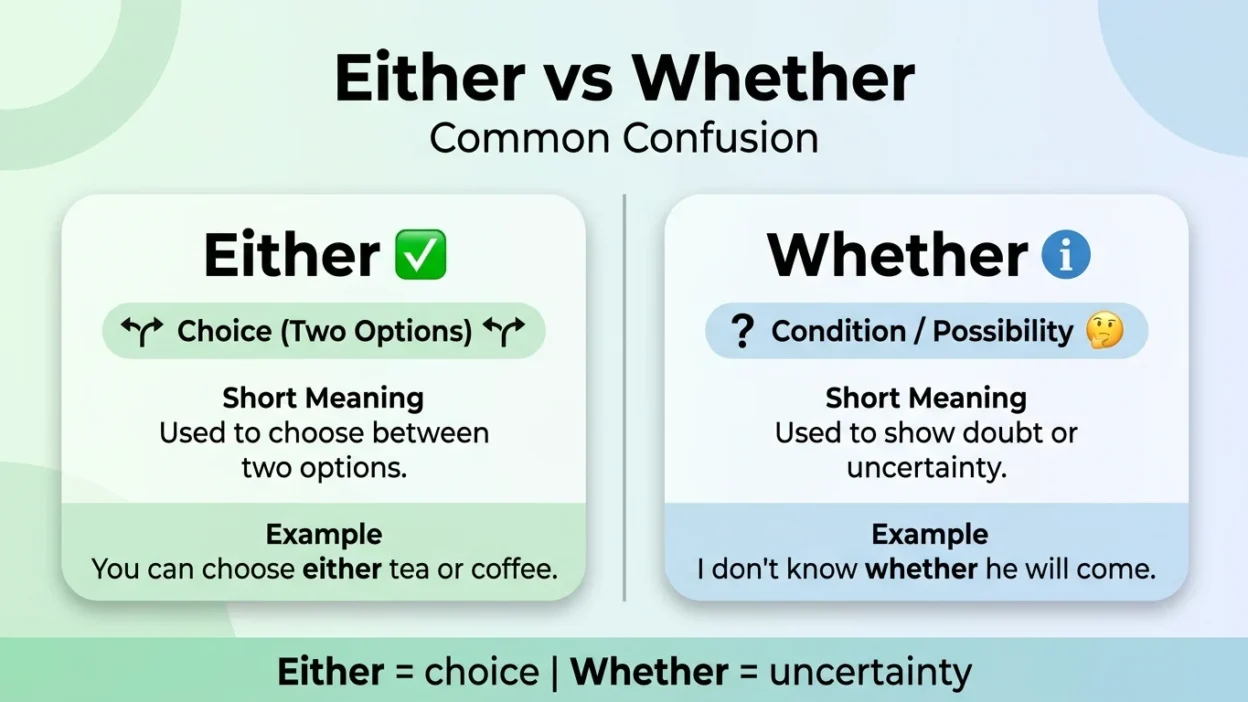
- Use whether when introducing a choice, condition, or uncertainty.
- Use either when referring to one option out of two (or more), often paired with or.
Example:
- I don’t know whether she’ll come. ✅
- You can choose either tea or coffee. ✅
What Does “Whether” Mean?
Whether is a conjunction used to introduce alternatives, possibilities, or uncertainty. It often appears when there are two options (sometimes more), even if they’re not explicitly stated.
Common Uses of “Whether”
- Expressing doubt or uncertainty
- Introducing indirect questions
- Showing alternatives (with or without “or”)
Examples:
- I’m not sure whether he understands the problem.
- She asked whether we needed help.
- Decide whether to stay or leave.
💡 Tip: If you can replace the word with “if or not,” whether is usually correct.
What Does “Either” Mean?
Either is typically used as a determiner, pronoun, or adverb. It refers to one or the other of two choices.
Common Uses of “Either”
- Offering a choice between two options
- Indicating one option is acceptable
- Used in negative sentences (“not either”)
Examples:
- You can take either road.
- I don’t like either option.
- We can meet on either day.
💡 Tip: Either often appears before a noun or with “or.”
Either vs Whether: Key Differences
| Feature | Either | Whether |
| Part of Speech | Determiner / Pronoun / Adverb | Conjunction |
| Main Function | Refers to one of two choices | Introduces uncertainty or choice |
| Sentence Position | Before nouns or in structures | Begins clauses |
| Example | Choose either option | I don’t know whether to go |
When to Use “Whether” Instead of “Either”
Use whether when:
- You’re expressing uncertainty
- You’re forming indirect questions
- You’re discussing possibilities
Examples:
- I can’t decide whether to study or relax.
- Let me know whether you agree.
❌ Incorrect: I can’t decide either to study or relax.
✅ Correct: I can’t decide whether to study or relax.
When to Use “Either” Instead of “Whether”
Use either when:
- You’re choosing between two options
- You want to emphasize one of the two
Examples:
- You may choose either option.
- Either answer is acceptable.
❌ Incorrect: Choose whether option.
✅ Correct: Choose either option.
Common Mistakes to Avoid
1. Using “Either” Instead of “Whether”
- ❌ I don’t know either he’s coming.
- ✅ I don’t know whether he’s coming.
2. Mixing Structures
- ❌ Either you go whether you stay.
- ✅ Either you go or you stay.
3. Forgetting “Or” with Either
- ❌ Either tea coffee
- ✅ Either tea or coffee
4. Using “If” Instead of “Whether” (Formal Context)
- Informal: I don’t know if he’ll come.
- Formal: I don’t know whether he’ll come.
Either vs Whether in American and British English
There’s no major difference between American and British English when it comes to either vs whether. Both forms follow the same grammatical rules.
However, in formal British English, whether is often preferred over if in formal writing. American English tends to be slightly more flexible in casual usage.
Real-Life Usage Examples
- Please confirm whether you’ll attend the meeting.
- You can sit in either seat.
- I’m unsure whether this is correct.
- Either solution will work.
FAQs
1. Can “either” and “whether” be used interchangeably?
No. They serve different grammatical roles. Whether introduces choices or uncertainty, while either refers to one of two options.
2. Is “whether or not” always necessary?
Not always. You can often shorten it:
- I don’t know whether (or not) he’s coming.
3. Can I use “if” instead of “whether”?
Sometimes, but not always. In formal writing or when clarity matters, whether is safer.
4. Can “either” be used for more than two options?
Traditionally, either refers to two choices. For more, use any or rephrase.
5. What’s the difference between “either…or” and “whether…or”?
- Either…or = choosing one option
- Whether…or = expressing uncertainty
6. Is “either one” correct?
Yes. Example: You can pick either one.
7. Which is more formal: “whether” or “either”?
Whether is more common in formal contexts, especially in writing.
8. Can “either” be used in negative sentences?
Yes:
- I don’t like either option.
Final Summary
Understanding either vs whether comes down to recognizing their roles in a sentence. If is your go-to word when expressing uncertainty, doubt, or alternatives in a clause. On the other hand, either helps you point to one of two choices, usually in a more direct and concrete way.
Once you start noticing how they function in everyday sentences, the distinction becomes natural. You’ll find yourself using whether for thinking and questioning, and either for choosing and deciding.
Actionable Takeaway
Next time you write or speak:
- Ask yourself: “Am I expressing uncertainty?” → Use whether
- Or: “Am I choosing between options?” → Use either
Practice with a few sentences daily, and this confusion will disappear faster than you expect.

Matthew Benjamin is a contributing author at SpellPeak, dedicated to clear, engaging, and purposeful writing. He focuses on creating informative content that helps readers understand complex ideas with ease. His work emphasizes accuracy, creativity, and practical value, supporting better communication and thoughtful digital learning for a global audience.