If you’ve ever paused mid-sentence wondering whether to write discrete or discreet, you’re not alone. These two words look almost identical, sound very similar, and are often confused even by experienced writers. But using the wrong one can subtly change the meaning of your sentence.
In this guide, you’ll learn the exact difference between discrete and discreet, how to use each correctly, and easy tricks to remember them forever. If you’re writing professionally or just improving your English, this breakdown will make things clear and simple.
Quick Answer
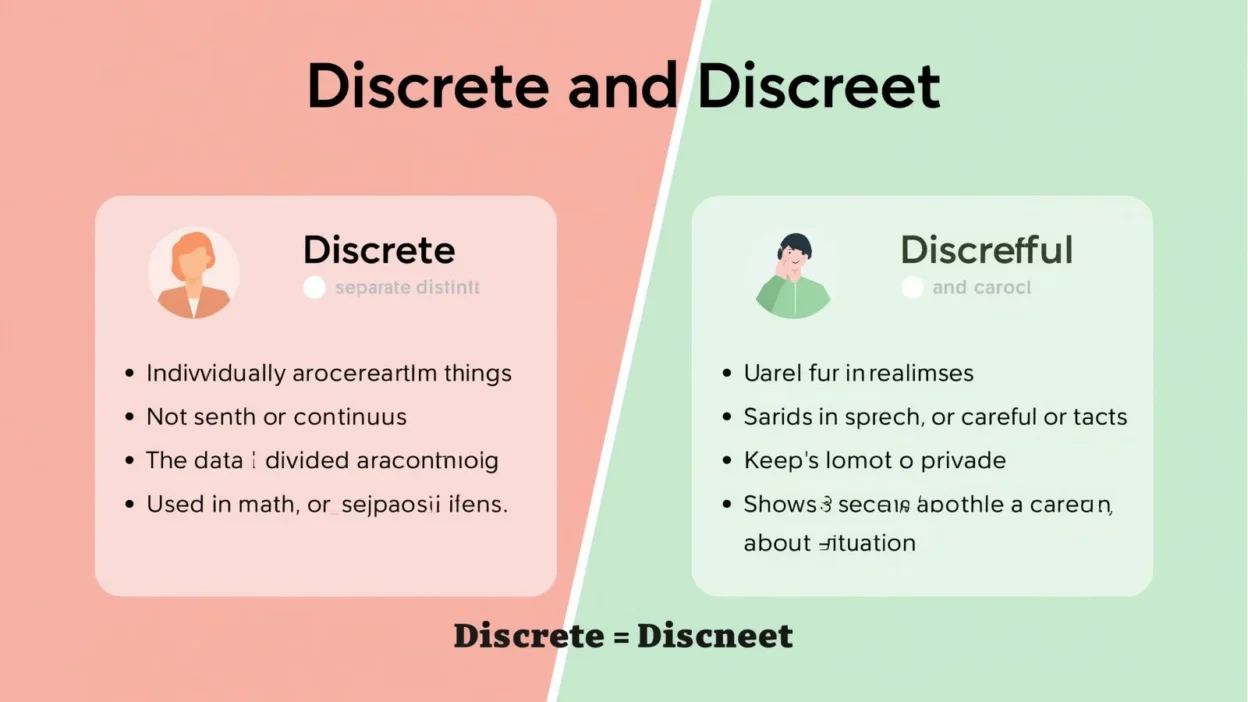
- Discrete means separate, distinct, or individual
- Discreet means careful, tactful, or private
👉 Think:
- Discrete = separate
- Discreet = secret
What Does “Discrete” Mean?
The word discrete refers to things that are separate, distinct, or not connected. It’s often used in technical, mathematical, or formal contexts.
Examples of “Discrete”
- The data is divided into discrete categories.
- The project consists of several discrete phases.
- Each issue should be treated as a discrete problem.
Where You’ll See “Discrete”
- Mathematics (discrete values vs continuous values)
- Technology (discrete signals)
- General writing when emphasizing separation or individuality
Easy Memory Trick
Discrete = distinct pieces
Both words share the letters “t-e” → separaTE
What Does “Discreet” Mean?
The word discreet describes someone who is careful, tactful, and respectful of privacy. It’s often used when talking about handling sensitive information or behaving politely.
Examples of “Discreet”
- She was very discreet about the situation.
- Please be discreet when discussing this matter.
- The service offers discreet delivery for privacy.
Where You’ll See “Discreet”
- Social situations
- Professional communication
- Customer service (especially privacy-related contexts)
Easy Memory Trick
Discreet = secret behavior
Both words share the letters “e-e” → bE quiEt, bE careful
Key Differences Between Discrete and Discreet
| Feature | Discrete | Discreet |
| Meaning | Separate, distinct | Careful, tactful, private |
| Usage Context | Technical, general separation | Social behavior, communication |
| Example | Discrete units of data | Discreet handling of information |
| Memory Trick | separaTE | bE quiEt |
Common Mistakes and How to Avoid Them
Even though the meanings are very different, people often mix these words up because of their similar spelling.
Mistake 1: Using “discrete” when talking about privacy
❌ Please be discrete about this issue.
✔️ Please be discreet about this issue.
Mistake 2: Using “discreet” when talking about separate items
❌ The system has discreet components.
✔️ The system has discrete components.
Mistake 3: Assuming they are interchangeable
They are not synonyms. Swapping them can confuse readers or weaken your message.
Quick Tip
If your sentence is about:
- Separation → use discrete
- Privacy or politeness → use discreet
Discrete vs Discreet in American and British English
Good news there is no difference between American and British English for these words. Both discrete and discreet are spelled and used the same way in:
- American English
- British English
This makes things simpler compared to other commonly confused words.
Real-Life Usage Scenarios
Understanding how these words appear in real situations can make them easier to remember.
In Business Writing
- “The report is divided into discrete sections.”
- “Handle client data in a discreet manner.”
In Technology
- “The system uses discrete components.”
- (Rarely “discreet” in tech unless referring to behavior)
In Everyday Conversation
- “She gave me a discreet nod.”
- “The tasks are discrete, so you can complete them independently.”
LSI Keywords and Related Terms
To deepen your understanding, here are some related words and phrases:
Related to Discrete
- Separate
- Distinct
- Individual
- Independent
- Isolated
Related to Discreet
- Private
- Careful
- Tactful
- Subtle
- Confidential
Using these synonyms can also help you avoid confusion when writing.
FAQs
1. What is the main difference between discrete and discreet?
Discrete means separate or distinct, while discreet means careful or private.
2. Are discrete and discreet pronounced the same?
They are very similar in pronunciation, which is why they’re often confused, but context clarifies meaning.
3. Can I use discreet instead of discrete?
No. They have different meanings and are not interchangeable.
4. Which word relates to privacy?
Discreet is used when talking about privacy or sensitive situations.
5. Which word is used in mathematics?
Discrete is commonly used in math, such as in “discrete variables.”
6. Is there a spelling difference in UK and US English?
No, both words are spelled the same in American and British English.
7. How can I remember the difference easily?
- Discrete = separate
- Discreet = bee quiet
8. Is using the wrong one a big mistake?
It won’t always ruin your sentence, but it can confuse readers and reduce clarity, especially in formal writing.
Final Summary
The difference between discrete and discreet comes down to meaning and context. Discrete is all about separation things that are distinct and independent. Discreet, on the other hand, is about behavior being careful, tactful, and respectful of privacy. Once you link each word to its core idea, choosing the right one becomes much easier.
To use them correctly every time, pause and ask yourself: “Am I talking about separate things or careful behavior?” That quick check can instantly guide you to the right word. With a little practice, this common confusion will become a thing of the past.
Actionable Takeaway
Next time you write:
- Use discrete for separate parts or categories
- Use discreet for privacy, tact, or subtle behavior
👉 Save this rule: “Discrete = Separate | Discreet = Secret”

Ethan William is the author behind SpellPeak, passionate about clear communication and meaningful language. He writes to help readers express ideas with confidence, simplicity, and impact. His work focuses on clarity, learning, and empowering individuals and businesses through thoughtful, practical content. He values creativity, consistency, and ethical digital publishing worldwide.