
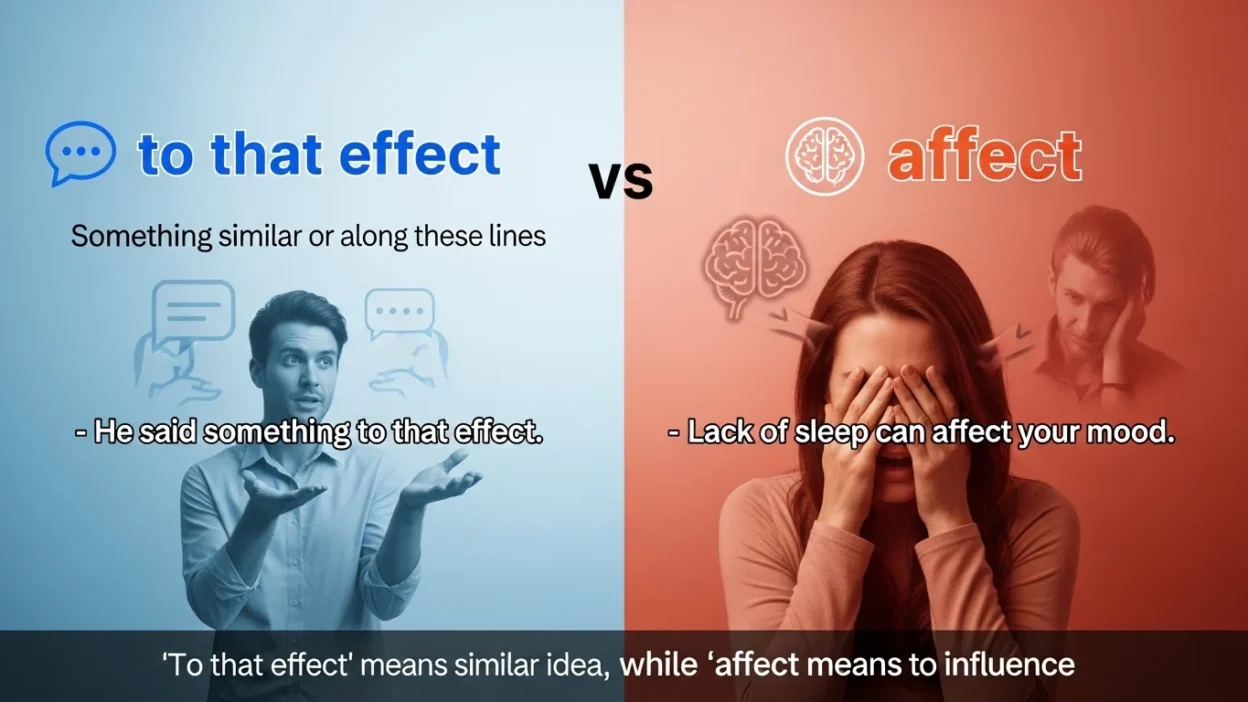
If you’ve ever paused while writing and wondered whether to use “to that effect” or “affect,” you’re not alone. These two phrases sound similar but serve completely different purposes and mixing them up can change the meaning of your sentence.
In this guide, you’ll learn the exact difference between to that effect vs affect in a simple, practical way. With real-life examples, common mistakes, and easy memory tips, you’ll walk away confident in using both correctly every time.
Quick Answer
- Affect = a verb meaning to influence or change something
- To that effect = a phrase meaning something was said or done with that meaning or intention
👉 Simple rule:
If you’re talking about impact, use affect.
If you’re referring to a statement or meaning, use to that effect.
What Does “Affect” Mean?
Affect is most commonly used as a verb. It describes how something influences or changes something else.
Examples:
- Lack of sleep can affect your health.
- The weather didn’t affect our travel plans.
- His words deeply affected her decision.
Key Idea:
Think of affect as impact or influence.
Easy Memory Tip:
👉 Affect = Action (both start with “A”)
It does something it causes change.
What Does “To That Effect” Mean?
To that effect is a phrase used when summarizing or referring to something that was said or written without quoting it exactly.
Examples:
- She said something to that effect, but I don’t remember the exact words.
- The manager made a statement to that effect during the meeting.
- He didn’t say it directly, but his message was to that effect.
Key Idea:
It means “in that sense” or “with that meaning.”
Easy Memory Tip:
👉 To that effect = Talking about meaning or intention
To That Effect vs Affect: Side-by-Side Comparison
| Feature | Affect | To That Effect |
| Part of Speech | Verb | Phrase |
| Meaning | To influence or change | With that meaning or intention |
| Usage | Describes impact | Refers to a statement or idea |
| Example | Stress can affect your health | She made a comment to that effect |
| Easy Clue | Action word | Reporting meaning |
Common Mistakes (And How to Avoid Them)
❌ Mistake 1: Using “to that effect” instead of “affect”
- Incorrect: This will to that effect your performance.
- Correct: This will affect your performance.
👉 Why? Because you need a verb showing impact.
❌ Mistake 2: Using “affect” when referring to a statement
- Incorrect: He said something affect.
- Correct: He said something to that effect.
👉 Why? Because you’re referring to what was said, not influence.
❌ Mistake 3: Confusing with “effect”
Many people confuse affect with effect too.
- Affect = verb (influence)
- Effect = noun (result)
Example:
- The new policy will affect employees.
- The effect of the policy was positive.
Real-Life Examples for Better Understanding
Using “Affect”
- Social media can affect mental health.
- Poor diet may affect your energy levels.
- The decision will affect everyone in the company.
Using “To That Effect”
- She hinted to that effect, but didn’t say it directly.
- The teacher gave instructions to that effect.
- He made a remark to that effect during the discussion.
American vs British English Differences
Good news there’s no major difference between American and British English when it comes to affect and to that effect.
- Both are used the same way in 🇺🇸 American English and 🇬🇧 British English
- Spelling, meaning, and usage remain consistent
👉 So once you learn it, you’re good globally.
When to Use Each (Quick Decision Guide)
Use affect when:
- You’re describing change or influence
- You need a verb
- Something impacts something else
Use to that effect when:
- You’re summarizing what someone said
- You don’t want to quote directly
- You’re describing meaning or intention
FAQs
1. Can “affect” ever be a noun?
Yes, but rarely. In psychology, affect can mean emotion or feeling. However, in everyday writing, it’s mostly a verb.
2. Is “to that effect” formal or informal?
It works in both, but it’s slightly more common in formal or semi-formal contexts.
3. Can I replace “to that effect” with something simpler?
Yes. You can use:
- “in that sense”
- “something like that”
- “with that meaning”
4. Why do people confuse “affect” and “effect”?
Because they sound similar and are closely related in meaning but they play different grammatical roles.
5. Is “affected” correct in past tense?
Yes. Example:
- The news affected everyone deeply.
6. Can “to that effect” be shortened?
Not really, but you can rephrase it depending on context.
7. Is this mistake common in SEO writing?
Yes, especially in beginner writing. Using the wrong word can hurt clarity and credibility.
8. What’s the fastest way to remember the difference?
👉 Affect = Action
👉 To that effect = Meaning or message
Final Summary
Understanding to that effect vs affect becomes simple once you focus on their roles. Affect is about impact it shows how something changes or influences something else. On the other hand, to that effect is about communication it refers to the meaning or intention behind words.
When writing or speaking, pause and ask yourself: Am I describing an influence or summarizing a message? That quick check will guide you to the correct choice every time.
Actionable Takeaway
- Use affect for impact → It changes something
- Use to that effect for meaning → It refers to what was said
- Practice with real sentences daily to build confidence

Noah Jacob is the administrator of SpellPeak, responsible for managing website operations, content coordination, and platform performance. He ensures smooth functionality, security, and reliability while supporting the team in delivering a seamless, user-focused experience and maintaining high standards of quality across the site.