If you’ve ever paused mid-sentence wondering whether to write foreword or forward, you’re not alone. These two words sound identical but carry completely different meanings and using the wrong one can subtly confuse your readers or weaken your writing.
In this guide, you’ll learn exactly what foreword vs forward means, when to use each, and how to avoid common mistakes. If you’re writing a book, an email, or a blog post, this simple breakdown will help you feel confident every time.
Quick Answer
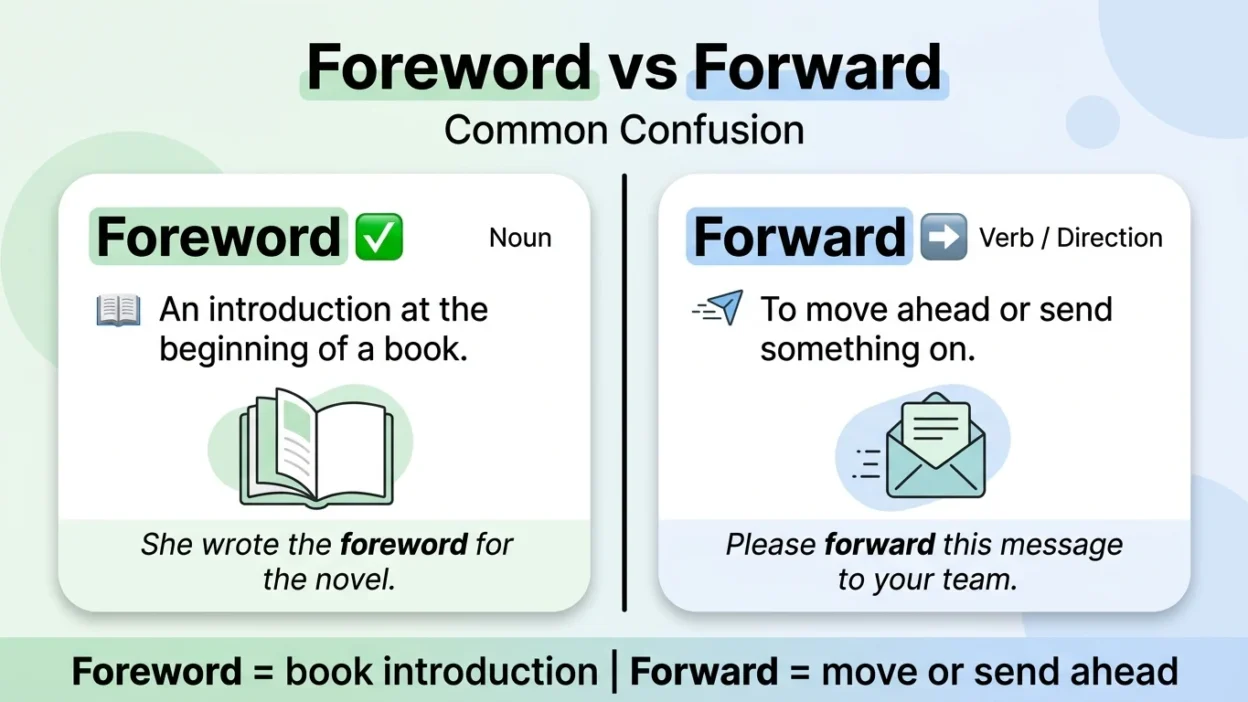
- Foreword: A short introduction written at the beginning of a book, usually by someone other than the author.
- Forward: A direction (ahead) or movement toward the future; also used as a verb meaning to send something on.
👉 Easy memory tip:
Foreword = “word before” (at the start of a book)
Forward = “moving ahead”
What Does “Foreword” Mean?
A foreword is a special section at the beginning of a book. It is typically written by someone other than the author often an expert, influencer, or respected voice to add credibility and context.
Key Features of a Foreword:
- Appears before the main content
- Written by a guest contributor
- Introduces the author or topic
- Builds trust with readers
Examples:
- The foreword was written by a well-known professor in the field.
- Before reading the novel, I skimmed the foreword to understand its background.
What Does “Forward” Mean?
The word forward has multiple meanings, but they all relate to movement, direction, or progress.
As an Adjective or Adverb:
- Moving ahead or toward the future
- She stepped forward to speak.
- We need to move forward with this plan.
As a Verb:
- To send something on (like an email or message)
- Please forward this email to your manager.
As a Noun:
- A position in sports (like football or hockey)
- He plays as a forward on the team.
Foreword vs Forward: Key Differences
Here’s a simple comparison to make things crystal clear:
| Feature | Foreword | Forward |
| Meaning | Intro in a book | Direction, movement, or sending |
| Usage Context | Publishing, books | Everyday language |
| Part of Speech | Noun | Noun, verb, adjective, adverb |
| Example | Read the foreword first. | Move forward confidently. |
Common Mistakes (And How to Avoid Them)
Because foreword and forward sound exactly the same, mix-ups are very common. Here are the mistakes to watch for:
❌ Incorrect:
- I enjoyed the forward of the book.
✔️ Correct: - I enjoyed the foreword of the book.
❌ Incorrect:
- He asked me to foreword the email.
✔️ Correct: - He asked me to forward the email.
Simple Trick:
- If it’s about a book intro → foreword
- If it’s about movement or sending → forward
American vs British English
Good news there’s no difference between American and British English when it comes to foreword vs forward. Both spellings and meanings are used consistently in both regions.
However, pronunciation remains the same in both accents, which is why confusion often happens in writing.
When Should You Use Each Word?
Use “Foreword” When:
- Writing or discussing books
- Referring to introductory sections
- Mentioning contributions by guest writers
Use “Forward” When:
- Talking about direction or progress
- Sending emails or messages
- Describing movement or advancement
Real-Life Usage Examples
Here are a few practical sentences to reinforce your understanding:
- The author invited a celebrity to write the foreword.
- Let’s move forward with confidence.
- Can you forward me the meeting details?
- The foreword gave deep insight into the author’s journey.
FAQs
1. Is “foreword” the same as a preface?
Not exactly. A foreword is written by someone else, while a preface is written by the author.
2. Can “forward” be used in formal writing?
Yes, absolutely. It’s commonly used in both formal and informal contexts.
3. Why do people confuse foreword and forward?
Because they are homophones they sound the same but have different meanings and spellings.
4. Is “foreword” commonly used outside books?
No, it’s mostly limited to publishing and book-related contexts.
5. Can I use “forward” as a noun?
Yes. For example: He plays as a forward in football.
6. How do I remember the difference easily?
Think:
- Foreword = before + word (book intro)
- Forward = ahead or moving
7. Is it wrong to mix them up?
It’s a common mistake, but in professional or published writing, it’s important to use the correct word.
8. Do both words have the same pronunciation?
Yes, they are pronounced exactly the same.
Final Summary
Understanding the difference between foreword vs forward comes down to context. Foreword belongs to the world of books and introductions, while forward is all about movement, direction, or sending something ahead. Even though they sound identical, their meanings are completely unrelated.
By remembering a simple trick foreword = book intro and forward = moving ahead you can avoid confusion and write with clarity. Small distinctions like this can make a big difference in how polished and professional your writing feels.
Actionable Takeaway
Next time you write:
- Pause and ask: Am I talking about a book or movement?
- Replace the word mentally with its meaning
- Double-check before publishing
With a little awareness, you’ll never mix up foreword vs forward again.

Noah Jacob is the administrator of SpellPeak, responsible for managing website operations, content coordination, and platform performance. He ensures smooth functionality, security, and reliability while supporting the team in delivering a seamless, user-focused experience and maintaining high standards of quality across the site.