If you’ve ever paused mid-sentence wondering whether to write everyone or every one, you’re not alone. These two look nearly identical but carry different meanings and using the wrong one can subtly change what you’re trying to say.
The good news? Once you understand the difference, it becomes surprisingly easy to choose the correct form every time. In this guide, you’ll get a clear explanation, real-life examples, common mistakes, and simple tricks to remember the difference between everyone vs every one.
Quick Answer
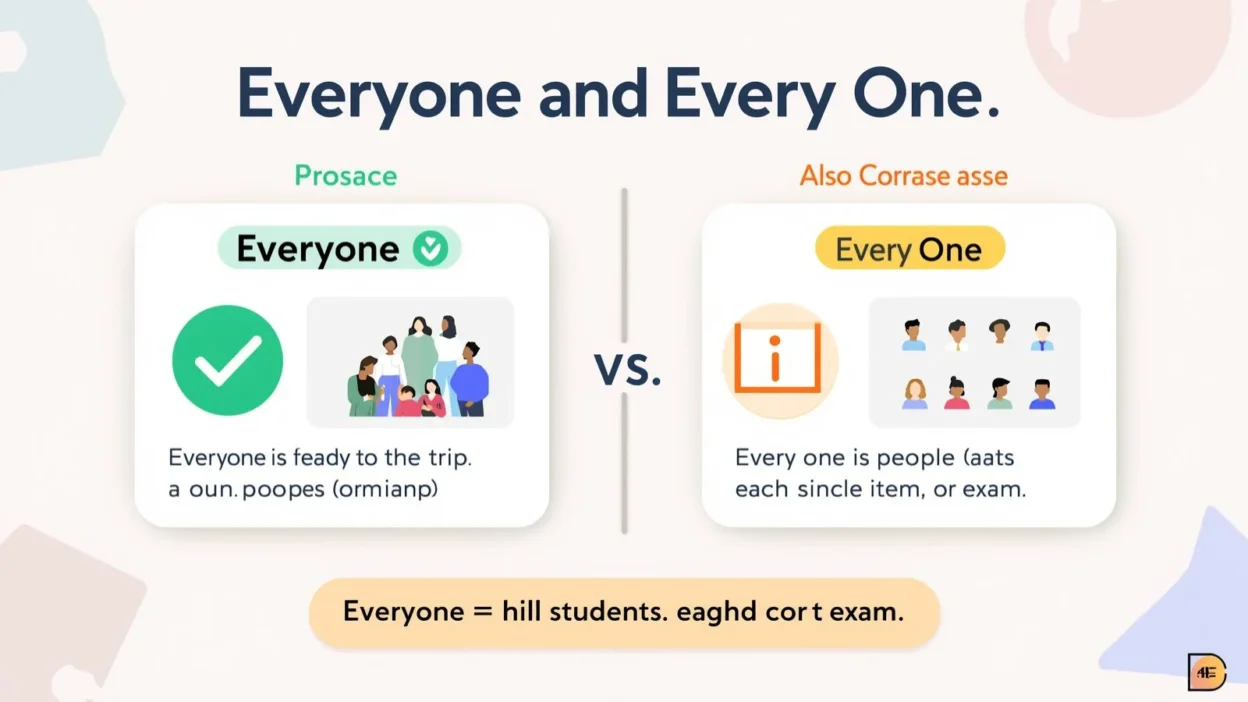
- Everyone = a pronoun meaning all people
- Every one = refers to each individual item or person in a group
👉 If you can replace it with everybody, use everyone.
👉 If you’re emphasizing individual members of a group, use every one.
What Does “Everyone” Mean?
Everyone is an indefinite pronoun that refers to all people in a group collectively. It’s similar to words like everybody, someone, or anyone.
Examples:
- Everyone is excited about the trip.
- I invited everyone to the party.
- Everyone needs a little rest sometimes.
In each case, you’re talking about a group of people as a whole not focusing on individuals separately.
Key Tip:
Use everyone when you mean all people together.
What Does “Every One” Mean?
Every one (two words) emphasizes each individual member of a group. It’s often followed by of + noun/pronoun.
Examples:
- Every one of the cookies was delicious.
- I checked every one of the answers carefully.
- Every one of them deserves recognition.
Here, the focus is on each item or person individually, not the group as a whole.
Key Tip:
Use every one when you’re talking about each single member of a group.
Everyone vs Every One: Side-by-Side Comparison
| Feature | Everyone | Every One |
| Part of Speech | Pronoun | Determiner phrase |
| Meaning | All people collectively | Each individual in a group |
| Replacement Test | Can replace with “everybody” | Cannot replace with “everybody” |
| Usage Structure | Standalone word | Often followed by “of” phrase |
| Example | Everyone is here. | Every one of the players scored. |
Common Mistakes to Avoid
1. Using “everyone” when you mean individuals
❌ Everyone of the students passed the test.
✔️ Every one of the students passed the test.
👉 Why? Because you’re referring to each student individually.
2. Using “every one” instead of “everyone”
❌ Every one is invited to the wedding.
✔️ Everyone is invited to the wedding.
👉 Here, you’re speaking about all people collectively.
3. Forgetting the “of” structure
❌ Every one students passed.
✔️ Every one of the students passed.
👉 “Every one” usually needs of when followed by a group.
Easy Memory Tricks
- Think: “Everyone = Everybody”
If the sentence still makes sense, go with everyone. - Look for “of”
If your sentence includes of the, you likely need every one. - Focus on meaning
Group as a whole? → everyone
Individual members? → every one
Real-Life Examples for Better Understanding
Using “Everyone”
- Everyone enjoyed the movie.
- Everyone has their own opinion.
- Everyone in the room agreed.
Using “Every One”
- Every one of the books is worth reading.
- She answered every one of the questions correctly.
- Every one of those paintings is unique.
American vs British English Differences
Good news there’s no difference between American and British English when it comes to everyone vs every one. Both forms are used the same way in both versions of English.
The distinction is purely grammatical, not regional.
LSI Keywords & Related Terms
To better understand and use this topic, here are some related terms:
- everyone meaning
- every one vs everybody
- grammar differences
- English confusion words
- pronoun vs determiner
- common English mistakes
- writing tips for beginners
FAQs
1. Is “everyone” one word or two?
“Everyone” is always written as one word when used as a pronoun.
2. When should I use “every one”?
Use every one when referring to individual items or people within a group, often followed by of.
3. Can “everyone” refer to things?
No, everyone refers only to people. For things, use “everything” or “every one.”
4. Is “everyone of” correct?
No, it’s incorrect. Use every one of instead.
5. What’s the difference between “everyone” and “everybody”?
They mean the same thing and can usually be used interchangeably.
6. Can I say “every one is here”?
Grammatically possible, but usually incorrect unless you’re emphasizing individuals. In most cases, use everyone is here.
7. Is “every one” formal?
Not necessarily. It’s used in both formal and informal writing when emphasizing individuals.
8. How do I quickly test which one to use?
Replace the word with everybody. If it fits, use everyone. If not, use every one.
Final Summary
Understanding the difference between everyone vs every one comes down to meaning. Everyone refers to all people as a group, while every one highlights each individual member within a group. Though they look similar, their usage changes the clarity and accuracy of your sentence.
By remembering simple tricks like the “everybody test” or watching for “of the” you can avoid common mistakes and write with confidence. If you’re writing casually or professionally, mastering this small distinction can make your English clearer and more precise.
Actionable Takeaway
Next time you write, pause and ask:
👉 Am I talking about a group as a whole? → Use everyone
👉 Am I focusing on each individual? → Use every one
Practice with real sentences, and soon the difference will feel natural.

Mia Elizabeth is a contributing author at SpellPeak, passionate about thoughtful writing and clear communication. She creates engaging, well-researched content that helps readers learn and connect with ideas easily. Her work emphasizes clarity, creativity, and practical value, supporting meaningful digital experiences and accessible knowledge sharing worldwide.