If you’ve ever paused mid-sentence wondering whether to write past or passed, you’re not alone. These two words sound identical, but they do very different jobs in English and mixing them up is one of the most common writing mistakes.
The good news? Once you understand a few simple rules, you’ll never second-guess yourself again. In this guide, you’ll learn the difference between past vs passed, see real-life examples, avoid common mistakes, and build confidence in your writing.
Quick Answer:
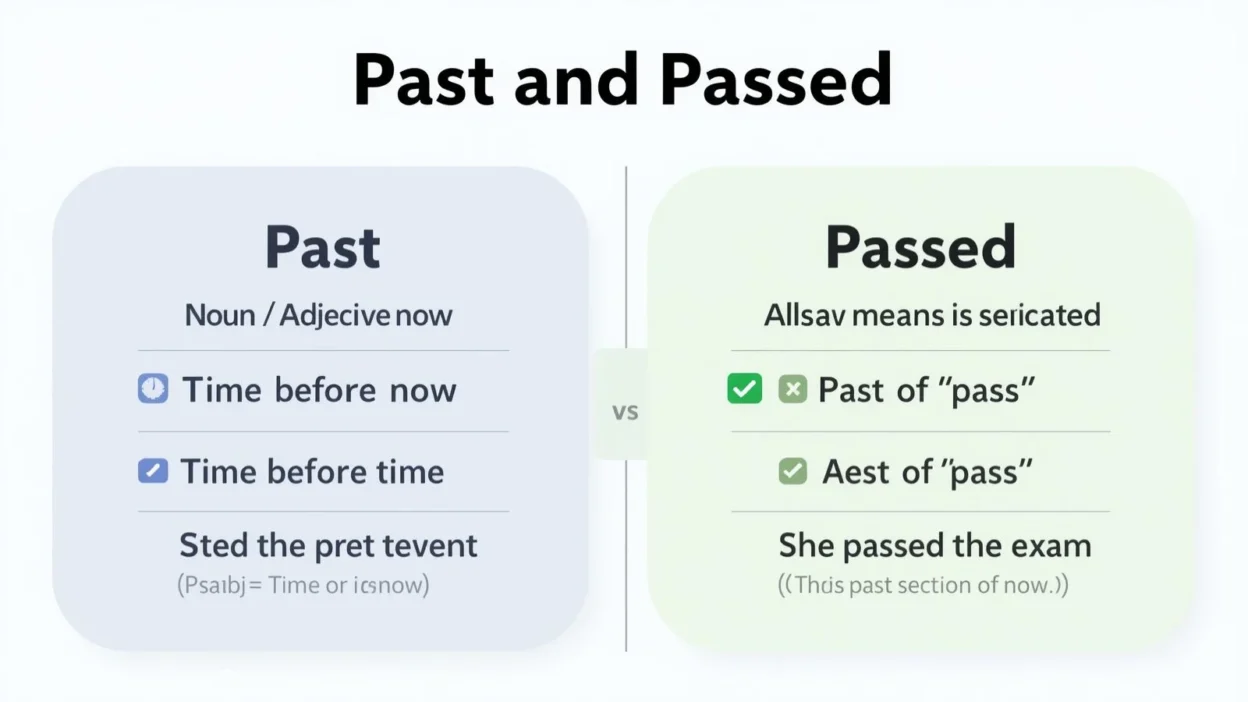
- Past = a noun, adjective, preposition, or adverb related to time or position (e.g., the past, past events, walk past the store)
- Passed = the past tense of “pass” (a verb), meaning to move, go by, succeed, or transfer (e.g., she passed the exam)
👉 Quick tip: If you can replace the word with “went” or “gave”, use passed. Otherwise, it’s likely past.
What Does “Past” Mean?
Past is not a verb it never shows action. Instead, it describes time, position, or direction.
Common Uses of “Past”
- Noun (time before now):
We should learn from the past. - Adjective (describing time):
Past experiences shape who we are. - Preposition (movement beyond something):
He walked past the building. - Adverb (beyond a point):
The deadline is long past.
Example Sentences
- I can’t change what happened in the past.
- She ran past me without stopping.
- It’s already half past ten.
👉 Notice: None of these sentences involve an action like “passing” they describe time or position.
What Does “Passed” Mean?
Passed is always a verb. It’s the past tense of “pass.” It shows that an action has already happened.
Common Meanings of “Passed”
- Moved by or went beyond:
The car passed us quickly. - Succeeded:
He passed the test. - Gave or transferred something:
She passed the salt. - Time went by:
Two hours passed in silence.
Example Sentences
- She passed her driving test on the first try.
- The train passed through the station.
- Time passed slowly during the meeting.
👉 Key idea: If there’s an action happening, you probably need passed.
Past vs Passed: Side-by-Side Comparison
| Feature | Past | Passed |
| Part of Speech | Noun, adjective, adverb, preposition | Verb (past tense of “pass”) |
| Meaning | Time before now or beyond a point | Action of moving, succeeding, or giving |
| Example | That’s in the past. | She passed the exam. |
| Action? | ❌ No | ✅ Yes |
| Trick | Think “time/position” | Replace with “went” or “gave” |
Easy Trick to Remember the Difference
Here’s a simple memory trick:
- If the sentence needs a verb (action) → use passed
- If it refers to time or location → use past
Test It Yourself:
- She ___ the ball. → passed (action)
- It’s ___ midnight. → past (time)
Common Mistakes and How to Fix Them
Even fluent English speakers mix these up. Let’s fix the most common errors.
❌ Incorrect: I walked passed the park.
✔ Correct: I walked past the park.
👉 “Walked” is already the verb, so you need “past” for direction.
❌ Incorrect: He past the exam.
✔ Correct: He passed the exam.
👉 This sentence needs an action (verb), so “passed” is correct.
❌ Incorrect: It is passed 5 o’clock.
✔ Correct: It is past 5 o’clock.
👉 This refers to time, not action.
❌ Incorrect: Time past quickly.
✔ Correct: Time passed quickly.
👉 “Passed” shows the action of time moving.
Past vs Passed in Everyday Contexts
Understanding real-life usage helps make the difference stick.
Talking About Time
- The past shapes our future.
- Midnight has passed.
Talking About Movement
- He walked past me.
- He passed me on the road.
Talking About Success
- She passed the exam.
- (You cannot use “past” here.)
American vs British English Differences
There’s no major difference between American and British English when it comes to past vs passed. Both forms follow the same grammar rules and meanings.
However, usage frequency in phrases may vary slightly:
- British English might more commonly use phrases like “half past ten”
- American English often prefers “10:30” in casual speech
But grammatically, the rules stay exactly the same.
Related Words and LSI Keywords
To strengthen your understanding, here are related terms and phrases often connected to past vs passed:
- past tense vs present tense
- passed away meaning
- walk past vs passed by
- grammar mistakes in English
- homophones in English
- confusing English words
- passed exam meaning
- time expressions in English
Using these correctly will improve both your writing clarity and SEO strength.
FAQs
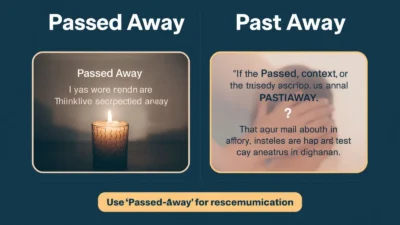
1. Is it “passed away” or “past away”?
It’s always passed away, because it’s a verb phrase describing an action.
2. Can “past” ever be a verb?
No, past is never a verb. Only “passed” functions as a verb.
3. How do I quickly check which one to use?
Try replacing the word with “went” or “gave.”
If it works → use passed.
4. Is “past” always about time?
Not always. It can also describe position or direction, like “walk past the door.”
5. Why are past and passed confusing?
Because they are homophones words that sound the same but have different meanings and spellings.
6. Which is correct: “He passed by me” or “He past by me”?
Correct: He passed by me, because it describes an action.
7. Can I say “the passed year”?
No. Correct form: the past year (adjective describing time).
Summary:
Understanding the difference between past vs passed comes down to one simple idea: past is about time or position, and passed is about action. Once you recognize whether your sentence needs a verb or not, the confusion disappears.
With a bit of practice, you’ll start spotting mistakes instantly both in your own writing and in others’. These small grammar improvements can make a big difference in how clear, professional, and confident your communication feels.
Actionable Takeaway
Next time you write, pause for a second and ask:
👉 “Is this showing an action?” If yes, use passed. If not, use past.
Practice by writing 3–5 sentences using both words correctly. The more you use them intentionally, the faster this rule becomes second nature.

Mia Elizabeth is a contributing author at SpellPeak, passionate about thoughtful writing and clear communication. She creates engaging, well-researched content that helps readers learn and connect with ideas easily. Her work emphasizes clarity, creativity, and practical value, supporting meaningful digital experiences and accessible knowledge sharing worldwide.