
If you’ve ever paused mid-sentence wondering whether to write ensure or insure, you’re not alone. These two words sound similar and are often used interchangeably but they don’t always mean the same thing. Choosing the right one can instantly make your writing clearer and more professional.
In this guide, you’ll learn the exact difference between ensure vs insure, when to use each, and how to avoid common mistakes. By the end, you’ll feel confident using both words naturally in everyday writing.
Quick Answer
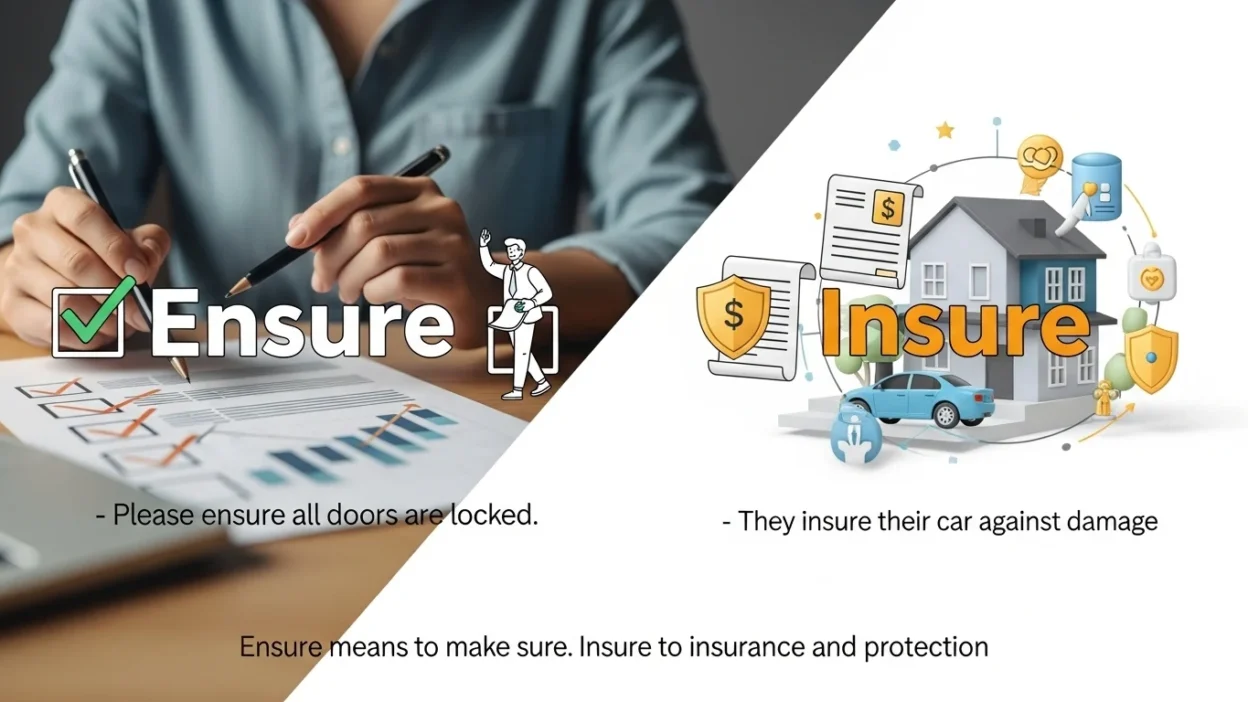
- Ensure = to make certain something happens
- Insure = to protect financially (usually with insurance)
👉 Simple trick:
- If it’s about guaranteeing an outcome, use ensure
- If it’s about insurance or financial protection, use insure
What Does “Ensure” Mean?
The word ensure means to make sure something happens or is guaranteed. It’s about certainty and outcomes.
Examples of Ensure
- Please double-check your work to ensure accuracy.
- The team trained hard to ensure success.
- Lock the door to ensure safety.
In each example, ensure is about making something definite or certain.
When to Use Ensure
Use ensure when:
- You want to guarantee a result
- You’re talking about outcomes or actions
- No financial protection is involved
What Does “Insure” Mean?
Insure specifically refers to protecting something financially through insurance.
Examples of Insure
- We need to insure the car before driving it.
- She decided to insure her home against damage.
- Businesses often insure their assets.
Here, insure is clearly tied to financial protection or insurance policies.
When to Use Insure
Use insure when:
- You’re talking about insurance coverage
- Money or protection against loss is involved
- It relates to policies, companies, or risk management
Ensure vs Insure: Key Differences
Here’s a simple comparison to make things crystal clear:
| Feature | Ensure | Insure |
| Meaning | Make certain or guarantee | Provide financial protection |
| Usage | General situations | Insurance-related contexts |
| Example | Ensure success | Insure a house |
| Focus | Outcome or certainty | Financial risk protection |
Common Mistakes to Avoid
Even fluent writers mix these up. Here are some common errors:
❌ Using “Insure” Instead of “Ensure”
- Incorrect: This plan will insure success
- Correct: This plan will ensure success
👉 Why? Success isn’t something you insure it’s something you ensure.
❌ Overusing “Insure” in General Contexts
Some people use insure as a fancy version of ensure. That’s not correct in modern usage.
❌ Ignoring Context
Always ask yourself:
- Is this about certainty? → Ensure
- Is this about insurance? → Insure
American vs British English Differences
This is where things get slightly interesting.
- In American English, the distinction is strict:
- Ensure = guarantee
- Insure = financial protection
- In British English, insure has sometimes been used more loosely in the past, but modern usage still prefers:
- Ensure for certainty
- Insure for insurance
👉 Bottom line: Stick to the clear distinction it works globally and avoids confusion.
Easy Memory Tricks
Here are a few simple ways to remember:
- Ensure = Sure → both relate to certainty
- Insure = Insurance → both relate to money and protection
Or think:
You ensure outcomes, but you insure assets.
Real-Life Usage Examples
Let’s look at practical, everyday sentences:
With Ensure
- We followed a checklist to ensure quality.
- She saved regularly to ensure financial stability.
- Teachers plan lessons to ensure student understanding.
With Insure
- They chose to insure their business.
- It’s wise to insure valuable items.
- Farmers often insure crops against weather damage.
Related Words and Synonyms (LSI Keywords)
To deepen your understanding, here are some related terms:
Synonyms for Ensure
- Guarantee
- Secure
- Assure
- Confirm
Synonyms for Insure
- Cover
- Protect
- Safeguard financially
- Underwrite
👉 Note: Assure is another similar word, but it means to give confidence to a person (e.g., “I assure you everything is fine”).
FAQs
1. Can “insure” ever mean the same as “ensure”?
Technically, it has been used that way historically, but modern usage strongly separates them. It’s best to avoid using insure for ensure.
2. Is it wrong to use “insure” in general writing?
Not wrong but only when referring to financial protection. Otherwise, it sounds incorrect.
3. What’s the difference between ensure, insure, and assure?
- Ensure = make certain
- Insure = provide insurance
- Assure = give confidence to someone
4. Which word is more common in daily use?
Ensure is more commonly used because it applies to many situations beyond finance.
5. How can I quickly decide which one to use?
Ask:
- Is money or insurance involved? → Insure
- Otherwise → Ensure
6. Do native speakers confuse these words?
Yes, especially in casual writing. But in professional or formal writing, the distinction matters.
7. Is this important for SEO or content writing?
Absolutely. Using the correct word improves clarity, trust, and professionalism key for SEO and user experience.
8. Can I replace “ensure” with “guarantee”?
Yes, in most cases. But “ensure” often sounds more formal and natural in professional writing.
Final Summary
Understanding ensure vs insure is simpler than it seems. The key difference comes down to purpose: ensure is about making something certain, while insure is about financial protection. Once you recognize this distinction, your writing becomes clearer and more precise.
In everyday use, you’ll rely on ensure far more often. Reserve insure strictly for insurance-related contexts. This small change can make a big difference in how professional and polished your writing feels.
Actionable Takeaway
Next time you write:
- Pause and check the context
- Replace confusion with clarity
- Use the simple rule: certainty = ensure, protection = insure
Master this, and you’ll never mix them up again.

Noah Jacob is the administrator of SpellPeak, responsible for managing website operations, content coordination, and platform performance. He ensures smooth functionality, security, and reliability while supporting the team in delivering a seamless, user-focused experience and maintaining high standards of quality across the site.