
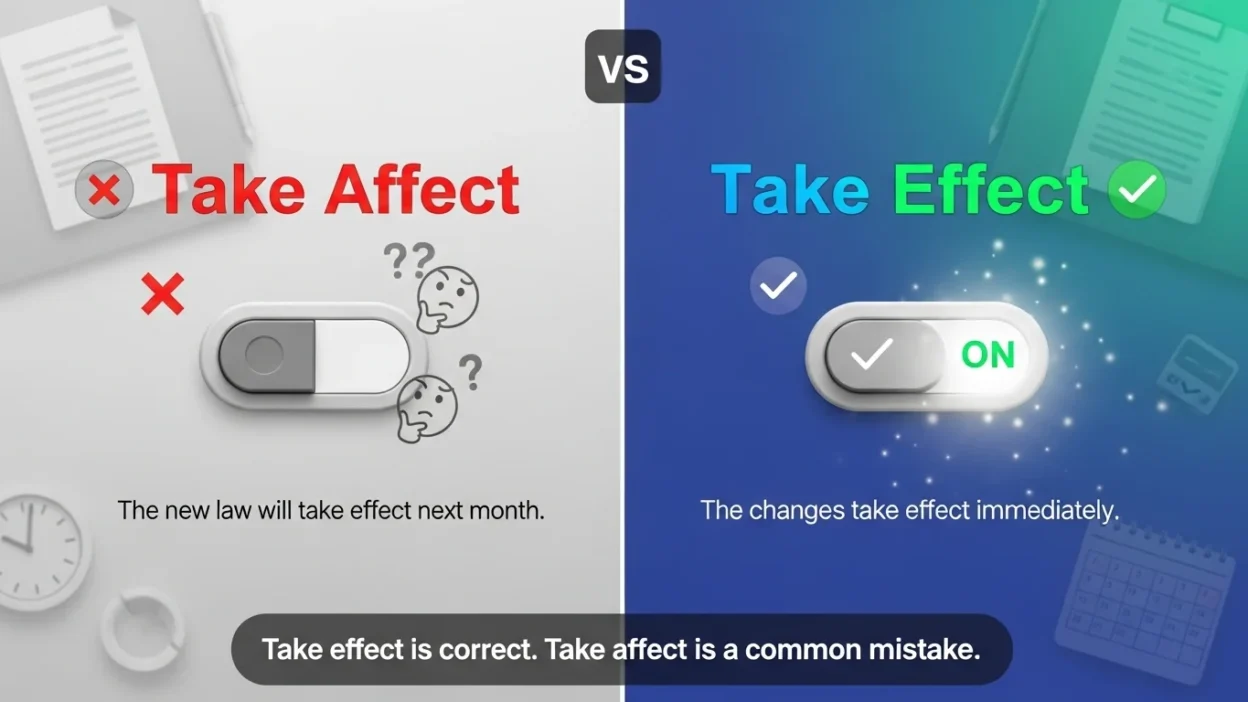
If you’ve ever paused while writing “take effect vs take affect,” you’re not alone. This pair confuses even fluent English speakers because both words sound similar, yet only one is correct in this phrase. Choosing the wrong one can make your writing look unpolished especially in professional or academic contexts.
The good news? This is one of those grammar rules that becomes crystal clear once you understand a simple distinction. In this guide, you’ll learn exactly which form to use, why it matters, and how to avoid this mistake forever.
Quick Answer:
- ✅ Correct phrase: take effect
- ❌ Incorrect phrase: take affect
“Take effect” means something begins to work, apply, or produce results.
“Take affect” is almost always incorrect in standard English.
What Does “Take Effect” Mean?
The phrase “take effect” refers to something starting to become active or producing a result. It’s commonly used with laws, rules, policies, medications, or changes.
Simple definition:
Take effect = to begin working or become active
Examples:
- The new law will take effect next month.
- The medicine should take effect within 30 minutes.
- The changes will take effect immediately.
In each case, something is beginning to function or show results.
Why “Take Affect” Is Incorrect
The confusion comes from the words “effect” and “affect.” While they sound alike, they have different meanings and roles in a sentence.
Key difference:
- Effect → usually a noun (a result or outcome)
- Affect → usually a verb (to influence something)
Since “take effect” uses a noun (effect), it makes sense grammatically:
- ✔ The rule takes effect (becomes active)
But “take affect” mixes the structure incorrectly:
- ❌ “Take affect” doesn’t follow standard grammar rules
Understanding Affect vs Effect (The Root of the Confusion)
Affect (Verb)
Meaning: to influence or change something
- The weather can affect your mood.
- Stress may affect your health.
Effect (Noun)
Meaning: a result or outcome
- The new policy had a positive effect.
- One effect of exercise is better sleep.
Easy memory tip:
👉 Affect = Action (both start with A)
👉 Effect = End result
Comparison Table: Take Effect vs Take Affect
| Phrase | Correct? | Meaning | Example Sentence |
| Take effect | ✅ Yes | Begin to work or apply | The law will take effect tomorrow. |
| Take affect | ❌ No | Grammatically incorrect usage | ❌ The law will take affect tomorrow. |
Real-Life Examples of “Take Effect”
Using “take effect” correctly helps your writing sound natural and professional.
In everyday situations:
- The new school schedule will take effect on Monday.
- The discount offer will take effect after checkout.
In formal or professional writing:
- The updated policy will take effect from January 1st.
- The agreement will take effect upon signing.
In health and science:
- The pain relief medication will take effect shortly.
- The treatment may take time to take effect.
Common Mistakes to Avoid
1. Writing “take affect” instead of “take effect”
This is the most frequent mistake. Always double-check this phrase.
❌ The new rule will take affect soon.
✅ The new rule will take effect soon.
2. Mixing up affect and effect in general
- ❌ This will effect your performance.
- ✅ This will affect your performance.
3. Overthinking the rule
Many people second-guess themselves. Remember:
👉 If you mean “start working,” always use take effect.
American vs British English Usage
There is no difference between American and British English when it comes to “take effect vs take affect.”
- Both use “take effect” as the correct form
- “Take affect” is incorrect in both varieties
However, pronunciation may vary slightly depending on accent, which is part of why confusion happens.
Related Phrases and Synonyms
To improve your writing variety and SEO richness, here are similar expressions:
Alternatives to “take effect”:
- come into force
- go into effect
- become active
- start working
- be implemented
- be enforced
Examples:
- The law will come into force next week.
- The changes will be implemented immediately.
When Should You Use “Take Effect”?
Use this phrase when referring to:
- Laws and regulations
- Policies and rules
- Changes or updates
- Medications or treatments
- Plans or decisions
Example:
- The contract will take effect once both parties sign it.
FAQs
1. Is “take affect” ever correct?
No, “take affect” is not considered correct in standard English. Always use “take effect.”
2. Why do people confuse affect and effect?
They sound similar and are closely related in meaning, which leads to frequent mix-ups.
3. Can “effect” be used as a verb?
Yes, but it’s rare. As a verb, “effect” means “to bring about” (e.g., “to effect change”), which is different from “take effect.”
4. What does “go into effect” mean?
It means the same as “take effect” something becomes active or starts working.
5. Is “take effect immediately” correct?
Yes, it’s a very common and correct phrase used in formal and informal contexts.
6. How can I remember the difference quickly?
Think:
Effect = End result → take effect = result begins
7. Is “affect” always a verb?
Usually yes, but in rare psychological contexts, “affect” can be a noun referring to emotion. This doesn’t apply to this phrase.
8. Which is more formal: “take effect” or “start working”?
“Take effect” is more formal and commonly used in official writing.
Summary
Understanding “take effect vs take affect” comes down to one simple rule: only “take effect” is correct. It means something begins to work, apply, or produce results. The confusion happens because “affect” and “effect” sound similar, but they play different roles in grammar.
Once you remember that “effect” refers to a result and that “take effect” means that result is starting you’ll avoid this mistake with confidence. This small correction can make a big difference in how polished and professional your writing appears.
Actionable Takeaway
Next time you’re about to write this phrase, pause and ask:
👉 “Am I talking about something starting to work?”
If yes, always write “take effect.”
To reinforce the habit, try using it in 2–3 sentences today. The more you practice, the more natural it will feel.

Mia Elizabeth is a contributing author at SpellPeak, passionate about thoughtful writing and clear communication. She creates engaging, well-researched content that helps readers learn and connect with ideas easily. Her work emphasizes clarity, creativity, and practical value, supporting meaningful digital experiences and accessible knowledge sharing worldwide.