If you’ve ever paused mid-sentence wondering whether to write payed or paid, you’re definitely not alone. This is one of those tricky English word pairs that even confident writers sometimes get wrong especially because both look correct at first glance.
Here’s the good news: once you understand the simple rule behind payed vs paid, you’ll never second-guess yourself again. In this guide, we’ll break it down clearly, show real examples, highlight common mistakes, and make sure you walk away feeling confident every time you write it.
Quick Answer:
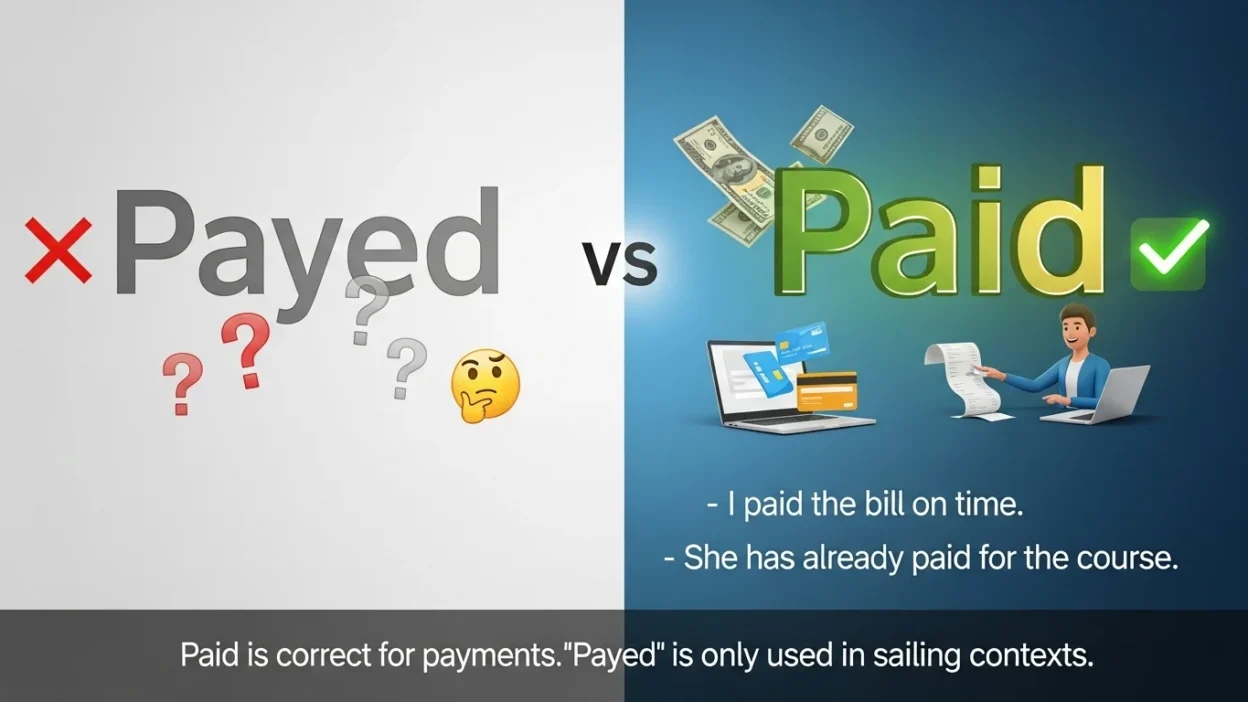
- Paid is the correct past tense of pay in almost all situations
- Payed is rare and used only in specific nautical (sailing) contexts
👉 In 99% of everyday writing, you should use paid
What Does “Paid” Mean?
Paid is the past tense and past participle of the verb pay. It refers to giving money, settling a debt, or receiving money for work or services.
Examples of “Paid”
- I paid my electricity bill yesterday
- She paid for dinner
- They were paid on Friday
- He finally paid off his loan
In all of these cases, paid is the correct and natural choice.
Related Terms and Synonyms
Using LSI keywords improves clarity and SEO:
- Settled a bill
- Made a payment
- Compensated
- Remitted
- Cleared a debt
What Does “Payed” Mean?
Here’s where things get interesting.
Payed is a real word but it’s rarely used. It appears mainly in nautical and sailing contexts, where it means:
- To coat or seal (like a ship’s deck or seams) with tar or resin
- To let out rope or cable gradually
Examples of “Payed”
- The sailors payed the deck to protect it from water
- They payed out the rope slowly
If you’re not writing about ships, ropes, or maritime work, you almost certainly don’t need payed.
Payed vs Paid: Key Differences
Here’s a simple comparison to lock it in:
| Feature | Paid | Payed |
| Meaning | Past tense of pay (money) | Nautical term |
| Usage frequency | Very common | Extremely rare |
| Context | Everyday English | Maritime/sailing |
| Example | I paid the bill | They payed the rope |
| Correct in writing | Yes (almost always) | Only in specific contexts |
Why Do People Confuse Payed and Paid?
This confusion happens because English usually forms past tense verbs with -ed.
Examples:
- Play → Played
- Stay → Stayed
- Work → Worked
So naturally, people assume:
- Pay → Payed ❌
But pay is an irregular verb, so its correct past tense is:
- Pay → Paid ✅
This is similar to:
- Say → Said
- Lay → Laid
Common Mistakes to Avoid
Let’s clear up the most frequent errors so you don’t repeat them.
❌ Incorrect Usage
- I payed my rent
- She payed the invoice
- He payed me back
👉 These are all wrong in standard English
✅ Correct Usage
- I paid my rent
- She paid the invoice
- He paid me back
Quick Tip
If your sentence involves money, salary, bills, or transactions, always use paid.
American vs British English
Good news there’s no difference here.
- In both American English and British English, the correct form is paid
- The rare word payed is also recognized in both, but only in nautical contexts
So no matter where you’re writing for, the rule stays the same.
Real-Life Example Sentences
Here are more examples to help reinforce your understanding:
Everyday Context (Correct: Paid)
- I paid for the course online
- She paid him in cash
- We paid our taxes on time
- The company paid its employees early
Rare Nautical Context (Correct: Payed)
- The crew payed the ship’s seams
- The workers payed out the anchor line
Memory Trick to Remember the Difference
Try this simple trick:
👉 If money is involved → use “paid”
Or remember:
- “I got paid” sounds natural
- “I got payed” sounds wrong
Your ear can often guide you!
FAQs
1. Is “payed” ever correct?
Yes, but only in very specific nautical or maritime contexts. In everyday writing, it’s almost always incorrect.
2. Why is “paid” spelled differently from “pay”?
Because pay is an irregular verb, and its past tense doesn’t follow the usual “-ed” pattern.
3. Can I use “payed out” instead of “paid out”?
Only when referring to ropes or cables in a sailing context. For money, always use paid out.
4. Is “paid” correct in formal writing?
Yes, paid is correct in both formal and informal writing.
5. Do native English speakers confuse these words?
Yes, many people make this mistake, especially in casual writing or online content.
6. How can I quickly check which one to use?
Ask yourself: “Am I talking about money?”
If yes → use paid
7. Is “paid” used as both past tense and past participle?
Yes.
Example:
- Past tense: I paid yesterday
- Past participle: I have paid already
Final Summary
The difference between payed vs paid is actually simple once you break it down. Paid is the correct past tense of pay and should be used in almost all everyday situations involving money, transactions, or compensation.
On the other hand, payed is a rare, specialized term used mainly in nautical contexts, which most writers never need.
If you remember just one thing, let it be this: when writing about money, bills, salaries, or payments, always choose paid. It’s the standard, correct, and widely accepted form across both American and British English.
Actionable Takeaway
Before you write payed, pause and check your context. If it’s not about ships, ropes, or sealing decks, switch it to paid. This one small habit will instantly improve your writing accuracy and make your content more professional.
Keep practicing with real sentences, and soon the correct choice will feel completely natural no second-guessing needed.

Ethan William is the author behind SpellPeak, passionate about clear communication and meaningful language. He writes to help readers express ideas with confidence, simplicity, and impact. His work focuses on clarity, learning, and empowering individuals and businesses through thoughtful, practical content. He values creativity, consistency, and ethical digital publishing worldwide.