If you’ve ever paused mid-sentence wondering whether to write deep-seeded or deep-seated, you’re not alone. This is one of those word confusions that trips up even confident writers because both versions sound almost identical. But here’s the truth: only one is correct in standard English.
In this guide, you’ll learn the real meaning, see clear examples, avoid common mistakes, and confidently use the right phrase in your writing. If you’re a student, blogger, or professional writer, this explanation will stick with you.
Quick Answer
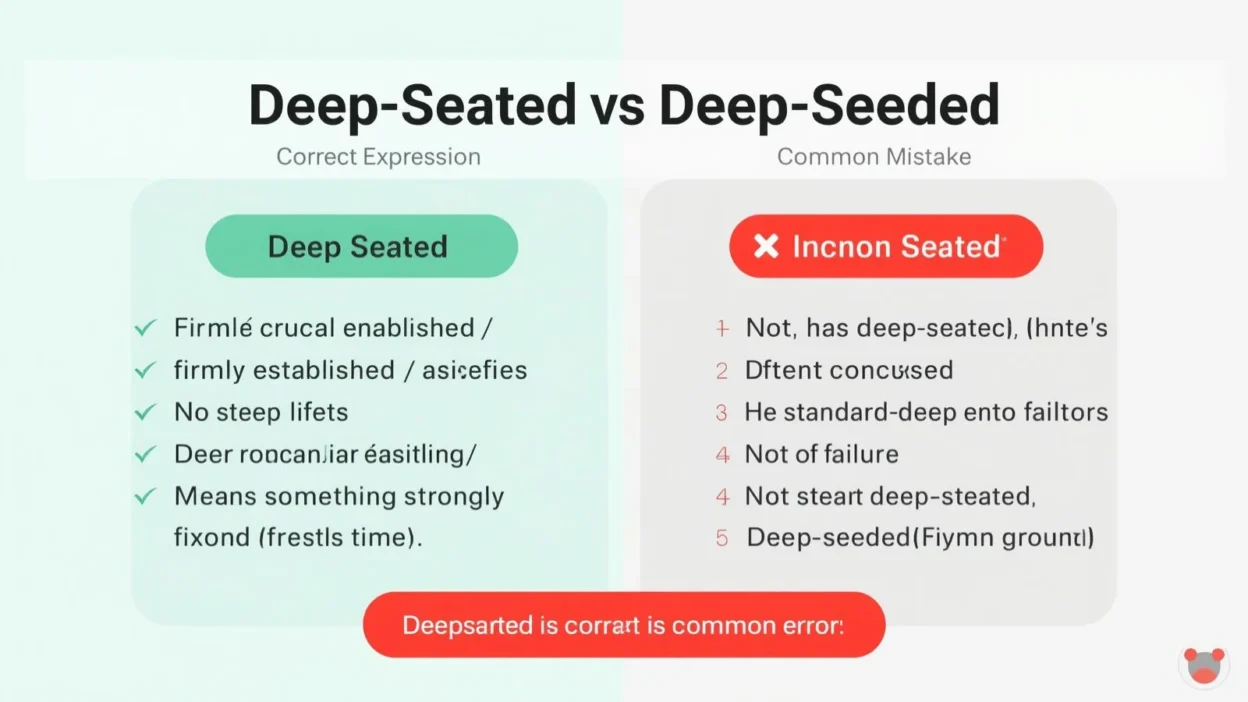
- ✅ Correct: Deep-seated
- ❌ Incorrect: Deep-seeded (commonly mistaken form)
- Meaning: Something firmly established, deeply rooted, or strongly felt over time
What Does “Deep-Seated” Mean?
The phrase deep-seated refers to something that is firmly established and difficult to change. It often describes emotions, beliefs, habits, or problems that have existed for a long time.
Think of it like something “sitting deep inside” a person or system it’s not surface-level.
Examples:
- She has a deep-seated fear of failure.
- There’s a deep-seated rivalry between the two teams.
- His deep-seated beliefs shape his decisions.
In each example, the idea isn’t new or temporary it’s deeply embedded.
Why Do People Say “Deep-Seeded”?
The confusion comes from the word “seed.” People naturally associate “seed” with growth, roots, and origin, which feels like it should fit. But in reality, “deep-seeded” is a mistake, not a standard English phrase.
This is called an eggcorn a word or phrase that sounds logical but is actually incorrect.
Why it seems correct:
- Seeds grow roots → feels like “deep origin”
- Sounds almost identical to “deep-seated”
- Easy to visualize, so it sticks in memory
Still, in formal and correct English, you should always use deep-seated.
The Real Origin of “Deep-Seated”
The word “seated” comes from the idea of something being firmly placed or positioned. So when we say “deep-seated,” we mean something that is firmly set deep within.
It has nothing to do with planting seeds it’s about stability and depth.
Deep-Seated vs Deep-Seeded (Comparison Table)
| Feature | Deep-Seated ✅ | Deep-Seeded ❌ |
| Correct usage | Yes | No |
| Meaning | Firmly established, deeply rooted | Misinterpretation |
| Origin | From “seated” (firmly placed) | From confusion with “seed” |
| Usage in writing | Formal & informal English | Avoid in all contexts |
| Example | Deep-seated fear | ❌ Deep-seeded fear |
Common Mistakes to Avoid
Even experienced writers slip up here. Let’s fix that.
❌ Mistake 1: Using “deep-seeded” in formal writing
Always replace it with deep-seated.
❌ Mistake 2: Assuming both are acceptable
They are not interchangeable only one is correct.
❌ Mistake 3: Thinking it relates to growth
It’s not about seeds growing; it’s about something being firmly established.
When to Use “Deep-Seated”
Use deep-seated when describing:
- Long-held beliefs
- Strong emotions
- Persistent problems
- Cultural or social issues
More Examples:
- A deep-seated mistrust of authority
- Deep-seated insecurity can affect relationships
- The issue stems from deep-seated corruption
American vs British English
Good news there’s no difference here.
- 🇺🇸 American English: deep-seated
- 🇬🇧 British English: deep-seated
Both forms use the same spelling and meaning. The incorrect version (deep-seeded) appears in both regions but is considered wrong everywhere.
Related Words and Synonyms (LSI Keywords)
To strengthen your vocabulary and SEO understanding, here are similar phrases:
- Deep-rooted
- Strongly ingrained
- Firmly established
- Long-standing
- Embedded beliefs
- Persistent issue
- Underlying problem
These can often replace deep-seated depending on context.
FAQs
1. Is “deep-seeded” ever correct?
No. It’s a common mistake and should always be replaced with deep-seated.
2. Why do so many people say “deep-seeded”?
Because it sounds logical and relates to “seeds growing,” but it’s not historically or grammatically correct.
3. What does “deep-seated fear” mean?
It means a fear that is deeply ingrained and has likely existed for a long time.
4. Can I use “deep-rooted” instead?
Yes, “deep-rooted” is a correct and similar alternative.
5. Is “deep-seated” formal or informal?
It works in both formal and informal writing.
6. How can I remember the correct form?
Think: “Seated = sitting deep inside.” Not planting seeds.
7. Is this mistake common in professional writing?
Yes, even professionals sometimes make this error, but it should be corrected during editing.
8. Are there other similar confusing phrases?
Yes English has many “sound-alike” mistakes like “supposably” vs “supposedly.”
Summary
The difference between deep-seated vs deep-seeded is simple once you understand it. Deep-seated is the only correct form, used to describe something firmly established or deeply ingrained. On the other hand, deep-seeded is a widespread but incorrect variation that should be avoided in all types of writing.
Remember, language often tricks us with familiar sounds and logical guesses. But strong writing comes from knowing what’s correct not just what feels right. By choosing deep-seated, you keep your communication clear, professional, and accurate.
Actionable Takeaway
Next time you write about strong emotions, beliefs, or long-standing issues, pause and choose wisely:
👉 Always use deep-seated
A quick mental trick:
“Seated = settled deep inside.”
That one thought can save you from this mistake forever.

Noah Jacob is the administrator of SpellPeak, responsible for managing website operations, content coordination, and platform performance. He ensures smooth functionality, security, and reliability while supporting the team in delivering a seamless, user-focused experience and maintaining high standards of quality across the site.