
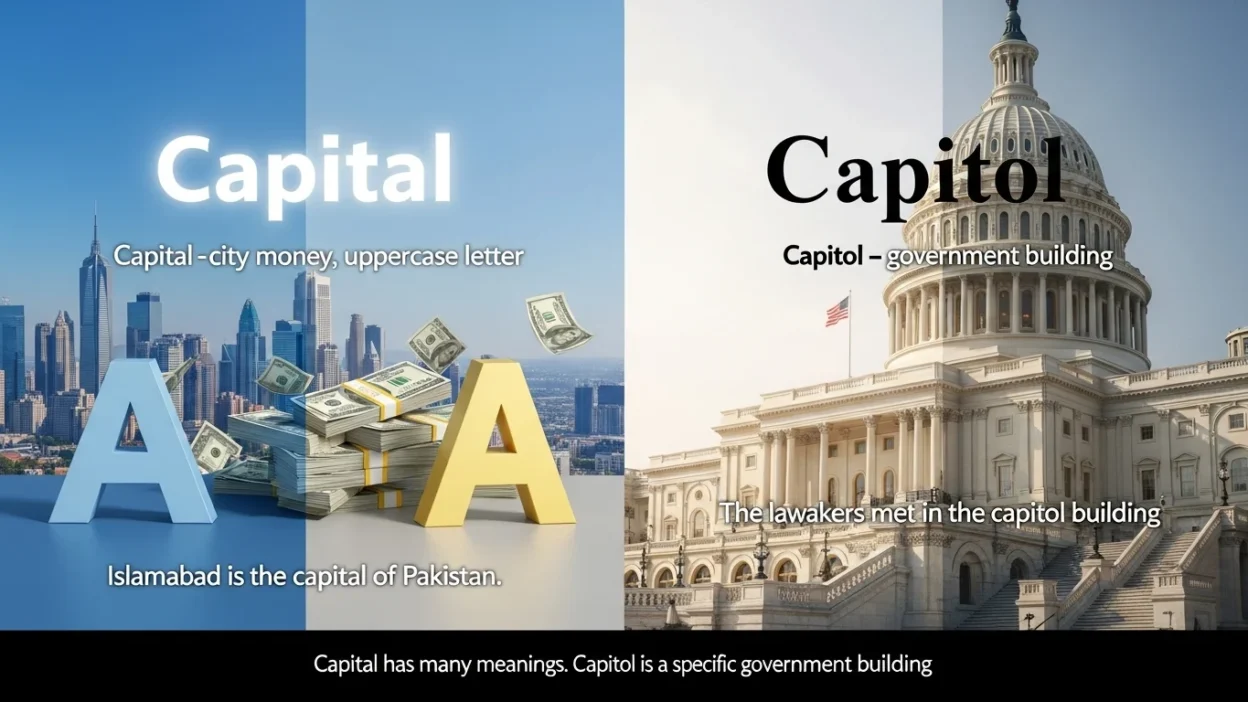
Confused about capital vs capitol? You’re not alone. These two words look almost identical, sound the same, and are often mixed up even by native speakers. But once you understand the difference, it’s actually very easy to remember.
In this guide, we’ll break it down in a simple, friendly way so you can use each word correctly every time. If you’re writing an essay, blog, or professional content, mastering this distinction will boost your clarity and credibility.
Quick Answer:
- Capital has multiple meanings: a city, money, or uppercase letters.
- Capitol refers specifically to a building where a legislature meets.
👉 Tip: Think of “Capitol” with an “o” as a building with a dome.
What Does “Capital” Mean?
The word capital is versatile and commonly used in everyday English. It has several meanings depending on context.
1. A City (Most Common Meaning)
A capital is the main city of a country or region, where the government operates.
Examples:
- Islamabad is the capital of Pakistan.
- Paris is the capital of France.
2. Money or Wealth
In business and finance, capital refers to money or assets used to invest or run a company.
Examples:
- The startup raised enough capital to grow.
- Investors provided financial capital for expansion.
3. Uppercase Letters
In grammar, capital letters are the big letters used at the start of sentences or names.
Examples:
- Always use a capital letter for proper nouns.
- “A” is a capital letter; “a” is lowercase.
4. Something Important or Excellent
Sometimes, capital can mean “very important” or “excellent” (though this usage is less common today).
Example:
- That’s a capital idea!
What Does “Capitol” Mean?
The word capitol has a much narrower meaning.
1. A Government Building
A capitol is a building where lawmakers meet to create laws.
Examples:
- The meeting was held in the state capitol.
- Tourists visited the national capitol building.
The term is especially associated with the United States Capitol, where the U.S. Congress meets.
Capital vs Capitol: Key Differences
Here’s a clear side-by-side comparison:
| Feature | Capital | Capitol |
| Meaning | City, money, uppercase letter | Government building |
| Usage frequency | Very common | Less common |
| Context | Geography, finance, grammar | Politics, government |
| Example | The capital of Italy is Rome | The law was passed in the capitol |
| Memory tip | Many meanings | “O” = dome-shaped building |
Easy Memory Trick
A simple trick can help you remember forever:
👉 CapitOL = dOme
Both words have an “O,” and many capitol buildings have domes.
Once you connect the “O” with a building shape, you’ll rarely confuse them again.
Common Mistakes to Avoid
Even experienced writers sometimes mix these up. Here are the most common errors:
❌ Mistake 1: Using “Capitol” for a City
- Incorrect: Islamabad is the capitol of Pakistan.
- Correct: Islamabad is the capital of Pakistan.
❌ Mistake 2: Using “Capital” for a Building
- Incorrect: The law was passed in the capital building.
- Correct: The law was passed in the capitol building.
❌ Mistake 3: Forgetting Multiple Meanings
Some people assume “capital” only refers to cities but it also means money and uppercase letters.
❌ Mistake 4: Overusing “Capitol”
Because “capitol” sounds formal, some writers use it unnecessarily. Remember, it’s very specific.
Real-Life Examples in Sentences
Using both words correctly in context makes the difference clearer:
- The capital city is home to the national capitol building.
- She invested her capital in a new business near the capital.
- The senator gave a speech inside the capitol.
American vs British English Differences
There is no major difference between American and British English when it comes to capital vs capitol.
- Capital is widely used in both American and British English.
- Capitol is mainly used in American contexts (especially referring to government buildings), but the meaning remains the same globally.
In British English, the word “parliament” or “government building” is more commonly used instead of “capitol.”
Why This Difference Matters
Understanding the difference between capital vs capitol improves:
- ✅ Writing accuracy
- ✅ Professional credibility
- ✅ SEO and content quality
- ✅ Reader trust
Even small spelling errors can confuse readers or make your writing look less polished.
FAQs
1. Is “capitol” ever used for cities?
No, capitol is only used for buildings. Cities are always called capital.
2. Can “capital” mean money?
Yes, in finance, capital refers to funds or assets used for investment.
3. Why do people confuse capital and capitol?
Because they are homophones they sound the same but have different meanings and spellings.
4. Is “capitol” used outside the United States?
Yes, but it’s less common. Other countries usually use terms like “parliament building.”
5. What is the easiest way to remember the difference?
Remember: CapitOL = dOme (building).
6. Are both words nouns?
Yes, both capital and capitol function as nouns.
7. Can “capital” be an adjective?
Yes. Example: “Capital punishment” or “capital city.”
Summary:
The difference between capital vs capitol is simple once you break it down. Capital is a versatile word with multiple meanings it can refer to a city, money, or uppercase letters. On the other hand, capitol has a single, specific meaning: a building where lawmakers meet.
By remembering that “capitol” refers to a building and “capital” covers everything else, you can avoid one of the most common English mistakes. A small distinction like this can make a big difference in how clear and professional your writing feels.
Actionable Takeaway
Next time you write, pause and ask yourself:
👉 “Am I talking about a place (city), money, or letters or a government building?”
- If it’s a city, money, or letters → use “capital”
- If it’s a government building → use “capitol”
Practice using both in sentences, and soon it will feel completely natural.

Ethan William is the author behind SpellPeak, passionate about clear communication and meaningful language. He writes to help readers express ideas with confidence, simplicity, and impact. His work focuses on clarity, learning, and empowering individuals and businesses through thoughtful, practical content. He values creativity, consistency, and ethical digital publishing worldwide.