
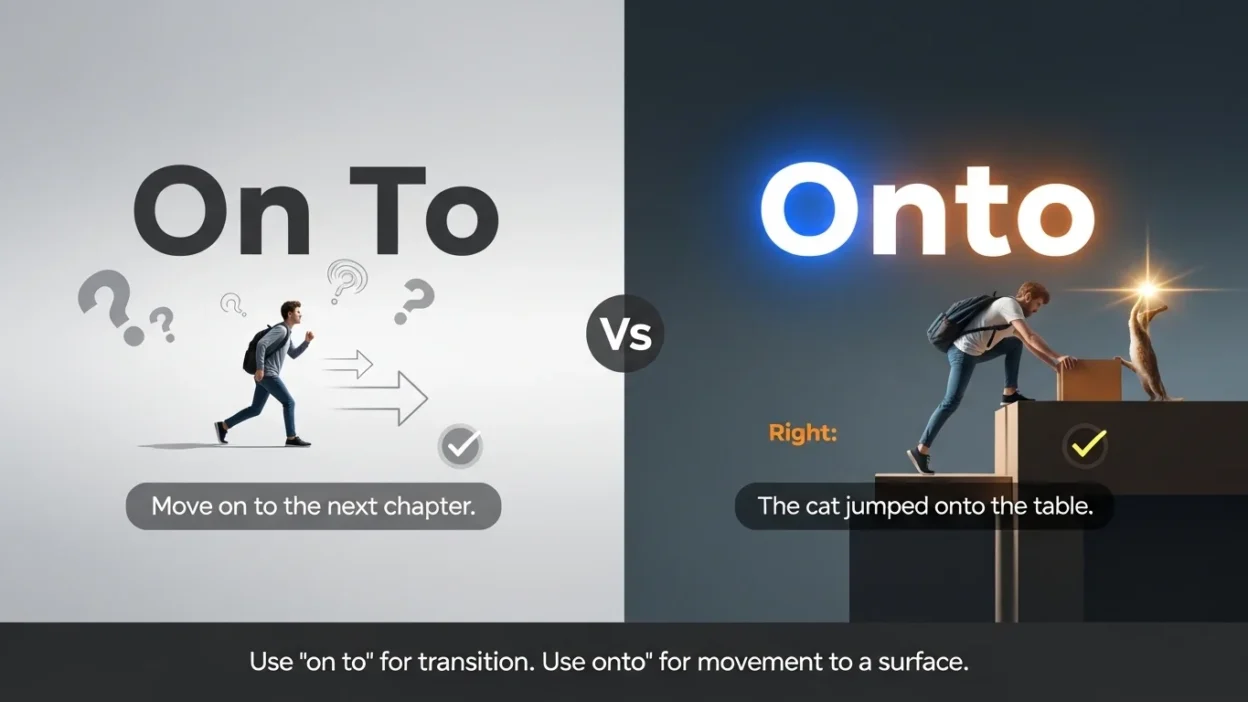
If you’ve ever paused mid-sentence wondering whether to write “on to” or “onto,” you’re not alone. These two forms look almost identical, sound the same, and are often used interchangeably but they don’t always mean the same thing. That confusion can quietly affect your writing clarity, especially in blogs, emails, or professional content.
The good news? Once you understand the difference, it becomes surprisingly simple. In this guide, you’ll learn when to use on to vs onto, see practical examples, avoid common mistakes, and gain confidence in your writing whether you’re a student, blogger, or professional.
Quick Answer: On To vs Onto
- “Onto” = shows movement to a surface or position
- Example: She jumped onto the table.
- “On to” = usually means moving forward to something else
- Example: Let’s move on to the next topic.
👉 Quick trick:
If you can replace it with “upon”, use onto.
If it means “continue” or “next step”, use on to.
What Does “Onto” Mean?
“Onto” is a preposition that describes movement toward a surface or position. It often answers the question: Where is something going?
Examples:
- The cat leaped onto the roof.
- He placed the book onto the shelf.
- She climbed onto the stage confidently.
In all these sentences, something is physically moving to a surface or position.
Key Idea:
“Onto” = motion + surface
What Does “On To” Mean?
“On to” is a combination of two words:
- “on” (part of a verb phrase)
- “to” (a preposition)
It usually means continuing or progressing to the next thing.
Examples:
- Let’s move on to the next chapter.
- We shifted on to a new strategy.
- After dinner, we went on to watch a movie.
Here, there’s no physical surface just a transition or progression.
Key Idea:
“On to” = continue + next step
Simple Comparison: On To vs Onto
| Feature | Onto | On To |
| Meaning | Movement to a surface | Continue to something else |
| Usage type | Single preposition | Verb phrase + preposition |
| Focus | Physical direction | Progression or transition |
| Example | Jump onto the bed | Move on to the next idea |
Easy Trick to Remember the Difference
Here’s a simple mental shortcut:
- Use “onto” when you can say “on top of”
- Example: He climbed onto the wall → on top of the wall
- Use “on to” when you can say “continue to”
- Example: Let’s move on to the next task → continue to the next task
Common Mistakes (And How to Fix Them)
Even experienced writers mix these up. Let’s fix the most common errors.
❌ Incorrect:
- She walked on to the stage.
👉 (This suggests “continue,” which is wrong)
✅ Correct:
- She walked onto the stage.
❌ Incorrect:
- Let’s move onto the next point.
👉 (This implies physical movement, which isn’t intended)
✅ Correct:
- Let’s move on to the next point.
❌ Incorrect:
- He jumped on to the table.
👉 (Grammatically possible, but less natural)
✅ Better:
- He jumped onto the table.
When Both “On To” and “Onto” Can Work
Sometimes, both forms are technically correct but the meaning changes slightly.
Example:
- She held on to the rope. (She continued holding it)
- She climbed onto the rope. (She moved onto it)
👉 Notice how the meaning shifts from continuation to movement.
American vs British English Differences
There’s no major difference between American and British English when it comes to on to vs onto. Both forms follow the same rules.
However:
- American English tends to prefer “onto” more frequently in everyday writing.
- British English sometimes leans slightly toward separating words (“on to”) in formal contexts, but the meaning rules remain the same.
👉 Bottom line: Focus on meaning, not region.
Related Keywords and Similar Confusions
If you’re learning this, you might also find these helpful:
- Into vs in to
- Upon vs up on
- Over vs over to
- Continue vs proceed
These pairs follow similar logic whether something is combined or separate often depends on meaning and context.
FAQs
1. Is “onto” one word or two?
“Onto” is always one word when used as a preposition showing movement to a surface.
2. Can “on to” and “onto” be used interchangeably?
Not always. They have different meanings, so using the wrong one can confuse readers.
3. How do I quickly check which one to use?
Try replacing it:
- Use “onto” if “on top of” works
- Use “on to” if “continue to” fits
4. Is “move onto” ever correct?
Usually, it should be “move on to” because it means progressing to something else.
5. Why do people confuse these words?
Because they sound the same and look similar, but they serve different grammatical roles.
6. Is “on to” more formal than “onto”?
Not really. Both are standard correctness depends on context, not formality.
7. Can I use “onto” in figurative meaning?
Yes, sometimes:
- She’s onto something important.
Here, it means understanding or discovering something, not physical movement.
8. What’s the biggest mistake to avoid?
Using “onto” when you mean progression, like:
- ❌ move onto the next step
- ✅ move on to the next step
Final Summary
Understanding on to vs onto comes down to one simple idea: movement vs progression. “Onto” is used when something physically moves to a surface, while “on to” is used when you’re continuing or moving forward to the next step. Once you recognize this distinction, your writing becomes clearer and more precise.
Many writers struggle with this pair, but you don’t have to. With a few quick checks like replacing with “on top of” or “continue to” you can instantly choose the correct form. Over time, it will feel natural, and you won’t even have to think about it.
Actionable Takeaway
Next time you write:
- Pause and ask: Is this physical movement or progression?
- Apply the quick replacement trick
- Double-check common phrases like “move on to”
Practice with a few sentences today, and this confusion will disappear for good.

Mia Elizabeth is a contributing author at SpellPeak, passionate about thoughtful writing and clear communication. She creates engaging, well-researched content that helps readers learn and connect with ideas easily. Her work emphasizes clarity, creativity, and practical value, supporting meaningful digital experiences and accessible knowledge sharing worldwide.