
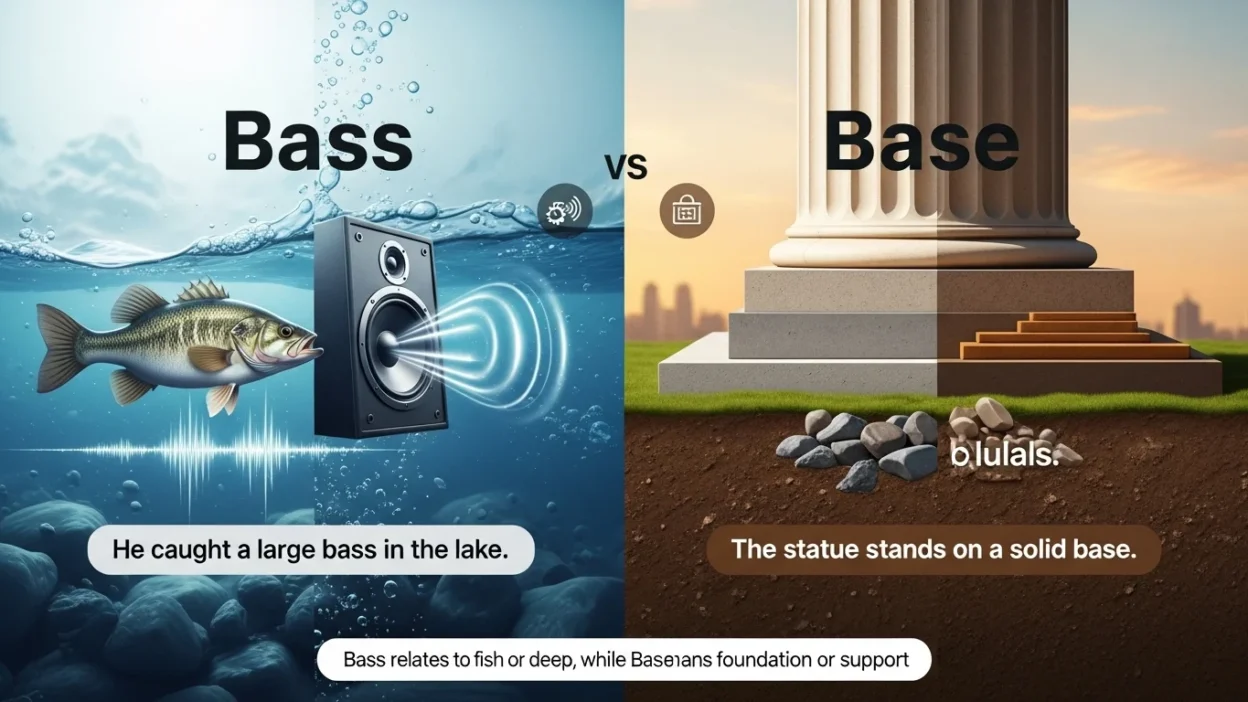
If you’ve ever paused mid-sentence wondering whether to write bass or base, you’re not alone. These two words sound similar but carry completely different meanings and using the wrong one can change your sentence entirely.
In this guide, you’ll learn the exact difference between bass vs base, when to use each, and how to avoid common mistakes. If you’re writing casually or professionally, this will clear up the confusion once and for all.
Quick Answer
- Bass refers to low-frequency sounds, a type of fish, or deep musical tones.
- Base means a foundation, starting point, or main support of something.
👉 Tip: Think of bass as “sound or fish” and base as “foundation or support.”
What Does “Bass” Mean?
The word bass has a few different meanings depending on context, but they all share the idea of something deep or low.
1. Bass in Music
In music, bass refers to:
- Low-frequency sounds
- Deep tones in songs
- Instruments like bass guitar or double bass
Examples:
- The bass in that song is powerful.
- She plays the bass in a jazz band.
2. Bass as a Fish
Bass is also the name of a popular type of fish.
Examples:
- He caught a large bass in the lake.
- We grilled fresh bass for dinner.
3. Pronunciation Note
Interestingly, bass is pronounced differently depending on meaning:
- Music: base (like “base”)
- Fish: bass (rhymes with “mass”)
What Does “Base” Mean?
The word base generally refers to a foundation, bottom, or starting point. It’s used across many contexts from everyday language to science and business.
1. Base as a Foundation
Base is the bottom support of something.
Examples:
- The statue rests on a stone base.
- Trust is the base of a strong relationship.
2. Base as a Starting Point
It can also mean a place where something begins.
Examples:
- We will base our decision on facts.
- The company is based in London.
3. Base in Other Contexts
- Math/Science: A chemical opposite of an acid
- Sports: Bases in baseball
- Military: A central location or headquarters
Examples:
- The army returned to its base.
- First base is just ahead.
Bass vs Base: Key Differences
Here’s a simple comparison to make things crystal clear:
| Feature | Bass | Base |
| Meaning | Low sound or fish | Foundation or starting point |
| Context | Music, audio, fishing | Structure, ideas, location |
| Pronunciation | “Base” (music), “Bass” (fish) | Always “Base” |
| Example | The bass is loud | This is the base of the building |
When to Use Bass
Use bass when talking about:
- Music or sound
- Deep tones
- Fish species
Examples in Sentences:
- Turn up the bass in the speakers.
- The bass line makes the song catchy.
- We caught three bass during our trip.
When to Use Base
Use base when referring to:
- Foundations or support
- Starting points
- Locations or headquarters
Examples in Sentences:
- The tower has a solid base.
- Let’s base our argument on evidence.
- They moved their base to another city.
Common Mistakes to Avoid
Even native speakers mix up bass vs base. Here are the most common mistakes:
1. Using “Base” Instead of “Bass” (Music)
❌ The base in this song is amazing.
✅ The bass in this song is amazing.
2. Using “Bass” Instead of “Base” (Foundation)
❌ The building needs a strong bass.
✅ The building needs a strong base.
3. Confusion Due to Pronunciation
Because bass (music) sounds like base, people often spell it incorrectly. Always double-check the meaning.
👉 Quick memory trick:
- Bass = Beats
- Base = Bottom
Bass vs Base in American vs British English
Good news there’s no major difference between American and British English when it comes to bass vs base.
- Both use the same spelling and meanings
- Pronunciation differences are minimal and context-based
- Usage rules remain identical
This makes it easier for international writers and learners.
Related Words and Synonyms (LSI Keywords)
To strengthen your understanding, here are related terms:
For Bass:
- Low frequency
- Deep sound
- Subwoofer
- Bassline
- Acoustic depth
For Base:
- Foundation
- Core
- Groundwork
- Starting point
- Basis
FAQs
1. Is bass pronounced the same as base?
In music, yes bass is pronounced like base. But when referring to fish, it sounds like “mass.”
2. Can bass ever mean foundation?
No. Bass never means foundation. That meaning belongs to base.
3. Why do people confuse bass and base?
Because they sound the same (in music context) but have completely different meanings.
4. Is “base” used in grammar or writing?
Yes, it can mean the main idea or foundation of an argument.
5. What is a bass instrument?
It’s a musical instrument that produces low-frequency sounds, like a bass guitar.
6. Can base be used as a verb?
Yes. Example: “We will base our decision on research.”
7. Are bass and base homophones?
Sometimes. In music context, they sound the same, but not when referring to fish.
8. Which is more common in writing?
Base is more commonly used because it applies to many contexts.
Summary:
Understanding bass vs base comes down to context. If you’re talking about music, sound, or fish, the correct word is bass. If you mean foundation, support, or starting point, then base is the right choice. Even though they sound similar, their meanings are completely unrelated.
By remembering simple associations bass for beats and base for bottom you can avoid common mistakes. This distinction is especially important in professional writing, where clarity and accuracy matter.
Actionable Takeaway
Next time you write, pause and ask yourself: Am I talking about sound or structure? That quick check will help you instantly choose between bass and base.
To improve further:
- Read your sentence aloud
- Replace the word with a synonym (like “foundation” or “sound”)
- Double-check meaning before publishing
Mastering small differences like this builds stronger, more confident writing over time.

Noah Jacob is the administrator of SpellPeak, responsible for managing website operations, content coordination, and platform performance. He ensures smooth functionality, security, and reliability while supporting the team in delivering a seamless, user-focused experience and maintaining high standards of quality across the site.