If you’ve ever paused while writing and wondered whether to use “laid out” or “layed out,” you’re not alone. This is one of those tricky English grammar points that confuses even confident writers. The good news? Once you understand the rule, it becomes surprisingly easy to get it right every time.
In this guide, we’ll break down the difference between laid out vs layed out, explain why one is correct and the other isn’t, and give you clear examples you can actually use in real life. By the end, you’ll feel confident choosing the right phrase without second-guessing yourself.
Quick Answer:
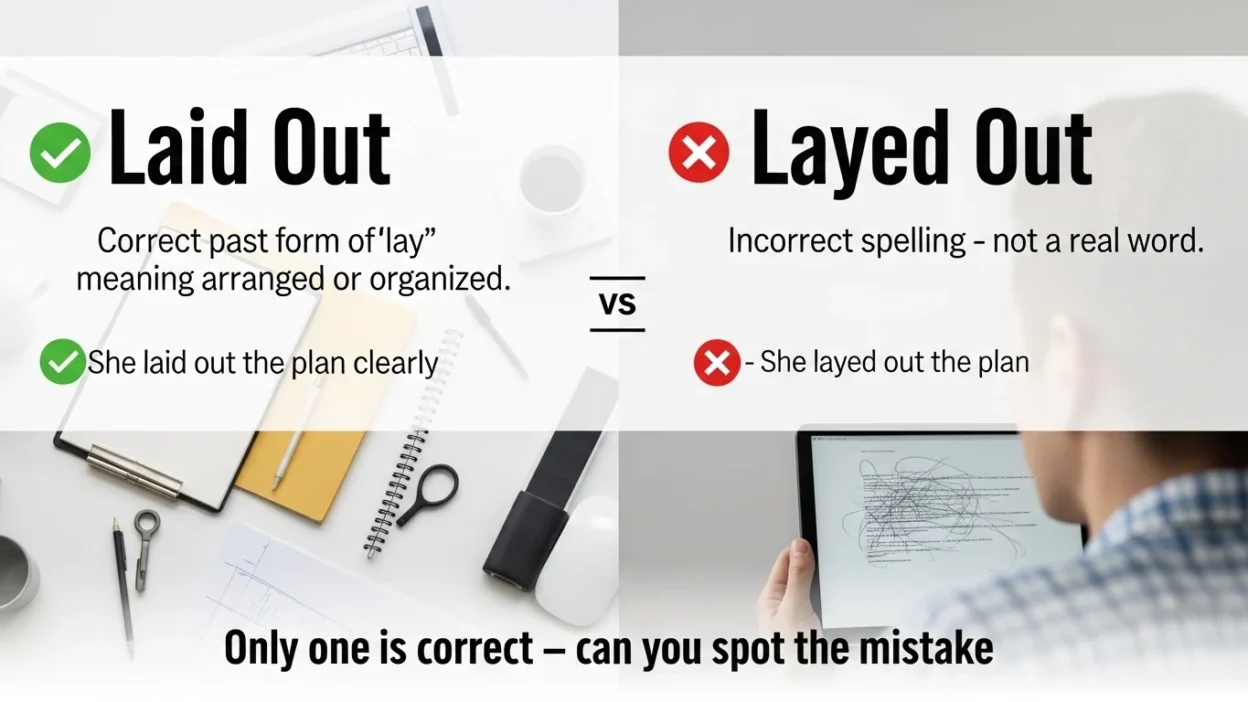
- ✅ Laid out is correct
- ❌ Layed out is incorrect (not a real standard English form)
Why?
“Laid” is the correct past tense of lay, while “layed” is a common misspelling.
Example:
- Correct: She laid out the plan clearly.
- Incorrect: She layed out the plan clearly.
What Does “Laid Out” Mean?
The phrase “laid out” comes from the verb lay, which means to put something down carefully or arrange it.
When you say laid out, you’re using the past tense, meaning something has already been placed, arranged, or explained.
Common meanings of “laid out”:
- To arrange something physically
He laid out the tools on the table. - To explain something clearly
The teacher laid out the rules for the class. - To plan or organize something
They laid out a strategy for success.
It’s a versatile phrase used in both casual and professional writing.
Why “Layed Out” Is Incorrect
“Layed” might sound right, but it’s not a proper English word in standard usage. The confusion comes from mixing up verb forms.
Here’s the correct structure:
- Present: lay
- Past: laid
- Past participle: laid
So when you write “layed,” you’re creating a non-standard form that doesn’t belong in correct English writing.
Understanding the Confusion: Lay vs Lie
Part of the confusion around laid out vs layed out comes from mixing up lay and lie.
Key difference:
- Lay → requires an object (you lay something)
- Lie → does not require an object (you lie down)
Examples:
- I lay the book on the table → I laid it there yesterday
- I lie down to rest → I lay down yesterday
This overlap makes English tricky but once you spot the pattern, it gets easier.
Examples of “Laid Out” in Sentences
Here are practical examples to help you see how “laid out” works naturally:
Everyday use:
- She laid out her clothes for the next day.
- He laid out the documents on the desk.
Professional context:
- The manager laid out the company’s goals for the year.
- The report clearly laid out the findings.
Informal conversation:
- They laid out everything we needed for the trip.
- I laid out my thoughts honestly.
Common Mistakes to Avoid
Even experienced writers sometimes slip up here. Let’s fix the most common errors.
1. Using “layed” instead of “laid”
❌ He layed out the plan
✅ He laid out the plan
2. Confusing present and past tense
❌ I lay out the plan yesterday
✅ I laid out the plan yesterday
3. Mixing up “lay” and “lie”
❌ I laid down for a nap (wrong if no object)
✅ I lay down for a nap
4. Overthinking the spelling
If you’re unsure, remember:
👉 “Laid” is always the safe, correct choice.
Comparison Table: Laid Out vs Layed Out
| Feature | Laid Out ✅ | Layed Out ❌ |
| Correct spelling | Yes | No |
| Standard English | Yes | No |
| Past tense of “lay” | Yes | No |
| Used in writing | Always | Never |
| Example | She laid out the plan | She layed out the plan |
American vs British English Differences
Here’s something reassuring: there’s no difference between American and British English when it comes to this phrase.
- 🇺🇸 American English: laid out
- 🇬🇧 British English: laid out
Both forms follow the same grammar rules, and “layed out” is incorrect in both versions.
Related Keywords and Synonyms
To strengthen your writing and avoid repetition, here are some alternatives and related phrases:
- arranged
- organized
- presented
- explained
- set out
- mapped out
- planned
Example:
Instead of repeating “laid out”:
- The plan was clearly mapped out
- She set out her ideas in detail
These variations improve readability and SEO while keeping your writing engaging.
When Should You Use “Laid Out”?
Use laid out whenever you’re describing something that has already been:
- arranged
- explained
- organized
- prepared
Quick tip:
If your sentence is in the past, “laid out” is almost always correct when using lay.
FAQs
1. Is “layed out” ever correct?
No. “Layed out” is not considered correct in standard English. Always use “laid out.”
2. Why do people write “layed out”?
It’s a common spelling mistake caused by confusion with regular verb patterns (like “played” or “stayed”).
3. What is the past tense of “lay out”?
The correct past tense is laid out.
4. Is “laid out” formal or informal?
It works in both formal and informal contexts. It’s widely accepted everywhere.
5. Can I use “laid out” in professional writing?
Yes. It’s perfectly appropriate in business, academic, and formal writing.
6. What’s the difference between “laid out” and “set out”?
Both are similar, but:
- Laid out → more physical or detailed arrangement
- Set out → often used for intentions or plans
7. How can I remember the correct form?
Think:
👉 “Paid” and “laid” follow the same pattern
You wouldn’t write “payed” (except in rare contexts), so don’t write “layed.”
Final Summary
Understanding the difference between laid out vs layed out is simpler than it seems. “Laid out” is the correct and standard form used to describe something that has been arranged, explained, or organized.
On the other hand, “layed out” is a common mistake that doesn’t belong in proper English writing. Once you recognize that “laid” is the correct past tense of “lay,” the confusion disappears.
The key is consistency and awareness. If you’re writing an email, blog post, or academic paper, choosing “laid out” ensures your writing stays polished and professional. Small grammar improvements like this can make a big difference in how your message is understood.
Actionable Takeaway
Next time you’re about to write “layed out,” pause and replace it with “laid out.” That one small correction instantly improves your grammar and credibility. If you’re ever unsure, remember: “laid” is always correct “layed” is not.
For even better writing, practice using “laid out” in a few sentences today. The more you use it, the more natural it will feel.

Matthew Benjamin is a contributing author at SpellPeak, dedicated to clear, engaging, and purposeful writing. He focuses on creating informative content that helps readers understand complex ideas with ease. His work emphasizes accuracy, creativity, and practical value, supporting better communication and thoughtful digital learning for a global audience.