If you’ve ever paused mid-sentence wondering whether to write “stay awhile” or “stay a while,” you’re not alone. This tiny difference confuses even fluent English speakers because both forms sound identical but they don’t function the same way.
The good news? Once you understand one simple rule, you’ll never mix them up again. In this guide, we’ll break down awhile vs a while in a clear, friendly way with examples, tips, and real-life usage so you can write with confidence.
Quick Answer
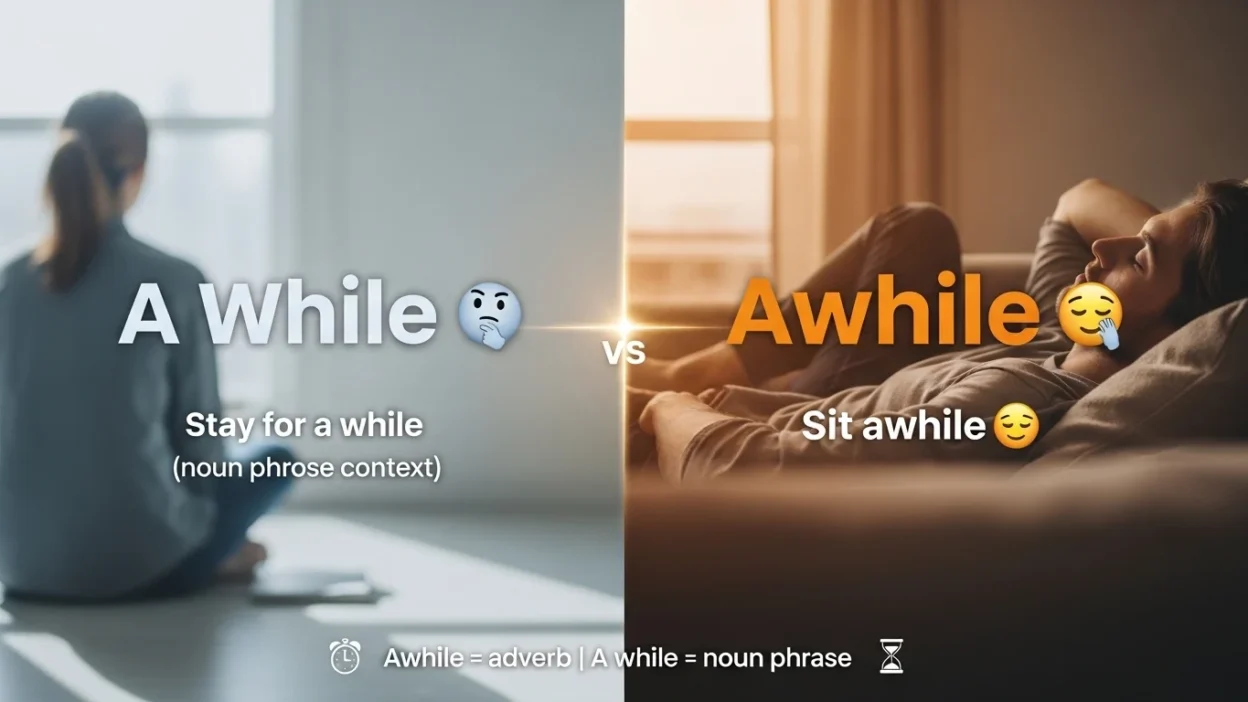
- Awhile = an adverb (means “for a short time”)
👉 Example: Sit awhile. - A while = a noun phrase (needs a preposition like for)
👉 Example: Sit for a while.
Quick trick:
If you can add “for” before it, use a while. If not, use awhile.
What Does “Awhile” Mean?
Awhile is an adverb, which means it modifies a verb. It describes how long an action happens usually a short or unspecified time.
Examples of “Awhile”
- Please stay awhile.
- Let’s rest awhile before continuing.
- She sat awhile and enjoyed the view.
In these sentences, “awhile” directly describes the verb (stay, rest, sat). You don’t need any extra words.
What Does “A While” Mean?
A while is a noun phrase. It refers to a period of time, so it often needs a preposition like for or after.
Examples of “A While”
- Please stay for a while.
- I haven’t seen him in a while.
- We talked for a while before leaving.
Here, “a while” acts like a thing (a period of time), which is why it needs a helper word like for or in.
The Key Difference Explained Simply
Think of it this way:
- Awhile = already includes “for a while”
- A while = needs “for” or another preposition
Side-by-Side Comparison
| Feature | Awhile | A While |
| Part of speech | Adverb | Noun phrase |
| Needs preposition? | ❌ No | ✅ Yes (for, in, after, etc.) |
| Meaning | For a short time | A period of time |
| Example | Sit awhile | Sit for a while |
Easy Trick to Remember
Here’s a simple test you can use anytime:
👉 Try adding “for” before the phrase.
- If it sounds correct → use a while
- If it sounds wrong → use awhile
Examples:
- Sit for awhile ❌ (wrong)
- Sit for a while ✅
- Sit awhile ✅
- Sit a while ❌ (incomplete without “for”)
This quick check works almost every time.
Common Mistakes to Avoid
Even experienced writers make these errors. Here are the most common ones:
1. Using “awhile” after a preposition
❌ I stayed for awhile
✅ I stayed for a while
👉 Remember: after “for,” always use a while.
2. Using “a while” without a preposition
❌ Sit a while
✅ Sit awhile
✅ Sit for a while
👉 Without “for,” use awhile.
3. Overthinking it
Many people avoid using “awhile” entirely. But it’s perfectly correct and widely used in everyday English.
Real-Life Examples in Sentences
Let’s look at more natural examples so you can see how both forms work in context.
Using “Awhile”
- Come in and relax awhile.
- He paused awhile before answering.
- Stay here awhile and wait for me.
Using “A While”
- I’ll be gone for a while.
- It’s been a while since we last spoke.
- She waited for a while, then left.
Awhile vs A While in Formal and Informal Writing
Both forms are correct in formal and informal English, but:
- Awhile feels slightly more natural in conversational tone
- A while is often clearer in formal writing due to structure
Example:
- Informal: Stay awhile and chat
- Formal: Please stay for a while and discuss the matter
American vs British English Differences
Good news there’s no major difference between American and British English for this pair.
- Both awhile and a while are used the same way in the US and UK
- The grammar rule stays consistent across both styles
However, British writing sometimes prefers slightly more formal phrasing, so you may see “for a while” used more often than “awhile” in formal contexts.
Synonyms and Related Phrases (LSI Keywords)
To improve your vocabulary and writing variety, here are some alternatives:
- For a short time
- Briefly
- Momentarily
- For some time
- Temporarily
- For a bit
Example:
- Stay awhile → Stay briefly
- Wait for a while → Wait for a bit
These synonyms can help you avoid repetition in writing.
When Should You Use Each One?
Here’s a quick decision guide:
Use awhile when:
- No preposition is needed
- You’re modifying a verb directly
- You want a smooth, conversational tone
Use a while when:
- You use “for,” “in,” or “after”
- You’re referring to a time period as a thing
- You want clarity in structured writing
FAQs
1. Is “awhile” one word or two?
“Awhile” is one word when used as an adverb. “A while” is two words when used as a noun phrase.
2. Can I say “for awhile”?
No, that’s incorrect. Always say “for a while.”
3. Is “awhile” outdated?
Not at all. It’s still commonly used in modern English, especially in casual writing and speech.
4. Which is more common: awhile or a while?
“A while” is more common because it fits more sentence structures, especially with prepositions.
5. Can I use both in the same sentence?
Yes!
Example: Sit awhile, then we’ll talk for a while.
6. Is “stay awhile” grammatically correct?
Yes, it’s completely correct and natural.
7. Why do people confuse these two?
Because they sound identical and have nearly the same meaning but different grammar roles.
8. Is it okay to avoid “awhile” altogether?
Yes, but you’ll miss out on a natural and concise expression.
Final Summary
Understanding awhile vs a while comes down to one key idea: grammar function. “Awhile” is an adverb that modifies a verb and doesn’t need extra words, while “a while” is a noun phrase that usually follows a preposition like “for” or “in.” Once you recognize this difference, the confusion disappears.
The easiest way to get it right every time is to use the **“for” test.” If your sentence needs “for,” go with “a while.” If it doesn’t, choose “awhile.” This simple trick will instantly improve your writing accuracy and confidence.
Actionable Takeaway
Next time you write or speak:
- Pause and check if a preposition is needed
- Use awhile for quick, direct actions
- Use a while when talking about a time period
Practice with a few sentences daily, and this rule will become second nature no more second-guessing.

Ethan William is the author behind SpellPeak, passionate about clear communication and meaningful language. He writes to help readers express ideas with confidence, simplicity, and impact. His work focuses on clarity, learning, and empowering individuals and businesses through thoughtful, practical content. He values creativity, consistency, and ethical digital publishing worldwide.