If you’ve ever paused while writing “laid off” vs “layed off,” you’re not alone. This small spelling choice can quietly affect how professional, polished, and credible your writing appears especially in job-related contexts where clarity matters most.
If you’re updating your resume, writing a LinkedIn post, or sending an email, using the correct form is essential. In this guide, we’ll break it down in simple terms, give clear examples, and help you avoid common mistakes with confidence.
Quick Answer:
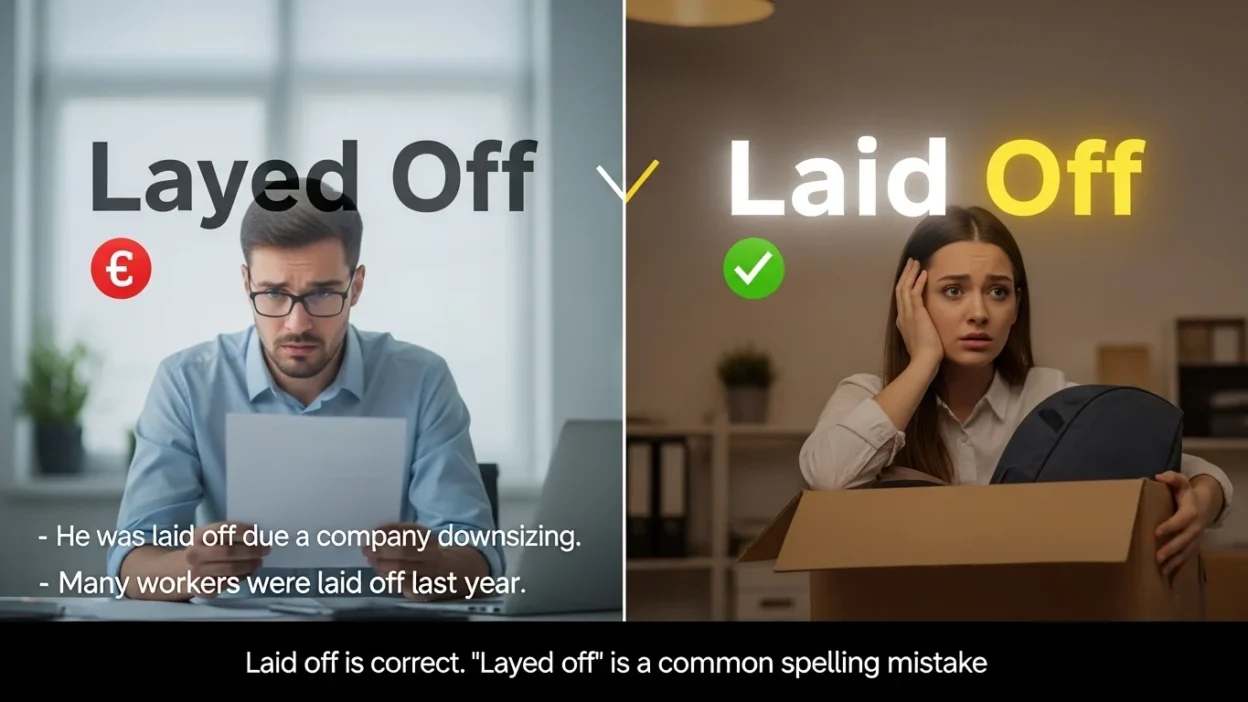
- ✅ “Laid off” is correct
- ❌ “Layed off” is incorrect and not a real word in standard English
Why?
“Lay” is an irregular verb, and its past tense is “laid,” not “layed.” So the correct phrase is always “laid off.”
Understanding the Meaning of “Laid Off”
The phrase “laid off” is commonly used in professional and workplace contexts. It means that an employee has been temporarily or permanently dismissed from their job, usually due to reasons beyond their control such as company downsizing, restructuring, or financial challenges.
Key points about “laid off”:
- It is the past tense of “lay off”
- It typically implies no fault of the employee
- It may be temporary or permanent
Examples:
- “She was laid off due to budget cuts.”
- “Many workers were laid off during the recession.”
- “I was recently laid off, so I’m exploring new opportunities.”
Why “Layed Off” Is Incorrect
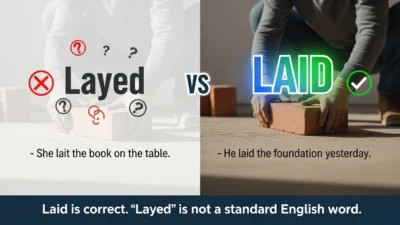
The confusion comes from the assumption that adding “-ed” makes a verb past tense. While that works for regular verbs (like worked or played), it does not apply to irregular verbs like “lay.”
There is no standard English word “layed.” The correct past tense of “lay” is always “laid.”
Incorrect examples:
- ❌ “He was layed off last month.”
- ❌ “They got layed off suddenly.”
These forms are considered grammatical errors and can weaken your writing, especially in formal contexts.
Verb Breakdown: Lay vs Lie
Part of the confusion also comes from mixing up “lay” and “lie.” Here’s a quick clarification:
- Lay (requires an object):
- Present: lay
- Past: laid
- Example: “She lays the book on the table.” → “She laid the book down.”
- Lie (does not require an object):
- Present: lie
- Past: lay
- Example: “He lies down to rest.” → “He lay down yesterday.”
👉 Notice how “lay” appears as a past tense of “lie,” which adds to the confusion!
Comparison Table: Laid Off vs Layed Off
| Phrase | Correct? | Meaning | Usage Example |
| Laid off | ✅ Yes | Past tense of “lay off” | “She was laid off last week.” |
| Layed off | ❌ No | Not a valid English form | ❌ “He was layed off.” |
Common Mistakes to Avoid
Even confident writers slip up with this one. Here are some frequent mistakes and how to fix them:
1. Adding “-ed” Automatically
- ❌ “Layed off”
- ✅ “Laid off”
Fix: Remember that “lay” is irregular.
2. Mixing Up Lay and Lie
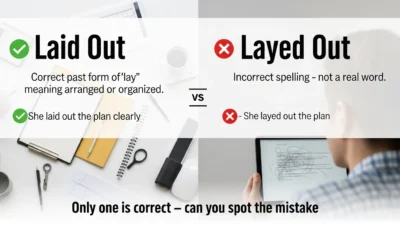
- ❌ “He layed the report on the desk.”
- ✅ “He laid the report on the desk.”
3. Using Incorrect Forms in Professional Writing
This mistake often appears in:
- Resumes
- Cover letters
- Job applications
Using “layed off” in these contexts can unintentionally signal a lack of attention to detail.
Real-Life Usage Scenarios
Let’s look at how “laid off” is used in everyday and professional communication:
In a Resume:
- “Position ended after being laid off due to company restructuring.”
In a Cover Letter:
- “After being laid off, I took time to upgrade my skills.”
On Social Media:
- “Recently laid off, but staying positive and open to new roles.”
In Conversation:
- “I heard they were laid off last quarter.”
American vs British English Usage
Good news there’s no difference between American and British English when it comes to this phrase.
- 🇺🇸 American English: laid off
- 🇬🇧 British English: laid off
Both follow the same grammatical rules, and “layed off” is incorrect in both variants.
Related Terms and Synonyms
To strengthen your vocabulary and writing, here are some related terms often used alongside “laid off”:
- Redundant (commonly used in British English)
- Dismissed
- Terminated
- Furloughed
- Let go
Each has slightly different connotations:
- Redundant → position no longer needed
- Furloughed → temporary leave
- Terminated → broader, sometimes more formal
Tips to Remember the Correct Form
Here are a few simple tricks to keep it straight:
- Think: “Lay → Laid → Laid off”
- There is no word “layed” in standard English
- If you’re unsure, replace it with another irregular verb:
- “Say → Said” (not “sayed”)
- Similarly: “Lay → Laid” (not “layed”)
FAQs
1. Is “layed off” ever correct?
No. “Layed off” is not a correct spelling in English.
2. Why do people use “layed off”?
It’s a common mistake due to applying regular verb rules to an irregular verb.
3. What is the past tense of “lay off”?
The correct past tense is “laid off.”
4. Can “laid off” mean something else?
Yes. Outside work contexts, “laid” can mean placing something down, but “laid off” specifically refers to job loss.
5. Is “laid off” formal or informal?
It’s neutral and widely accepted in both formal and informal communication.
6. What’s the difference between “laid off” and “fired”?
- Laid off → not the employee’s fault
- Fired → usually due to performance or behavior
7. Should I use “laid off” on my resume?
Yes, it’s the correct and professional term.
Summary:
Understanding the difference between “laid off” and “layed off” is simple once you know the rule: “laid off” is correct, and “layed off” is not a real word. This comes down to recognizing that “lay” is an irregular verb, and its past tense is “laid.”
Using the correct form is especially important in professional writing, where small mistakes can have a big impact. If you’re writing a resume, email, or post, sticking with “laid off” ensures clarity and credibility.
Actionable Takeaway
Next time you write about job loss or workplace changes, pause and double-check: “laid off” is the only correct choice. Build the habit by remembering other irregular verbs like “said” and “paid” they follow the same pattern.
If you’re unsure, read your sentence aloud or run a quick grammar check. With just a little awareness, you can avoid this common mistake and present yourself more confidently in every piece of writing.

Noah Jacob is the administrator of SpellPeak, responsible for managing website operations, content coordination, and platform performance. He ensures smooth functionality, security, and reliability while supporting the team in delivering a seamless, user-focused experience and maintaining high standards of quality across the site.