Many English learners and even native speakers confuse continually vs continuously because both words relate to something happening over time. At first glance, they seem interchangeable, but they actually carry different meanings. Using the wrong one can subtly change the message of your sentence.
If you’ve ever wondered whether someone is “continually talking” or “continuously talking,” you’re not alone. This guide will explain the difference in simple terms, provide real-world examples, highlight common mistakes, and help you use both words confidently in everyday writing and speech.
Quick Answer
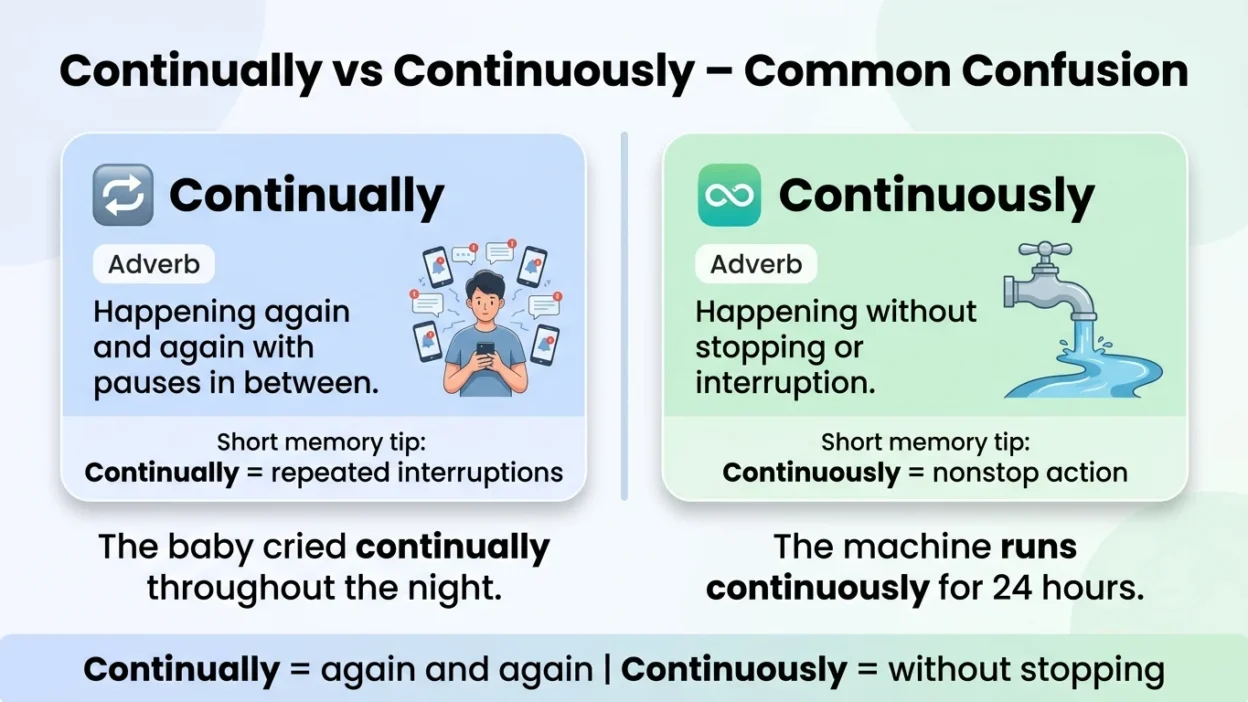
- Continually means something happens repeatedly with pauses or interruptions.
- Continuously means something happens without stopping or interruption.
Simple Example:
- The baby cried continually during the night.
(The crying stopped and started again.) - The machine ran continuously for 24 hours.
(It never stopped.)
Continually vs Continuously: Why People Get Confused
The confusion happens because both words come from the idea of “continuing.” They also look and sound very similar. However, the small difference between them matters in grammar, professional writing, and clear communication.
Think of it this way:
- Continually = again and again
- Continuously = nonstop
This distinction is especially important in academic writing, business communication, technical documents, and English exams.
What Does “Continually” Mean?
The word continually describes actions that happen repeatedly over a period of time but with breaks in between.
Definition
“Continually” means:
- frequently repeated
- occurring again and again
- recurring over time
The action is not constant. It stops and starts.
Examples of Continually
- She continually checked her phone during dinner.
- The teacher continually reminded students about the deadline.
- It rained continually throughout the week.
- He continually interrupted the meeting.
In all these examples, the actions happened many times but not nonstop every second.
Easy Memory Trick
If something happens regularly but not nonstop, use continually.
What Does “Continuously” Mean?
The word continuously describes something happening without interruption or pause.
Definition
“Continuously” means:
- constantly
- nonstop
- without breaks
- uninterrupted
Examples of Continuously
- The river flowed continuously.
- The fan operated continuously all day.
- She spoke continuously for two hours.
- The alarm rang continuously until someone turned it off.
These actions never stopped during the time mentioned.
Easy Memory Trick
If something happens in one uninterrupted flow, use continuously.
Continually vs Continuously Comparison Table
| Feature | Continually | Continuously |
| Meaning | Repeatedly with pauses | Without interruption |
| Type of Action | Recurring | Constant |
| Breaks Included? | Yes | No |
| Common Use | Human behavior, repeated events | Machines, processes, nonstop actions |
| Example | He continually complained. | The engine ran continuously. |
Key Difference Between Continually and Continuously
The main difference is interruption.
Continually
Something happens over and over again, but it pauses between occurrences.
Example:
- My neighbor continually plays loud music.
(The music stops sometimes.)
Continuously
Something happens without any break at all.
Example:
- The waterfall flows continuously.
(The water never stops flowing.)
This subtle distinction improves precision in writing and helps your message sound more natural and professional.
Real-Life Examples of Continually vs Continuously
Here are side-by-side examples to make the difference crystal clear.
Continually
- The child continually asked questions during the trip.
- Employees continually received updates from management.
- He continually forgot his keys.
Continuously
- The security camera records continuously.
- The internet connection stayed continuously active.
- The heart beats continuously throughout life.
Notice how “continually” suggests repetition, while “continuously” suggests nonstop action.
Common Mistakes People Make
Many writers accidentally swap these words because the meanings overlap slightly. Here are the most common errors.
Mistake 1: Using “Continuously” for Repeated Human Actions
Incorrect:
- She continuously called me yesterday.
Better:
- She continually called me yesterday.
Why? Because phone calls usually stop and restart.
Mistake 2: Using “Continually” for Nonstop Processes
Incorrect:
- The machine worked continually for 10 hours without stopping.
Better:
- The machine worked continuously for 10 hours without stopping.
Why? The machine never paused.
Mistake 3: Assuming They Always Mean the Same Thing
In casual conversation, many people use them interchangeably. However, in formal writing, grammar tests, or professional communication, choosing the correct word matters.
Continually vs Continuously in Business Writing
In workplace communication, these words can completely change meaning.
Example 1
- We are continually improving our services.
(Improvement happens repeatedly over time.)
Example 2
- The system operates continuously.
(The system never shuts down.)
Using the right word makes your writing clearer and more credible.
Continually vs Continuously in Academic English
Teachers and examiners often expect precise vocabulary. Knowing this difference helps in:
- essays
- research papers
- IELTS and TOEFL writing
- professional reports
Academic Example
- Climate conditions were monitored continuously during the experiment.
- Researchers continually updated the database throughout the study.
These examples show the importance of accuracy in formal English.
American vs British English Differences
There is no major difference between American and British English when it comes to continually vs continuously. Both varieties use the words in the same way.
However:
- American English may favor simpler wording in casual communication.
- British English sometimes uses “continually” more often in formal contexts.
The core meanings remain identical in both dialects.
Synonyms for Continually
Using synonyms can improve your writing variety and SEO relevance.
Common Synonyms
- repeatedly
- frequently
- regularly
- constantly (sometimes)
- over and over
Example
- He continually complained.
- He repeatedly complained.
Be careful with “constantly,” though. Depending on context, it can sometimes imply nonstop action.
Synonyms for Continuously
Common Synonyms
- nonstop
- constantly
- uninterruptedly
- persistently
- steadily
Example
- The lights stayed continuously on.
- The lights stayed nonstop on.
Grammar Tip: Can You Use Them Interchangeably?
Technically, sometimes yes — especially in casual speech. Most listeners will still understand your meaning.
But in precise English:
- Use continually for repeated actions.
- Use continuously for uninterrupted actions.
Professional writers, editors, and teachers usually prefer this distinction.
How to Remember the Difference Easily
Here’s a quick trick:
Continually
Think:
- “continue again and again”
Continuously
Think:
- “continuous line with no breaks”
Another helpful idea:
- Continually = repeated
- Continuously = constant
Examples in Everyday Conversation
Continually
- My dog continually barks at strangers.
- She continually changes her mind.
- They continually argue about money.
Continuously
- The air conditioner runs continuously in summer.
- The music played continuously all night.
- The clock ticks continuously.
Practicing with everyday examples helps the difference become natural.
FAQs
Is continually the same as continuously?
No. “Continually” means repeatedly with pauses, while “continuously” means without interruption.
Which is more formal: continually or continuously?
Neither is more formal. Both are standard English words used in formal and informal writing.
Can I use continuously for people?
Yes, but only when the action truly does not stop.
Example:
- He talked continuously for an hour.
What is the easiest way to remember the difference?
Remember:
- Continually = repeated action
- Continuously = nonstop action
Is “constantly” closer to continually or continuously?
It depends on context. “Constantly” can mean either repeated or nonstop action.
Do native speakers confuse these words?
Yes. Even native English speakers sometimes use them interchangeably in casual conversation.
Is the difference important in exams?
Yes. Grammar and English proficiency exams often test precise word usage.
Can both words be correct in some sentences?
Sometimes. Context determines which one sounds more accurate.
Final Thoughts :
Understanding the difference between continually vs continuously can instantly improve your English clarity. While the words are closely related, they are not identical. “Continually” refers to repeated actions with interruptions, while “continuously” describes actions that never stop.
Using the correct word helps your writing sound more polished, professional, and natural. Whether you are writing emails, essays, blog posts, or business documents, this small grammar distinction makes a big difference in communication quality.
Actionable Takeaway
Before choosing between these two words, ask yourself one simple question:
Did the action stop at any point?
- If yes, use it continually.
- If not, use it continuously.
Practice using both words in daily sentences, and soon the difference will feel automatic.

Mia Elizabeth is a contributing author at SpellPeak, passionate about thoughtful writing and clear communication. She creates engaging, well-researched content that helps readers learn and connect with ideas easily. Her work emphasizes clarity, creativity, and practical value, supporting meaningful digital experiences and accessible knowledge sharing worldwide.