
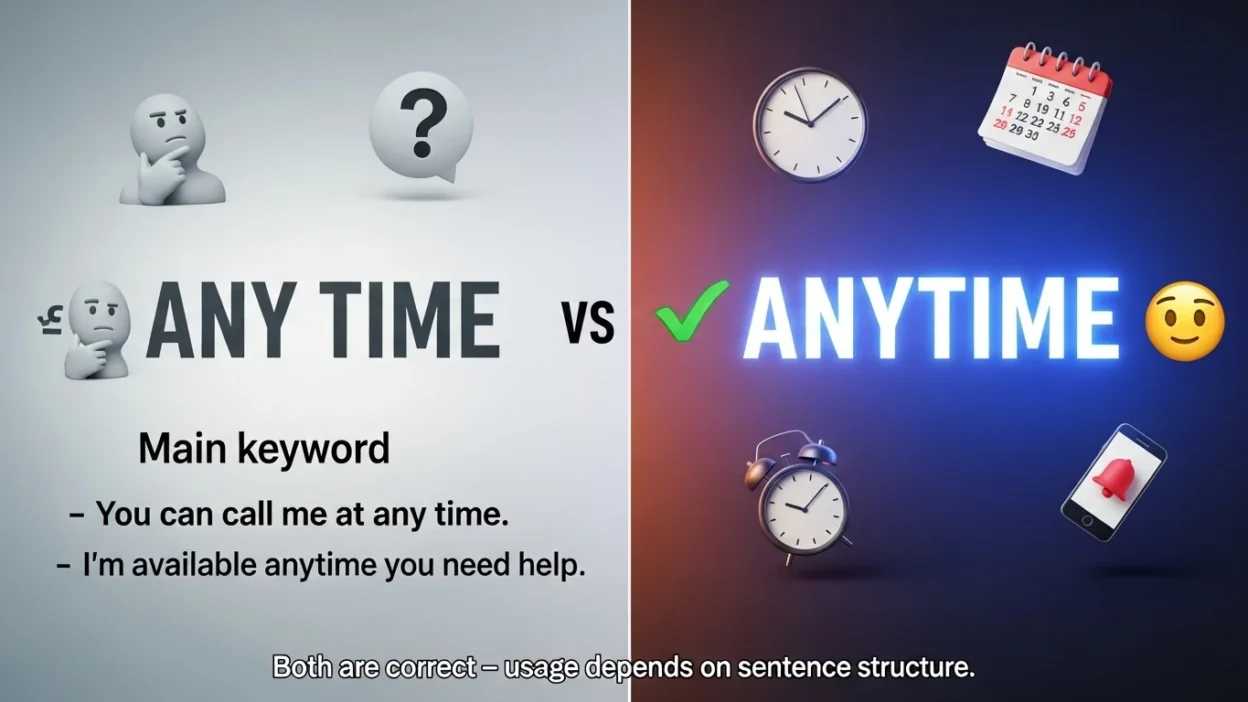
If you’ve ever paused mid-sentence wondering whether to write any time or anytime, you’re not alone. These two look nearly identical, but using the wrong one can subtly affect clarity and professionalism especially in emails, blog posts, or academic writing.
The good news? The difference is actually simple once you see it in action. In this guide, you’ll learn exactly when to use any time vs anytime, with clear rules, examples, and common mistakes to avoid.
Quick Answer
- Any time (two words) = a noun phrase meaning “at any point in time”
- Anytime (one word) = an adverb meaning “whenever” (mainly in American English)
👉 Quick tip:
If you can replace it with “at any time,” use any time (two words).
What Does “Any Time” Mean?
Any time (two words) is a noun phrase. It refers to an unspecified amount of time or moment.
Examples:
- You can call me any time.
- Do you have any time to talk today?
- I don’t have any time for distractions.
Easy Trick:
Try inserting “at” before it:
- You can call me at any time ✔️ (still makes sense)
If this works, you should use any time (two words).
What Does “Anytime” Mean?
Anytime (one word) is an adverb. It modifies verbs and means “whenever.”
Examples:
- You can visit anytime.
- Stop by anytime you’re free.
- I’m available anytime this week.
Here, anytime acts like whenever, not a noun.
Any Time vs Anytime: Key Differences
Here’s a quick comparison to lock it in:
| Feature | Any Time (Two Words) | Anytime (One Word) |
| Part of Speech | Noun phrase | Adverb |
| Meaning | At any point in time | Whenever |
| Can use “at” | Yes (at any time) | No |
| Formal Writing | Preferred | Less formal |
| Example | I don’t have any time | Call me anytime |
American vs British English Differences
This is where things get interesting.
- American English: Both any time and anytime are widely used
- British English: Anytime (one word) is less common; any time is preferred
👉 If you’re writing for an international audience, it’s safer to use any time (two words) in formal contexts.
Common Mistakes to Avoid
Even experienced writers mix these up. Here are the most common errors:
❌ Using “anytime” as a noun
- I don’t have anytime today. ❌
✔️ Correct: I don’t have any time today.
❌ Using “any time” as an adverb incorrectly
- Visit me any time you want. (Technically acceptable, but less natural in casual American English)
✔️ Better: Visit me anytime you want.
❌ Forgetting the “at” test
If you’re unsure, test it:
- Call me at any time ✔️ → use any time
- Call me at anytime ❌ → incorrect
More Real-Life Examples
Seeing both in context makes the difference clearer.
With “Any Time”
- Do you have any time to review this document?
- I haven’t had any time to rest all week.
- She can meet you at any time tomorrow.
With “Anytime”
- You can text me anytime.
- Come over anytime you feel like it.
- I’m free anytime after lunch.
When to Use Each (Simple Rule)
If you want a quick, no-thinking rule:
- Use any time when talking about time as a thing (noun)
- Use anytime when describing when something happens (adverb)
👉 Or even simpler:
- Formal writing → any time
- Casual writing → anytime (mostly okay in American English)
Synonyms and Related Phrases (LSI Keywords)
Using variations can improve both clarity and SEO:
- At any moment
- Whenever
- At your convenience
- At any point
- Whenever you like
- At any given time
These can often replace anytime in sentences:
- Call me whenever (instead of anytime)
- Visit at any moment
FAQs
1. Is “anytime” one word or two?
Both are correct, but they have different uses. Any time is a noun phrase, while anytime is an adverb.
2. Can I always use “anytime” instead of “any time”?
No. You can’t use anytime when referring to time as a noun. For example:
❌ I don’t have anytime → ✔️ I don’t have any time
3. Which is more formal: any time or anytime?
Any time (two words) is more formal and preferred in professional or academic writing.
4. Is “anytime” correct in British English?
It’s less common. British English usually prefers any time (two words).
5. Can I start a sentence with “anytime”?
Yes:
- Anytime you need help, just ask.
6. What’s the easiest way to remember the difference?
Use the “at any time” test. If it works, use any time.
7. Is “anytime soon” correct?
Yes, especially in American English:
- I won’t be traveling anytime soon.
8. Can both forms be used in the same sentence?
Rarely, but possible:
- You can come anytime if you have any time available.
Final Summary
The difference between any time vs anytime comes down to grammar and usage. Any time (two words) is a noun phrase used when referring to time itself, while anytime (one word) is an adverb that means “whenever.” A simple trick adding “at” before the phrase can instantly tell you which one is correct.
While American English accepts both forms, British English leans toward any time, especially in formal writing. If you want to stay safe and professional, especially in emails, blogs, or academic work, any time is your best bet.
Actionable Takeaway
Next time you’re unsure, pause and apply this quick test:
👉 Can you say “at any time”? If yes, use any time.
👉 If you mean “whenever,” go with anytime (especially in casual American English).
Practice this a few times, and it’ll become second nature no more second-guessing your writing.

Mia Elizabeth is a contributing author at SpellPeak, passionate about thoughtful writing and clear communication. She creates engaging, well-researched content that helps readers learn and connect with ideas easily. Her work emphasizes clarity, creativity, and practical value, supporting meaningful digital experiences and accessible knowledge sharing worldwide.