It’s easy to mix up inpatient vs impatient they sound almost identical, yet their meanings couldn’t be more different. One belongs to the world of healthcare, while the other describes a common human emotion we all experience.
If you’ve ever hesitated while writing these words or second-guessed your spelling, you’re not alone. This guide will help you clearly understand the difference, avoid common mistakes, and use both words confidently in everyday writing.
Quick Answer:
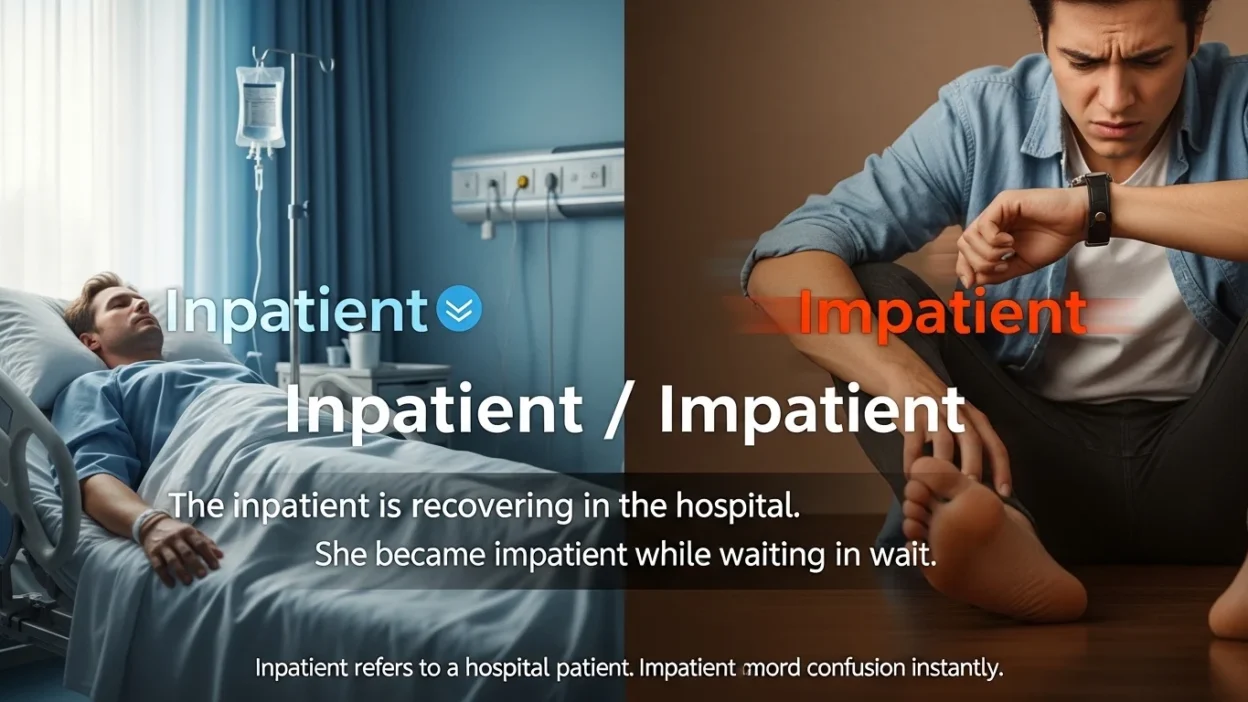
- Inpatient: A person who stays in a hospital for treatment.
- Impatient: Feeling restless or unable to wait calmly.
👉 Simple trick:
- Inpatient → think “in” the hospital
- Impatient → think “no patience”
What Does “Inpatient” Mean?
The word inpatient is a noun used in medical contexts. It refers to someone who is admitted to a hospital or healthcare facility and stays overnight (or longer) for treatment.
Examples of “Inpatient” in Sentences:
- She was admitted as an inpatient after the surgery.
- The hospital has separate wards for inpatients and outpatients.
- His condition required inpatient care for close monitoring.
Related Terms:
- Inpatient care
- Inpatient treatment
- Hospital admission
These phrases are commonly used in healthcare systems, insurance, and medical discussions.
What Does “Impatient” Mean?
Impatient is an adjective that describes a feeling of irritation or frustration when something takes too long.
Examples of “Impatient” in Sentences:
- He became impatient while waiting in line.
- She’s too impatient to sit through long meetings.
- The children grew impatient as the show was delayed.
Synonyms for “Impatient”:
- Restless
- Irritable
- Eager
- Agitated
This word is widely used in daily conversation and writing.
Key Differences Between Inpatient and Impatient
Here’s a simple comparison to make things crystal clear:
| Feature | Inpatient | Impatient |
| Part of Speech | Noun | Adjective |
| Meaning | A hospital patient staying overnight | Lack of patience |
| Context | Medical/healthcare | Emotions/behavior |
| Example | He is an inpatient in the ward | She is impatient with delays |
| Memory Tip | “In” the hospital | “No” patience |
Common Mistakes and How to Avoid Them
Because these words sound alike, they are often confused in writing. Here are the most common errors:
1. Using “Impatient” Instead of “Inpatient”
❌ The doctor treated him as an impatient.
✅ The doctor treated him as an inpatient.
👉 Fix: If you’re talking about a hospital, use inpatient.
2. Using “Inpatient” for Emotions
❌ She felt inpatient during the delay.
✅ She felt impatient during the delay.
👉 Fix: If it’s about feelings or behavior, use impatient.
3. Spelling Confusion
The extra “m” in impatient changes the meaning completely. Always double-check spelling when writing quickly.
Easy Memory Tricks
If you struggle to remember the difference, these simple tricks can help:
- Inpatient = “IN” the hospital
- Impatient = “I’M not patient”
- Associate inpatient with doctors and hospitals
- Associate impatient with emotions and waiting
Real-Life Usage Examples
Seeing both words in context makes the distinction clearer:
- The inpatient required constant medical supervision, but he became impatient with the slow recovery process.
- As an inpatient, she had to stay overnight, even though she felt impatient to return home.
Notice how both words can appear in the same sentence but mean entirely different things.
American vs British English Differences
Good news there’s no major difference between American and British English for these words.
- Inpatient and impatient are spelled and used the same way in both forms of English.
- However, in British English, you might occasionally see “in-patient” with a hyphen, especially in older or formal texts.
Example:
- American English: inpatient
- British English: inpatient / in-patient
Both are correct, but the unhyphenated form is now more common globally.
Why This Confusion Happens
The confusion between inpatient vs impatient comes from:
- Similar pronunciation
- Nearly identical spelling
- Fast typing or autocorrect errors
This type of confusion is called a homophone-related mistake, where words sound alike but have different meanings.
When to Use Inpatient vs Impatient
Use inpatient when:
- Talking about hospitals or medical care
- Referring to admitted patients
- Writing about healthcare systems
Use impatient when:
- Describing emotions
- Talking about waiting or delays
- Expressing frustration or eagerness
FAQs
1. Is “inpatient” one word or two?
“Inpatient” is usually written as one word, though “in-patient” may appear in British English.
2. Can “impatient” be used as a noun?
No, impatient is an adjective. It describes a feeling, not a person or thing.
3. What is the opposite of “impatient”?
The opposite is patient, meaning calm and able to wait.
4. What is the opposite of “inpatient”?
The opposite is outpatient, a patient who does not stay overnight in a hospital.
5. Are “inpatient” and “patient” related?
Yes, inpatient comes from “patient” (a person receiving medical care), while impatient comes from “patience” (a quality of waiting calmly).
6. Why do people confuse these words?
They sound almost identical and differ by only one letter, making them easy to mix up.
7. Is “impatient” always negative?
Not always. It can sometimes show eagerness or excitement, depending on context.
Summary:
Understanding the difference between inpatient vs impatient is simpler than it first appears. Inpatient belongs to the medical world and refers to someone staying in a hospital for treatment. Impatient, on the other hand, describes a feeling of restlessness or frustration when waiting.
These words may look and sound similar, but their meanings are entirely unrelated. Once you connect inpatient with hospitals and impatient with emotions, the confusion disappears quickly.
Actionable Takeaway
Next time you write, pause for a second and ask:
- Am I talking about a hospital stay? → Use inpatient
- Am I describing a feeling or behavior? → Use impatient
A quick mental check can save you from a common writing mistake and make your communication clearer and more professional.

Matthew Benjamin is a contributing author at SpellPeak, dedicated to clear, engaging, and purposeful writing. He focuses on creating informative content that helps readers understand complex ideas with ease. His work emphasizes accuracy, creativity, and practical value, supporting better communication and thoughtful digital learning for a global audience.