If you’ve ever paused mid-sentence wondering whether to write farther or further, you’re not alone. These two words look similar, sound alike, and are often used interchangeably but there is a difference, and knowing it can instantly sharpen your writing.
The good news? The distinction is simple once you see it clearly. In this guide, you’ll learn exactly when to use farther vs further, with easy examples, common mistakes to avoid, and practical tips you can apply right away.
Quick Answer:
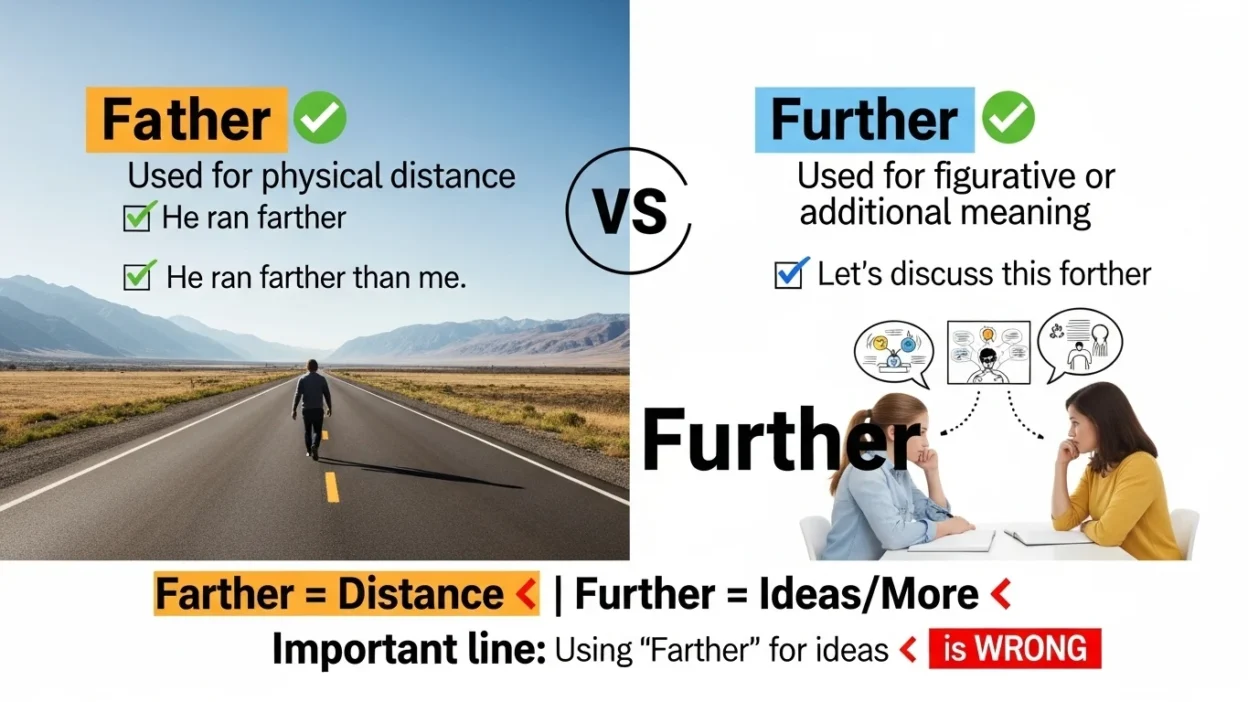
- Farther = physical distance (measurable space)
- Further = figurative distance (ideas, degree, or time)
Example:
- “He ran farther than I did.” (actual distance)
- “Let’s discuss this further.” (abstract idea)
What Does “Farther” Mean?
Farther refers to physical distance something you can measure in miles, meters, or steps.
Examples:
- “She walked farther down the road.”
- “The store is farther than I thought.”
- “Can you throw the ball any farther?”
Think of farther as relating to something you could physically point to or measure on a map.
Quick Tip:
If you can replace it with “more miles” or “greater distance,” farther is the right choice.
What Does “Further” Mean?
Further is used for non-physical distance. It often relates to ideas, progress, time, or degree.
Examples:
- “We need to discuss this further.”
- “He continued his education to further his career.”
- “Nothing could be further from the truth.”
Here, the “distance” isn’t physical it’s abstract.
Bonus Use:
Further can also be a verb, meaning “to advance or promote”:
- “She worked hard to further her goals.”
Farther vs Further: Key Differences at a Glance
| Feature | Farther | Further |
| Meaning | Physical distance | Figurative distance |
| Usage | Measurable space | Ideas, time, degree |
| Part of Speech | Adverb, adjective | Adverb, adjective, verb |
| Example | “Drive farther down the road.” | “Let’s talk further.” |
| Memory Trick | “Far” = distance | “Further” = beyond/extra |
Simple Memory Trick
A quick way to remember the difference:
- Farther → Far → Physical distance
- Further → Figurative or “furthermore” (ideas)
If it’s about actual space, go with farther.
If it’s about everything else, choose further.
Common Mistakes to Avoid
Even native speakers mix these up, so don’t worry—but here are mistakes to watch for:
1. Using “farther” for abstract ideas
❌ “We need to think farther about this.”
✔ “We need to think further about this.”
2. Using “further” for physical distance (in formal writing)
❌ “He ran further than me.”
✔ “He ran farther than me.”
(Note: In casual conversation, “further” is often used for both—but formal writing prefers the distinction.)
3. Forgetting “further” as a verb
❌ “He wants to farther his career.”
✔ “He wants to further his career.”
Farther vs Further in American vs British English
There’s a slight difference in how these words are used across regions:
- American English: The distinction between farther (physical) and further (figurative) is more strictly followed.
- British English: Further is often used for both meanings, especially in everyday usage.
Example:
- British usage: “He walked further down the street.” (acceptable)
- American usage: “He walked farther down the street.” (preferred)
If you’re writing for a global audience, sticking to the traditional distinction is the safest choice.
Real-Life Examples for Better Understanding
Physical Distance (Farther)
- “The hotel is farther from the airport than we expected.”
- “She swam farther than anyone else in the competition.”
- “Move a little farther away from the edge.”
Figurative or Abstract (Further)
- “Let’s explore this idea further.”
- “Further research is needed.”
- “He refused to go further into the argument.”
Mixed Context Awareness
Sometimes sentences can feel tricky:
- “The investigation went further than expected.”
Here, further works because it refers to progress, not physical distance.
When It’s Okay to Use “Further” for Everything
In informal contexts—especially speech—many people use further for both meanings.
For example:
- “He ran further than me.”
This isn’t considered wrong in casual English, but for:
- academic writing
- professional communication
- SEO content
…it’s better to maintain the distinction.
Related Words and Synonyms (LSI Keywords)
- Distance vs degree
- Physical vs abstract meaning
- Extend, advance, promote
- Additional, extra, beyond
- Longer distance, deeper discussion
These variations help reinforce your understanding and make your writing more natural.
FAQs
1. Can “further” replace “farther”?
Yes, especially in informal usage. However, in formal writing, it’s better to use farther for physical distance.
2. Is “farther” becoming outdated?
Not exactly, but “further” is more commonly used overall, especially in British English and casual speech.
3. Which is correct: “farther away” or “further away”?
Both can be correct:
- Farther away = physical distance
- Further away = figurative or emotional distance
4. Can “further” be used as a verb?
Yes. Example: “She wants to further her education.”
5. Why do people confuse farther and further?
Because they sound similar and overlap in meaning. Over time, everyday usage has blurred the distinction.
6. Is one more formal than the other?
No, but using them correctly shows stronger writing precision, especially in formal contexts.
7. How can I remember the difference quickly?
Think:
- Farther = Far (distance)
- Further = Figurative (ideas, progress)
8. Which one should I use in exams or professional writing?
Follow the rule:
- Physical distance → farther
- Abstract meaning → further
Final Summary
Understanding farther vs further doesn’t have to be complicated. The core idea is simple: farther is for physical distance, while further is for everything abstract ideas, progress, or time. Once you start noticing this pattern, it becomes second nature.
While everyday speech often blurs the line, using these words correctly can make your writing clearer, more polished, and more professional. If you’re writing an essay, blog post, or email, this small distinction can have a big impact.
Actionable Takeaway
Next time you write, pause and ask yourself:
“Is this about measurable distance or not?”
- If yes → use farther
- If no → use further
Practice with a few sentences daily, and you’ll master this quickly without overthinking it.

Ethan William is the author behind SpellPeak, passionate about clear communication and meaningful language. He writes to help readers express ideas with confidence, simplicity, and impact. His work focuses on clarity, learning, and empowering individuals and businesses through thoughtful, practical content. He values creativity, consistency, and ethical digital publishing worldwide.