Have you ever wondered whether disorganized and unorganized mean the same thing? You’re not alone. These two words are often used interchangeably, but they carry slightly different meanings that can change how your message is understood.
If you’re writing professionally, studying English, or just trying to sound more precise, knowing the difference between disorganized vs unorganized can instantly improve your clarity. Let’s break it down in a simple, human way.
Quick Answer
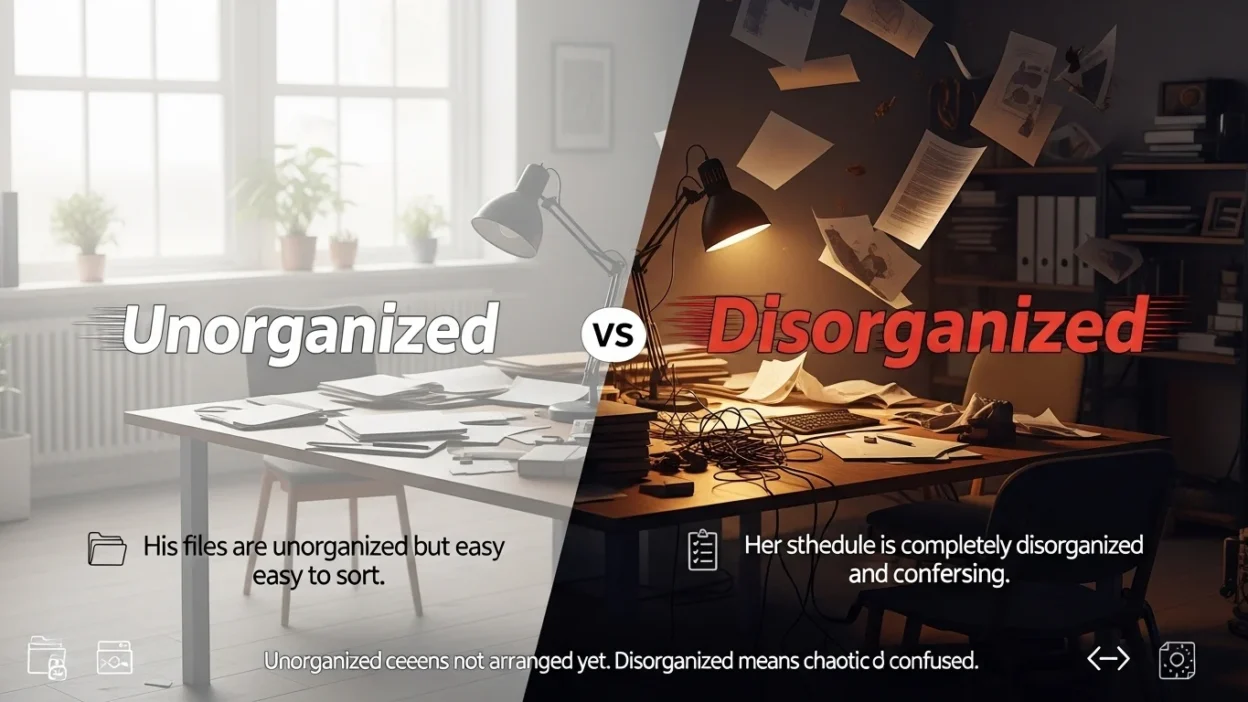
- Disorganized = messy, chaotic, lacking order
- Unorganized = not yet arranged, planned, or structured
👉 In short:
Disorganized = badly organized
Unorganized = not organized (yet)
What Does “Disorganized” Mean?
The word disorganized describes something that was supposed to be organized but isn’t. It often carries a negative tone.
Key idea:
Things are messy, chaotic, or poorly structured.
Examples:
- Her desk is completely disorganized with papers everywhere.
- The meeting felt disorganized and confusing.
- He gave a disorganized presentation with no clear points.
When to use it:
Use disorganized when:
- There should be order, but there isn’t
- Something feels chaotic or inefficient
- You want to highlight a problem or lack of structure
Synonyms:
- Messy
- Chaotic
- Cluttered
- Confused
- Unsystematic
What Does “Unorganized” Mean?
The word unorganized is more neutral. It simply means something hasn’t been arranged or structured yet.
Key idea:
There is no organization but not necessarily a problem.
Examples:
- The files are still unorganized because we just moved offices.
- The event is currently unorganized, but planning starts tomorrow.
- The data remains unorganized in its raw form.
When to use it:
Use unorganized when:
- Something is still in progress
- There’s no expectation of order yet
- You want a neutral or softer tone
Synonyms:
- Unsorted
- Unarranged
- Raw
- Unstructured (neutral sense)
Disorganized vs Unorganized: Side-by-Side Comparison
| Feature | Disorganized | Unorganized |
| Meaning | Lacking order, messy | Not yet arranged or structured |
| Tone | Negative | Neutral |
| Implies expectation | Yes (should be organized) | No (not expected yet) |
| Usage context | Problems, confusion | Early stages, unfinished tasks |
| Example | A disorganized office | Unorganized data |
Key Differences Explained Simply
The difference between disorganized vs unorganized comes down to expectation and tone.
- If something should be organized but isn’t, it’s disorganized
- If something just hasn’t been organized yet, it’s unorganized
Think of it like this:
- A messy room after cleaning attempts = disorganized
- A room you haven’t cleaned yet = unorganized
Common Mistakes to Avoid
Even fluent English speakers mix these up. Here are some common mistakes:
❌ Using “unorganized” when you mean messy
- Incorrect: My room is very unorganized.
- Correct: My room is very disorganized.
👉 Why? Because the room should be organized.
❌ Using “disorganized” for something unfinished
- Incorrect: The files are disorganized because we haven’t sorted them yet.
- Better: The files are unorganized.
👉 Why? There’s no expectation yet they’re just not sorted.
❌ Assuming both words are always interchangeable
They can overlap sometimes, but tone matters:
- Disorganized sounds critical
- Unorganized sounds neutral or temporary
Real-Life Usage Scenarios
In the Workplace
- A disorganized manager struggles to run meetings
- An unorganized project hasn’t started planning yet
In Writing & Communication
- A disorganized essay lacks structure
- An unorganized draft is still in progress
In Daily Life
- A disorganized kitchen is messy
- An unorganized closet hasn’t been arranged yet
American vs British English
Good news: there’s no major difference between American and British English for these words.
- Both disorganized and unorganized are used in the same way
- British English may sometimes prefer alternatives like “untidy” (for disorganized) or “not arranged” (for unorganized), but the meanings stay consistent
Related Words and LSI Keywords
To strengthen your understanding (and writing), here are related terms:
- Disorganized → messy, chaotic, cluttered, inefficient
- Unorganized → unsorted, unplanned, raw, undeveloped
- Organization → structure, system, order, arrangement
- Productivity → efficiency, time management, planning
FAQs
1. Are disorganized and unorganized the same?
No. Disorganized means messy or chaotic, while unorganized means not yet arranged.
2. Which word is more negative?
Disorganized is more negative because it suggests a problem.
3. Can I use “unorganized” for a messy room?
Not usually. A messy room is better described as disorganized.
4. Is “unorganized” incorrect English?
No, it’s correct. It’s just less commonly used than disorganized in everyday speech.
5. Which word should I use in professional writing?
Use:
- Disorganized for criticism or analysis
- Unorganized for neutral or early-stage situations
6. Why do people confuse these words?
Because both relate to “lack of organization,” but the difference lies in intent and timing.
7. Is one word more common than the other?
Yes, disorganized is more commonly used, especially in daily conversation.
Final Summary
Understanding disorganized vs unorganized comes down to one simple idea: expectation. If something is messy when it should be structured, it’s disorganized. If something simply hasn’t been arranged yet, it’s unorganized. This small distinction can make your communication clearer and more precise.
In everyday use, disorganized is far more common and carries a stronger, often negative tone. Unorganized, on the other hand, is softer and more neutral, making it ideal for situations that are still developing or unfinished.
Actionable Takeaway
Next time you’re unsure which word to use, ask yourself:
- “Was this supposed to be organized?” → Use disorganized
- “Is this just not organized yet?” → Use unorganized
Practicing this simple rule will instantly improve your writing, speaking, and confidence in English.

Mia Elizabeth is a contributing author at SpellPeak, passionate about thoughtful writing and clear communication. She creates engaging, well-researched content that helps readers learn and connect with ideas easily. Her work emphasizes clarity, creativity, and practical value, supporting meaningful digital experiences and accessible knowledge sharing worldwide.