If you’ve ever paused mid-conversation wondering whether to say “me either” or “me neither,” you’re not alone. These two phrases are often mixed up, even by fluent English speakers. The confusion usually comes from how we respond to negative and positive statements in everyday speech.
The good news? Once you understand one simple rule, you’ll never hesitate again. This guide breaks it down clearly, with examples, common mistakes, and easy tips you can start using right away.
Quick Answer
- Use “me neither” to agree with a negative statement
- Use “me either” in informal speech, but it’s technically less correct
- In formal English, “me neither” is preferred and grammatically accurate
Example:
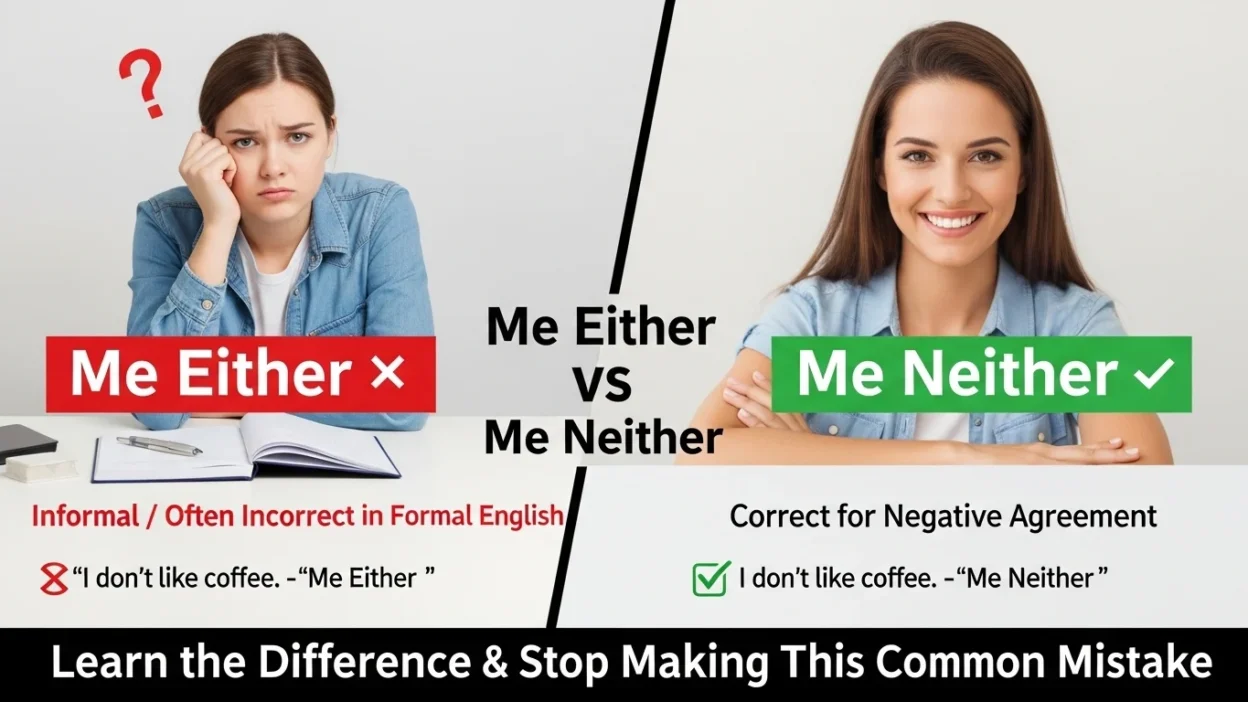
- “I don’t like coffee.” → “Me neither.” ✅
- “I don’t like coffee.” → “Me either.” ⚠️ (informal, but widely used)
What Do “Me Either” and “Me Neither” Mean?
Both phrases are used to show agreement, especially when someone says something about themselves and you feel the same way.
- “Me neither” means “I also do not…”
- “Me either” is often used to mean the same thing, but it’s less formally correct
They act as short responses instead of repeating the full sentence.
Example:
- “I don’t understand this lesson.”
- Full response: “I don’t understand it either.”
- Short response: “Me neither.”
The Key Rule (Easy to Remember)
Here’s the simplest way to get it right:
👉 If the sentence is negative, use “me neither.”
That’s it.
Examples:
- “I can’t swim.” → “Me neither.”
- “I don’t eat spicy food.” → “Me neither.”
- “I haven’t seen that movie.” → “Me neither.”
Why “Me Either” Still Exists
You’ll hear “me either” a lot in casual conversation, especially in American English. It’s not technically standard grammar, but it has become common in spoken language.
Think of it as a shortcut or informal variation of:
- “I don’t either.”
So while it’s widely understood, it’s better to stick with “me neither” in writing or formal situations.
Examples in Real Conversations
Here are some natural examples to help you see how these phrases work in context:
Negative Statements → Use “Me Neither”
- “I don’t like waking up early.”
→ “Me neither.” - “I can’t solve this problem.”
→ “Me neither.” - “I’m not feeling well today.”
→ “Me neither.”
Positive Statements → Don’t Use Either Phrase
- “I like pizza.”
→ ❌ Me neither
→ ❌ Me either
→ ✅ “Me too.”
That’s an important distinction many learners miss.
Common Mistakes to Avoid
Even though these phrases seem simple, people often misuse them. Here are the most common errors:
1. Using “Me Either” in Formal Writing
- ❌ “I don’t agree. Me either.”
- ✅ “I don’t agree. Me neither.”
Tip: Stick to “me neither” in essays, emails, or professional contexts.
2. Using Them with Positive Sentences
- ❌ “I love music.” → “Me neither.”
- ✅ “I love music.” → “Me too.”
3. Mixing Sentence Structures
- ❌ “I don’t like it, and me too.”
- ✅ “I don’t like it, and me neither.”
4. Overusing Informal Speech
While “me either” is common in casual talk, relying on it too much can make your English sound less polished.
Comparison Table: Me Either vs Me Neither
| Feature | Me Neither ✅ | Me Either ⚠️ |
| Grammar correctness | Standard and correct | Informal / nonstandard |
| Usage | Negative agreement | Casual negative agreement |
| Formal writing | Recommended | Not recommended |
| Spoken English | Common | Very common (especially US) |
| Example | “I don’t go out.” → Me neither | “I don’t go out.” → Me either |
American vs British English Differences
Both American and British English understand “me either” and “me neither,” but there’s a slight preference difference:
- American English:
- “Me either” is more commonly heard in casual speech
- British English:
- “Me neither” is strongly preferred, even in conversation
In both varieties, “me neither” remains the grammatically correct option, especially in writing.
Better Alternatives You Can Use
If you want to sound more natural or formal, try these alternatives:
- “Neither do I.”
- “I don’t either.”
- “Nor do I.” (more formal)
Example:
- “I don’t like cold weather.”
→ “Neither do I.”
These are especially useful in professional or academic settings.
When to Use “Neither Do I” Instead
Sometimes, “me neither” isn’t the best fit especially in formal writing.
Use “neither do I” when you want a complete and grammatically strong sentence.
Example:
- “I don’t enjoy long meetings.”
→ “Neither do I.” (more formal and polished)
FAQs
1. Is “me either” grammatically correct?
Not strictly. It’s widely used in informal speech, but “me neither” is the correct standard form.
2. Can I use “me either” in writing?
It’s best to avoid it in formal writing. Use “me neither” or “neither do I” instead.
3. What do I say for positive agreement?
Use “me too.”
Example: “I love coffee.” → “Me too.”
4. Is “me neither” formal or informal?
It’s acceptable in both casual and semi-formal contexts, but “neither do I” is more formal.
5. Why do people say “me either”?
It comes from shortening “I don’t either.” Over time, it became common in spoken English.
6. Can I use both phrases interchangeably?
In casual speech, yes but for correctness and clarity, prefer “me neither.”
7. What’s the safest option to use?
Always go with “me neither.” It works in almost every situation.
8. Is there a difference in meaning?
No major difference in meaning only in correctness and formality.
Summary
Understanding the difference between “me either” and “me neither” comes down to one simple idea: negative agreement needs “neither.” While “me either” is common in casual conversation, it’s not considered standard grammar, especially in formal writing.
If you want to sound clear, confident, and correct, stick with “me neither” or upgrade to “neither do I” in more formal contexts. These small choices can make your English feel much more polished and natural.
Actionable Takeaway
Next time someone says a negative sentence like “I don’t like this,” pause for a second and respond with “me neither.” Practice it in daily conversations until it feels automatic. If you’re writing professionally, switch to “neither do I” for an even stronger impression.
Keep it simple:
👉 Negative sentence = Me neither
👉 Positive sentence = Me too
Master this rule once, and you’ll never second-guess yourself again.

Matthew Benjamin is a contributing author at SpellPeak, dedicated to clear, engaging, and purposeful writing. He focuses on creating informative content that helps readers understand complex ideas with ease. His work emphasizes accuracy, creativity, and practical value, supporting better communication and thoughtful digital learning for a global audience.