If you’ve ever paused mid-sentence wondering whether to write segway or segue, you’re not alone. These two words sound identical, but they couldn’t be more different in meaning and usage. This confusion is incredibly common in both casual writing and professional content.
In this guide, you’ll learn exactly what segway vs segue means, when to use each, and how to avoid embarrassing mistakes. By the end, you’ll feel confident using the right word every time whether you’re writing an essay, blog post, or social media caption.
Quick Answer
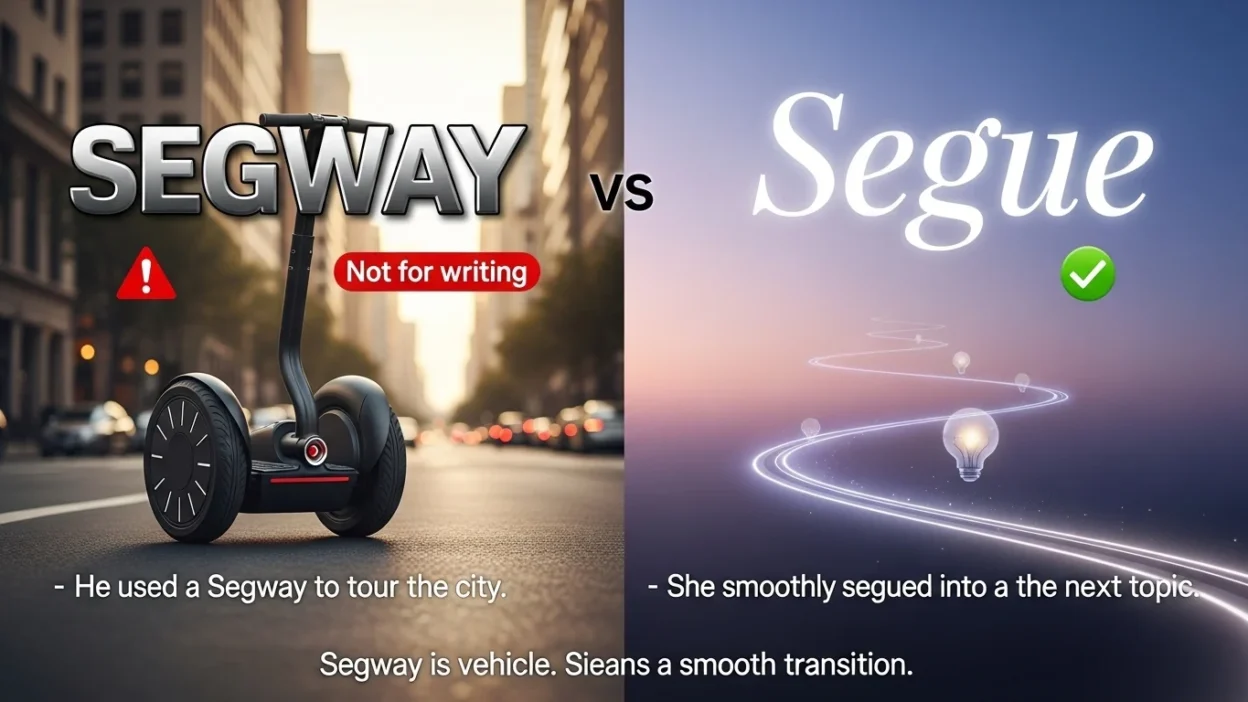
- Segue (verb/noun): A smooth transition from one topic or idea to another
- Segway (noun): A brand name for a two-wheeled self-balancing personal vehicle
👉 Use “segue” when talking about transitions in writing or speech.
👉 Use “Segway” only when referring to the vehicle.
What Does “Segue” Mean?
The word segue comes from Italian, meaning “it follows.” In English, it refers to a smooth and natural transition from one idea, topic, or section to another.
How “Segue” Is Used
- As a verb: “to move smoothly from one topic to another”
- As a noun: “a transition”
Examples of “Segue” in Sentences
- “Let me segue into the next topic about digital marketing.”
- “That joke was a perfect segue into the main presentation.”
- “She smoothly segued from her introduction into the core argument.”
Common Contexts for “Segue”
- Writing and blogging
- Public speaking
- Presentations
- Conversations
LSI keywords: transition words, smooth transition, shift in topic, connect ideas, flow in writing
What Does “Segway” Mean?
Segway is a trademarked brand name. It refers to a two-wheeled, self-balancing electric vehicle often used for short-distance travel or guided city tours.
Examples of “Segway” in Sentences
- “We explored the city on a Segway tour.”
- “He bought a Segway for commuting around campus.”
- “Tourists were riding Segways along the waterfront.”
Important Note
Using “segway” instead of “segue” in writing is considered a spelling mistake, not an alternative form.
Segway vs Segue: Side-by-Side Comparison
| Feature | Segue | Segway |
| Meaning | Transition between ideas | Personal transport vehicle |
| Part of Speech | Verb / Noun | Proper noun (brand name) |
| Usage Context | Writing, speaking, storytelling | Travel, transportation |
| Origin | Italian | Brand name |
| Pronunciation | /ˈseɡ.weɪ/ | /ˈseɡ.weɪ/ (same as segue) |
| Common Mistake | Misspelled as “segway” | Misused in place of “segue” |
Why Do People Confuse “Segway” and “Segue”?
The confusion comes down to one simple reason: they sound exactly the same.
Here’s why it happens:
- English has many homophones (words that sound alike but differ in meaning)
- “Segue” has an unusual spelling
- “Segway” looks more intuitive and phonetic
Because of this, many writers mistakenly type “segway” when they actually mean a transition.
Common Mistakes to Avoid
Let’s clear up some of the most frequent errors people make:
❌ Incorrect Usage
- “This paragraph will segway into the conclusion.”
- “Let me segway to another topic.”
✅ Correct Usage
- “This paragraph will segue into the conclusion.”
- “Let me segue to another topic.”
Pro Tip
If you’re talking about ideas, topics, or flow, always choose segue.
Easy Trick to Remember the Difference
Here’s a simple memory hack:
- Segue = Sequence (both relate to flow and order)
- Segway = Scooter-like vehicle
Or think of it this way:
If you can ride it, it’s a Segway.
If you can write it, it’s a segue.
American vs British English Differences
Good news there’s no difference between American and British English for these words.
- Both American English and British English use “segue” for transitions
- Both recognize “Segway” as the brand name
However, pronunciation remains the same in both dialects, which continues to cause confusion.
Real-Life Examples in Writing and Speech
Understanding context makes everything clearer. Here are some practical examples:
In Blogging
- “Before we dive into SEO tips, let’s segue from basic concepts.”
In Public Speaking
- “That story serves as a perfect segue into our next discussion.”
In Travel Content
- “We booked a Segway tour to explore the old city.”
In Everyday Conversation
- “That reminds me let me segue into something important.”
Why Using the Correct Word Matters
You might think it’s a small detail, but using the wrong word can:
- Make your writing look unprofessional
- Confuse your audience
- Hurt credibility (especially in SEO content)
Search engines and readers both value clarity and accuracy, so choosing “segue” correctly improves your overall writing quality.
FAQs
1. Is “segway” ever correct in writing?
Yes, but only when referring to the vehicle. Otherwise, it’s incorrect.
2. Why is “segue” spelled so strangely?
It comes from Italian, which is why its spelling doesn’t match English phonetics.
3. Can “segue” be used as a noun?
Yes. It can mean a transition, such as “That was a smooth segue.”
4. Do people commonly misuse “segway”?
Very commonly, especially in informal writing and online content.
5. Is “segue” formal or informal?
It works in both formal and informal contexts, especially in writing and speaking.
6. How do you pronounce “segue”?
It’s pronounced “seg-way,” exactly like “Segway.”
7. Are there synonyms for “segue”?
Yes, including:
- transition
- shift
- bridge
- flow
- connection
8. Is “Segway” still popular today?
Yes, though it’s less common for personal use and more often seen in guided tours.
Final Summary
The difference between segway vs segue comes down to meaning and context. While they sound identical, segue is the correct word for transitions in writing and speech, while Segway refers to a specific type of electric vehicle. Mixing them up is a common mistake, but one that’s easy to fix once you understand the distinction.
Clear writing depends on choosing the right words, and this is a perfect example of how small details can make a big difference. If you’re crafting blog posts, giving presentations, or just chatting online, using “segue” correctly helps your ideas flow smoothly and professionally.
Actionable Takeaway
Next time you’re about to write “segway,” pause and ask yourself:
👉 Am I talking about a transition or a vehicle?
If it’s a transition, go with segue and you’ll instantly improve your writing clarity and credibility.

Mia Elizabeth is a contributing author at SpellPeak, passionate about thoughtful writing and clear communication. She creates engaging, well-researched content that helps readers learn and connect with ideas easily. Her work emphasizes clarity, creativity, and practical value, supporting meaningful digital experiences and accessible knowledge sharing worldwide.