
If you’ve ever paused mid-sentence wondering whether to write patient or patience, you’re not alone. These two words look and sound similar, but they mean very different things and using the wrong one can subtly change your message.
In this guide, you’ll learn the exact difference between patient vs patience, how to use each word correctly, and how to avoid common mistakes.
If you’re writing an email, an essay, or a social media post, this article will help you feel confident every time.
Quick Answer:
- Patient is usually an adjective meaning calm and able to wait, or a noun referring to a person receiving medical care.
- Patience is a noun that means the ability to stay calm and wait without getting frustrated.
Simple rule:
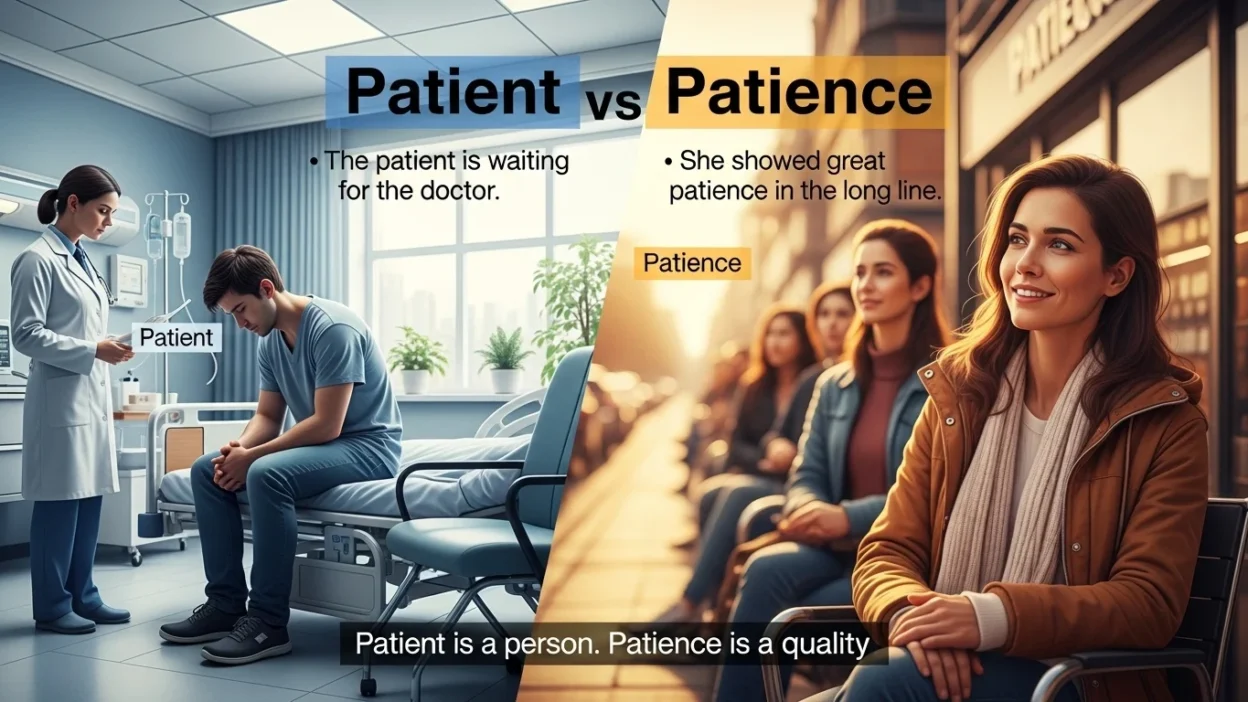
👉 Patient describes a person.
👉 Patience describes a quality.
What Does “Patient” Mean?
The word patient has two main meanings, depending on how it’s used.
1. Patient as an Adjective
When used as an adjective, patient describes someone who stays calm, doesn’t get angry easily, and can wait without frustration.
Examples:
- She is very patient with children.
- You need to be patient while learning a new skill.
- He remained patient despite the long delay.
2. Patient as a Noun
As a noun, patient refers to someone receiving medical care or treatment.
Examples:
- The doctor examined the patient carefully.
- The hospital admitted three new patients today.
What Does “Patience” Mean?
Patience is always a noun. It refers to the ability to stay calm and composed, especially when facing delays, challenges, or difficult situations.
Examples:
- Learning a language takes time and patience.
- She showed great patience during the project.
- Thank you for your patience while we resolved the issue.
Tip: If you’re talking about a quality or feeling, the correct word is almost always patience.
Patient vs Patience: Key Differences
Here’s a clear comparison to make things easier:
| Feature | Patient | Patience |
| Part of Speech | Adjective / Noun | Noun |
| Meaning | Calm person OR medical recipient | Ability to remain calm |
| Usage | Describes a person or role | Describes a quality or trait |
| Example | He is very patient | He has great patience |
Easy Examples to Remember
Sometimes, seeing both words side by side helps the difference stick.
- She is a patient teacher because she has a lot of patience.
- You must be patient if you want to develop patience over time.
- The patient waited calmly, showing incredible patience.
Common Mistakes (And How to Avoid Them)
Even confident writers mix these up. Here are the most common errors:
❌ Using “patient” instead of “patience”
- Incorrect: Thank you for your patient.
- Correct: Thank you for your patience.
👉 Why? Because you’re talking about a quality, not a person.
❌ Using “patience” instead of “patient”
- Incorrect: You need to be patience.
- Correct: You need to be patient.
👉 Why? Because you’re describing someone’s behavior.
❌ Confusing noun and adjective roles
- Incorrect: He showed very patient.
- Correct: He showed great patience.
👉 Tip: After “showed,” you usually need a noun so use patience.
Helpful Memory Trick
A simple way to remember:
- PatienT = Person (or trait describing a person)
- PatienCe = Character or quality
Or think of it this way:
👉 If you can replace the word with “calm,” use patient.
👉 If you can replace it with “calmness,” use patience.
American vs British English
Good news there’s no difference between American and British English when it comes to patient vs patience. Both spellings and meanings are exactly the same in both forms of English.
However, usage style may vary slightly in tone (formal vs informal), but the grammar rules remain identical.
Synonyms and Related Words (LSI Keywords)
Using variations can improve your writing and SEO:
Synonyms for “Patient”
- Calm
- Tolerant
- Understanding
- Composed
- Long-suffering
Synonyms for “Patience”
- Perseverance
- Endurance
- Tolerance
- Calmness
- Self-control
Related Phrases
- Be patient with yourself
- Practice patience daily
- Lose patience
- Test someone’s patience
- Have the patience to succeed
When to Use Patient vs Patience in Real Life
Understanding context is key. Here are some everyday situations:
In Emails
- ✔️ Thank you for your patience.
- ✔️ Please be patient while we process your request.
In Learning & Growth
- ✔️ Be patient with your progress.
- ✔️ Success requires patience and consistency.
In Customer Service
- ✔️ We appreciate your patience.
- ✔️ Our team will assist each patient promptly.
FAQs
1. Is “patient” a noun or adjective?
It can be both. It’s an adjective when describing calm behavior and a noun when referring to someone receiving medical care.
2. Is “patience” ever an adjective?
No, patience is always a noun.
3. Can I say “be patience”?
No, that’s incorrect. The correct phrase is “be patient.”
4. What is the correct phrase: “thank you for your patient” or “patience”?
The correct phrase is “thank you for your patience.”
5. How can I quickly remember the difference?
Think:
- Patient = person or description
- Patience = quality or ability
6. Can someone be both a patient and patient?
Yes!
Example: The patient was very patient during treatment.
7. Which is more formal: patient or patience?
Neither is more formal they serve different grammatical roles.
8. Is “patience” important in writing?
Absolutely. Using the correct word improves clarity, professionalism, and credibility.
Summary:
The difference between patient vs patience comes down to grammar and meaning. Patient describes a person or their behavior, while patience refers to the ability to stay calm and wait. Once you understand this distinction, choosing the right word becomes much easier.
In everyday writing, small word choices can make a big difference. By mastering this pair, you not only avoid common mistakes but also communicate more clearly and confidently.
If you’re writing professionally or casually, using the correct term shows attention to detail and strong language skills.
Actionable Takeaway
Next time you write, pause and ask yourself: Am I describing a person or a quality? If it’s a person, use patient. If it’s a quality, use patience.
Practice by writing a few sentences using both words correctly. The more you use them intentionally, the more natural it will feel and soon, you won’t even have to think twice.

Matthew Benjamin is a contributing author at SpellPeak, dedicated to clear, engaging, and purposeful writing. He focuses on creating informative content that helps readers understand complex ideas with ease. His work emphasizes accuracy, creativity, and practical value, supporting better communication and thoughtful digital learning for a global audience.