If you’ve ever paused mid-sentence wondering whether to write “laying” or “lying,” you’re not alone. This is one of the most common grammar mix-ups in English, and even confident writers slip up. The confusion comes from how similar the words look and how differently they behave.
The good news? Once you understand one small rule, the difference between laying vs lying becomes crystal clear. In this guide, you’ll learn the meanings, see real examples, avoid common mistakes, and walk away with a foolproof method to always choose the right word.
Quick Answer:
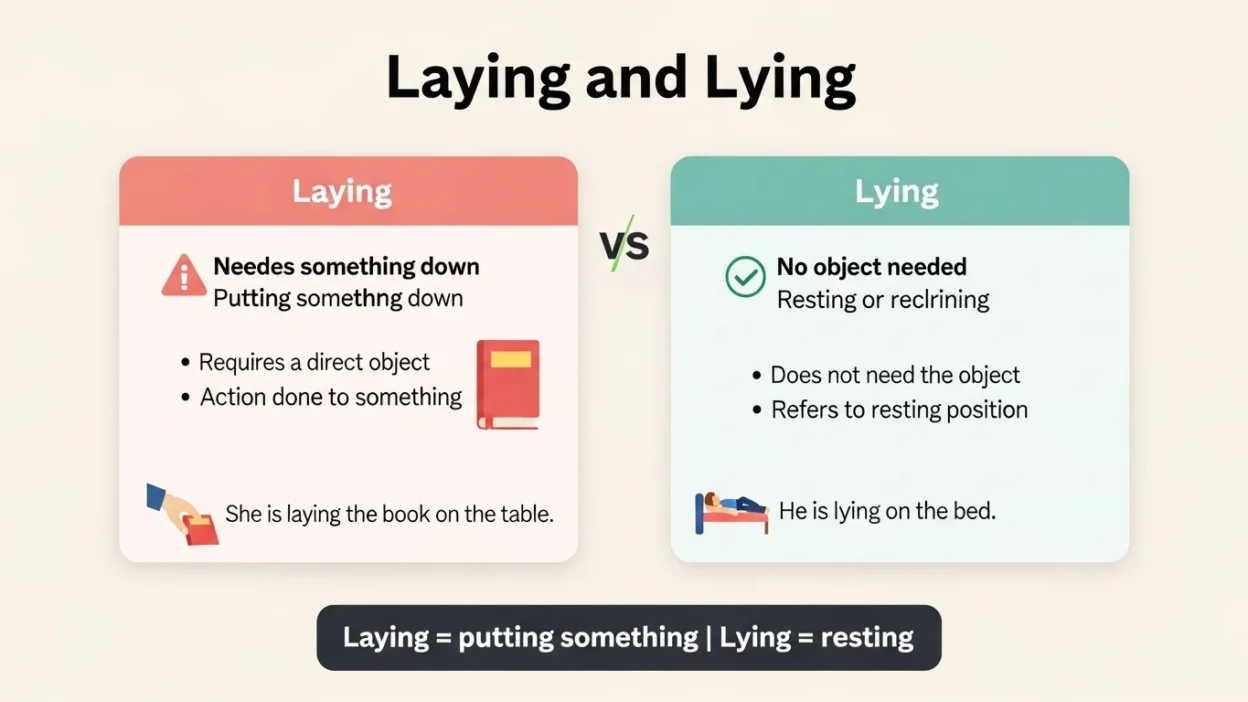
- Laying = putting something down (requires an object)
- Lying = resting or reclining (does NOT require an object)
👉 Easy trick:
- If you’re doing something to something, use laying
- If not, use lying
What Does “Laying” Mean?
The word laying comes from the verb lay, which means to place or put something down. It always needs an object something you’re placing.
Examples of “Laying”
- She is laying the book on the table.
- He is laying the bricks carefully.
- The hen is laying eggs.
In each sentence, something is being placed:
- book
- bricks
- eggs
Without that object, laying doesn’t work.
What Does “Lying” Mean?
The word lying comes from the verb lie, meaning to rest, recline, or be in a horizontal position. It does NOT need an object.
Examples of “Lying”
- She is lying on the bed.
- The dog is lying in the sun.
- He was lying on the couch all day.
Here, no object is being acted upon the subject is simply resting.
The Core Difference Explained
The difference between laying vs lying comes down to action vs state.
- Laying = action (you’re placing something)
- Lying = state (you’re resting)
Quick Comparison Table
| Word | Meaning | Needs Object? | Example |
| Laying | Putting something down | Yes | She is laying the keys on the table |
| Lying | Resting or reclining | No | She is lying on the sofa |
Present, Past, and Confusing Forms
Part of the confusion comes from verb forms changing in tricky ways.
Forms of “Lay”
- Present: lay / laying
- Past: laid
- Past participle: laid
Example:
- Yesterday, she laid the phone down.
Forms of “Lie”
- Present: lie / lying
- Past: lay
- Past participle: lain
Example:
- Yesterday, he lay on the bed.
👉 Notice something tricky?
The past tense of lie is lay, which adds to the confusion.
Common Mistakes (And How to Avoid Them)
Even native speakers often misuse these words. Here are the most frequent mistakes:
1. Using “laying” without an object ❌
- Wrong: I am laying on the couch.
- Correct: I am lying on the couch.
Why? There’s no object being placed.
2. Using “lying” when placing something ❌
- Wrong: She is lying the phone down.
- Correct: She is laying the phone down.
Why? The phone is the object.
3. Confusing past tense ❌
- Wrong: I laid on the bed all day.
- Correct: I lay on the bed all day.
👉 Tip: If no object is involved, avoid laid.
Simple Memory Trick
Here’s a quick way to lock it in forever:
👉 “Lay needs a thing. Lie does not.”
Or even simpler:
- Lay = Place (both have an “a”)
- Lie = Recline
Real-Life Examples for Clarity
Let’s look at side-by-side examples:
- She is laying the baby in the crib. (placing the baby)
- The baby is lying in the crib. (resting)
- He is laying the tools on the floor.
- The tools are lying on the floor.
Notice how the subject changes the verb choice.
LSI Keywords and Related Phrases
To better understand and use laying vs lying, here are related terms you might encounter:
- lay vs lie grammar
- laying or lying correct usage
- difference between lay and lie
- lie vs lay examples
- grammar mistakes in English
- transitive vs intransitive verbs
These concepts all connect to understanding how verbs interact with objects.
American vs British English Differences
Good news there’s no major difference between American and British English when it comes to laying vs lying. The rules are the same in both.
However, in informal speech (especially in American English), people sometimes use “laying” incorrectly in place of “lying.” While common, it’s still considered grammatically incorrect in formal writing.
👉 Tip: Always stick to the correct rule in professional or academic content.
FAQs
1. Is it “laying in bed” or “lying in bed”?
The correct phrase is lying in bed because no object is involved.
2. Why is “laying on the couch” wrong?
Because laying requires an object. You’re not placing anything, so it should be lying.
3. What is the past tense of “lie”?
The past tense of lie is lay.
Example: Yesterday, I lay on the sofa.
4. What is the past tense of “lay”?
The past tense of lay is laid.
Example: She laid the book on the desk.
5. Can “laying” ever be used without an object?
No. Laying always needs an object to be correct.
6. Why is this rule so confusing?
Because the past tense of lie is lay, which overlaps with the present form of lay.
7. Is it okay to use them interchangeably in casual speech?
It’s common, but not correct. For clear and professional writing, use them properly.
8. How can I remember the difference quickly?
Use this: “Lay = place, Lie = rest.”
Final Summary
Understanding laying vs lying doesn’t have to be complicated. At its core, the difference is simple: laying involves placing something, while lying refers to resting. The presence (or absence) of an object is the key that unlocks the correct choice every time.
The confusion mainly comes from overlapping verb forms and everyday misuse, but once you recognize the pattern, it becomes second nature. With practice, you’ll start spotting mistakes instantly and avoiding them in your own writing.
Actionable Takeaway
Next time you’re unsure, pause and ask yourself one question:
👉 “Am I placing something?”
- Yes → use laying
- No → use lying
Practice with a few sentences daily, and within a week, this grammar rule will feel effortless.

Noah Jacob is the administrator of SpellPeak, responsible for managing website operations, content coordination, and platform performance. He ensures smooth functionality, security, and reliability while supporting the team in delivering a seamless, user-focused experience and maintaining high standards of quality across the site.