Understanding either vs neither can feel confusing at first, but once you see how they work, it becomes surprisingly simple. These two words are small, yet they carry important meaning in everyday English especially when making choices or talking about negatives.
If you’ve ever wondered whether to say “either option works” or “neither option works,” you’re not alone. This guide breaks everything down in a clear, friendly way so you can use both words confidently in writing and conversation.
Quick Answer
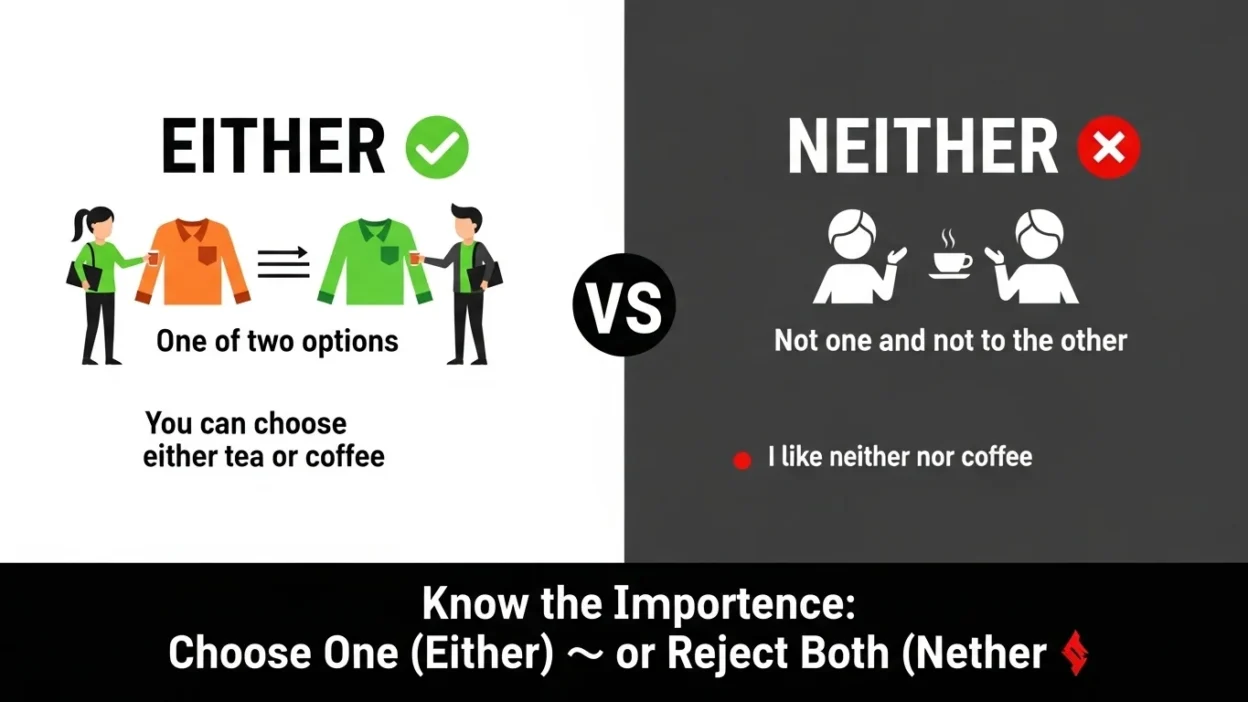
- Either = one or the other (positive choice between two options)
- Neither = not one and not the other (negative meaning for two options)
Example:
- You can choose either dress. ✅
- Neither dress fits me. ❌ (meaning: not this one, not that one)
What Does “Either” Mean?
The word either is used when referring to one of two choices, usually in a positive or neutral sense. It suggests that both options are acceptable, but only one will be chosen.
Common Uses of “Either”
- To present options: You can sit on either side.
- To show agreement in negative sentences: I don’t like coffee, and I don’t like tea either.
Examples of “Either” in Sentences
- You can pick either option it’s up to you.
- Either answer is correct.
- We can meet on either Monday or Tuesday.
Key Idea
Think of either as:
👉 “one or the other”
What Does “Neither” Mean?
The word neither is used to show that both options are rejected. It carries a negative meaning and is often used when something does not apply to either of two choices.
Common Uses of “Neither”
- To reject both options: Neither plan worked.
- To agree with a negative statement: I don’t like pizza. Me neither.
Examples of “Neither” in Sentences
- Neither answer is correct.
- I like neither of those movies.
- Neither of them showed up to the meeting.
Key Idea
Think of neither as:
👉 “not this one and not that one”
Either vs Neither: Side-by-Side Comparison
| Feature | Either | Neither |
| Meaning | One or the other | Not one and not the other |
| Tone | Positive or neutral | Negative |
| Number of options | Two | Two |
| Example | Either road leads to the city | Neither road is safe |
| Verb agreement | Usually singular | Usually singular |
Grammar Rules You Should Know
1. Singular Verb Usage
Both either and neither are typically followed by a singular verb.
- Either option is fine. ✅
- Neither answer is correct. ✅
However, in informal speech, especially with “of + plural noun,” people sometimes use plural verbs:
- Neither of the students are ready. (informal)
Formal writing prefers:
- Neither of the students is ready. ✅
2. “Either…or” and “Neither…nor”
These are common paired conjunctions.
Either…or (positive choice):
- You can either call me or text me.
Neither…nor (negative pairing):
- Neither the manager nor the staff were available.
3. Using with “Of”
When using either of or neither of, follow this structure:
- Either of the books is useful.
- Neither of the answers is correct.
Common Mistakes (and How to Fix Them)
❌ Mistake 1: Mixing Meanings
- Incorrect: Either of them are wrong.
- Correct: Either of them is wrong. (singular verb)
❌ Mistake 2: Double Negatives with “Neither”
- Incorrect: I don’t want neither option.
- Correct: I don’t want either option.
- Or: I want neither option.
👉 Remember: Neither is already negative, so don’t add another negative.
❌ Mistake 3: Confusing “Either” with “Too”
- Incorrect: I like it, and she likes it either.
- Correct: I like it, and she likes it too.
Use either only in negative sentences:
- I don’t like it, and she doesn’t either. ✅
❌ Mistake 4: Using “Neither” for More Than Two
- Incorrect: Neither of the three options works.
- Correct: None of the three options works.
👉 Use neither only for two choices.
Either vs Neither in Everyday Conversation
Here’s how these words naturally appear in real-life English:
- “You can either stay here or come with us.”
- “Neither of those shirts fits properly.”
- “I don’t watch TV.” “Me neither.”
- “I don’t like spicy food.” “I don’t either.”
These phrases are extremely common in spoken English and help you sound more natural.
American vs British English Differences
The good news? There’s no major difference between American and British English when it comes to either vs neither in meaning.
However, there are minor pronunciation differences:
- Either:
- American: EE-ther or EYE-ther
- British: often EYE-ther
- Neither:
- American: NEE-ther or NYE-ther
- British: often NYE-ther
Both pronunciations are correct, and usage rules remain the same in both varieties.
Related Words and Synonyms (LSI Keywords)
To strengthen your understanding, here are related terms often used alongside either vs neither:
- One or the other
- Not either
- Both / none
- Either-or choice
- Neither-nor structure
- Negative agreement
- Alternative options
- Binary choice
Using these variations can improve both your vocabulary and writing clarity.
FAQs
1. Can “either” be used in negative sentences?
Yes. “Either” is commonly used at the end of negative sentences:
- I don’t like it either.
2. Is “neither” always negative?
Yes. “Neither” already includes a negative meaning, so you don’t need another negative word.
3. Can I use “neither” for more than two things?
No. Use “none” when referring to more than two:
- None of the options work.
4. Which is correct: “neither is” or “neither are”?
Formally, “neither is” is correct because it’s singular.
5. What’s the difference between “either” and “too”?
- “Too” is used in positive sentences
- “Either” is used in negative sentences
6. Can “either” mean both?
No. “Either” refers to one of two options, not both.
7. Is “me neither” grammatically correct?
Yes, it’s acceptable in informal English. In formal writing, use:
- “Neither do I.”
Final Summary
The difference between either vs neither comes down to choice and negation. “Either” is used when you’re talking about one of two options, usually in a positive or neutral way.
On the other hand, “neither” is used when you’re rejecting both options entirely. Once you remember this core idea either = one, neither = none everything else becomes much easier.
These words are essential for clear communication, whether you’re writing an email, having a conversation, or improving your grammar skills.
By avoiding common mistakes like double negatives and incorrect verb agreement, you’ll sound more confident and natural in English.
Actionable Takeaway
Next time you’re choosing between two options, ask yourself:
- Am I selecting one? → Use either
- Am I rejecting both? → Use neither
Practice with simple sentences daily, and soon using either vs neither will feel completely natural.

Mia Elizabeth is a contributing author at SpellPeak, passionate about thoughtful writing and clear communication. She creates engaging, well-researched content that helps readers learn and connect with ideas easily. Her work emphasizes clarity, creativity, and practical value, supporting meaningful digital experiences and accessible knowledge sharing worldwide.