
Confused about who’s vs whose? You’re not alone. These two words sound exactly the same, but they mean very different things and mixing them up is one of the most common grammar mistakes in English.
The good news is that once you understand a tiny rule, you’ll never get confused again. This guide breaks it down in a clear, friendly way with examples, tips, and quick tricks you can actually remember.
Quick Answer
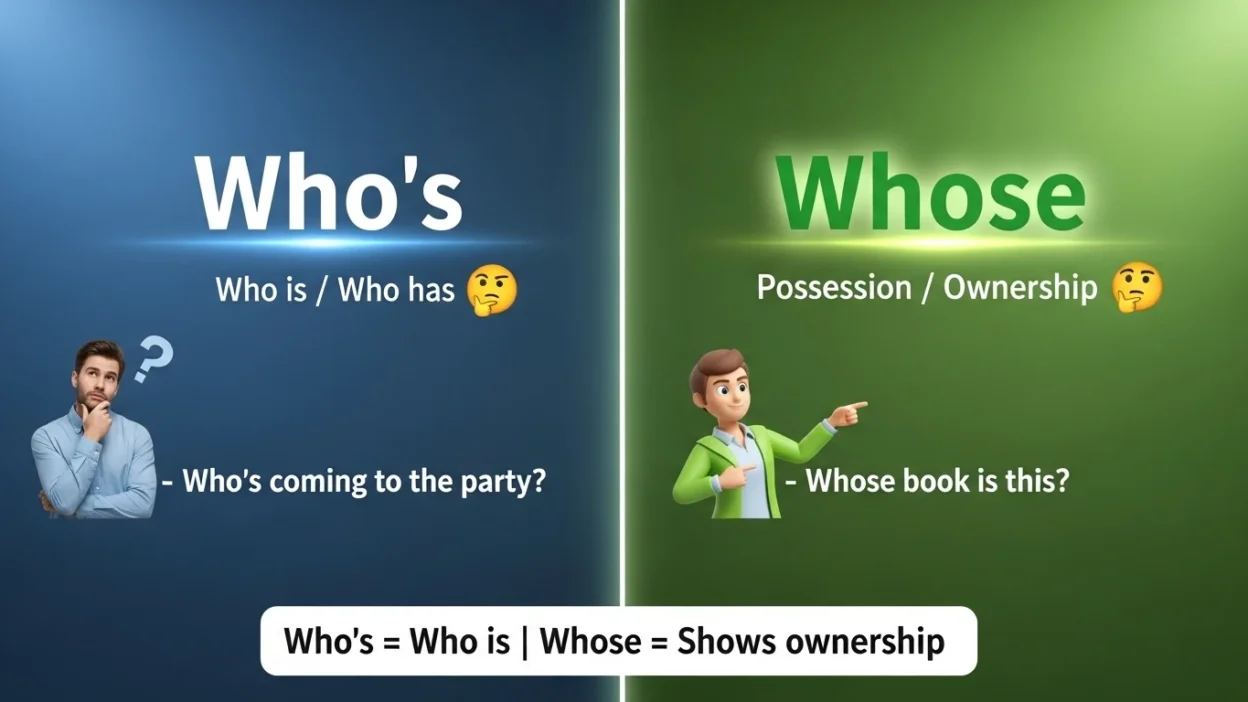
- Who’s = who is or who has
- Whose = shows possession (ownership)
👉 Simple trick:
If you can replace it with “who is” or “who has,” use who’s. Otherwise, use whose.
What Does “Who’s” Mean?
Who’s is a contraction. It combines:
- who + is
- who + has
Examples:
- Who’s coming to the party? → (Who is coming)
- Who’s finished the assignment? → (Who has finished)
- Do you know who’s at the door? → (Who is at the door)
👉 If the sentence still makes sense when you expand it, who’s is correct.
What Does “Whose” Mean?
Whose is a possessive pronoun. It shows ownership or relationship.
Examples:
- Whose book is this?
- I met a girl whose brother is a doctor.
- Whose idea was this?
👉 Here, whose is asking or showing “who something belongs to.”
Who’s vs Whose: Key Differences
Here’s a simple comparison to lock it in your memory:
| Word | Meaning | Usage Type | Example |
| Who’s | Who is / Who has | Contraction | Who’s ready? |
| Whose | Belonging to whom | Possessive | Whose phone is this? |
Easy Trick to Remember the Difference
Use this one-second test:
👉 Replace the word with “who is”
- If it works → use who’s
- If it doesn’t → use whose
Example:
- ❌ Who’s car is parked outside?
→ “Who is car” ❌ (doesn’t make sense)
✔ Correct: Whose car is parked outside? - ✔ Who’s going with you?
→ “Who is going with you” ✔ (works perfectly)
Common Mistakes (and How to Fix Them)
Let’s look at mistakes people make all the time:
1. Using “who’s” for possession
❌ Who’s bag is this?
✔ Whose bag is this?
2. Confusing contractions in questions
❌ Whose coming to dinner?
✔ Who’s coming to dinner?
3. Overthinking the apostrophe
Many people assume apostrophes show possession but not here.
👉 In this case:
- Who’s = contraction
- Whose = possession (no apostrophe!)
Real-Life Example Sentences
These will help you feel the difference naturally:
Using “Who’s”
- Who’s calling me this late?
- Who’s been using my laptop?
- Who’s your favorite teacher?
Using “Whose”
- Whose shoes are these?
- I found a wallet whose owner I don’t know.
- Whose turn is it?
American vs British English Differences
Good news there’s no difference between American and British English when it comes to who’s vs whose.
Both forms:
- Follow the same rules
- Have the same meanings
- Are used identically in writing and speech
So you don’t need to worry about regional variations here.
Why This Confusion Happens
There are two main reasons:
- They sound identical (homophones)
- Apostrophes usually show possession but not in this case
That second point is what tricks most people. English breaks its own “rules” sometimes, and this is one of those cases.
FAQs
1. Is “who’s” always short for “who is”?
Not always it can also mean “who has.”
Example: Who’s finished their work?
2. Can “whose” be used for things, not just people?
Yes!
Example: A company whose policies are strict.
3. Why doesn’t “whose” have an apostrophe?
Because it’s already a possessive pronoun, like “his” or “her.”
4. Can I replace “whose” with “who’s” in casual writing?
No this changes the meaning and makes the sentence incorrect.
5. Which one is used in formal writing?
Both are used, but correctly:
- Use who’s for contractions
- Use whose for possession
6. Is this mistake common among native speakers?
Yes, very common even fluent speakers mix them up.
7. What’s the fastest way to check?
Use the “who is” test it works almost every time.
Summary
Understanding who’s vs whose is easier than it looks. One is a contraction, and the other shows possession. Once you remember that who’s = who is / who has, everything starts to click.
The real key is practice. When you write or read, pause for a second and apply the simple test. Over time, it becomes automatic and your writing instantly looks more polished and professional.
Actionable Takeaway
Next time you’re unsure:
- Replace the word with “who is”
- If it works → use who’s
- If not → use whose
Do this consistently for a few days, and you’ll eliminate this mistake for good.

Mia Elizabeth is a contributing author at SpellPeak, passionate about thoughtful writing and clear communication. She creates engaging, well-researched content that helps readers learn and connect with ideas easily. Her work emphasizes clarity, creativity, and practical value, supporting meaningful digital experiences and accessible knowledge sharing worldwide.