If you’ve ever paused mid-sentence wondering whether to write breath or breathe, you’re not alone. These two words look almost identical, sound similar, and often appear in the same contexts making them one of the most commonly confused pairs in English.
The good news? Once you understand one tiny difference, you’ll never mix them up again. In this guide, you’ll learn the exact meanings, real-life examples, common mistakes, and an easy trick that sticks for life.
Quick Answer:
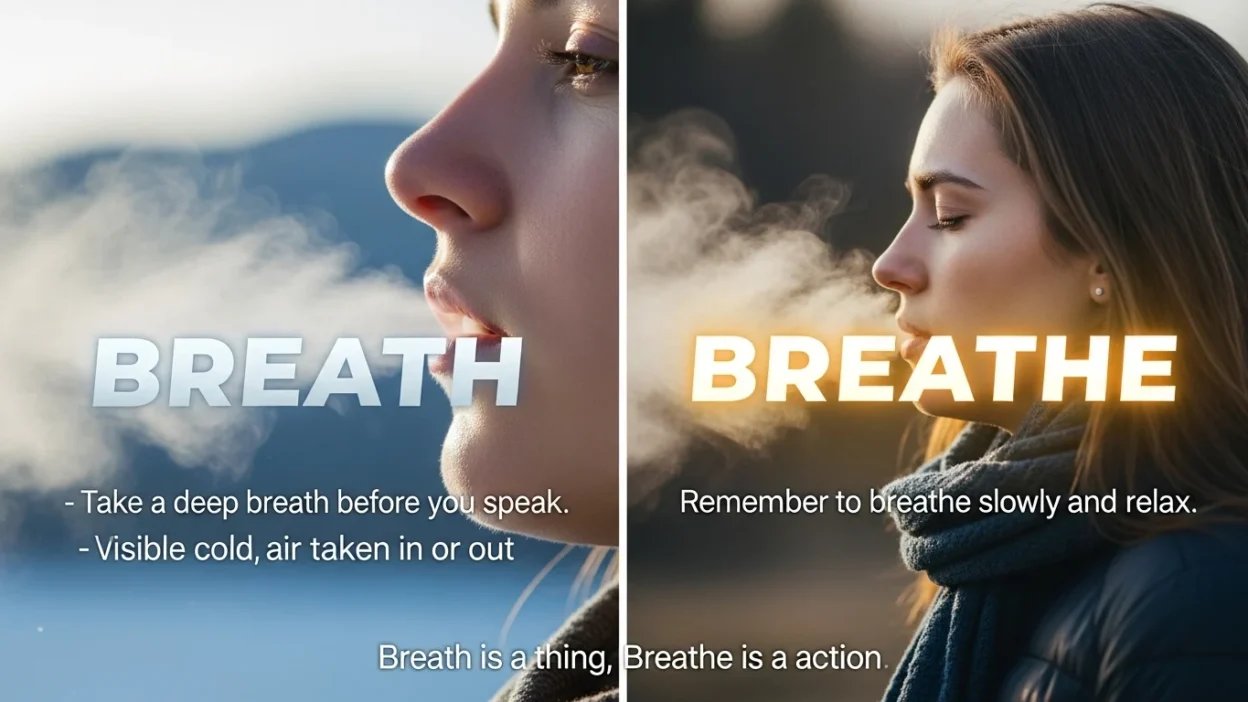
- Breath (noun): the air you take in or release
→ Take a deep breath. - Breathe (verb): the action of inhaling and exhaling
→ Remember to breathe slowly.
👉 Simple rule:
Breath = thing (noun)
Breathe = action (verb)
What Does “Breath” Mean?
Breath is a noun. It refers to the air that moves in and out of your lungs.
Examples of “Breath” in Sentences:
- I took a deep breath before speaking.
- His breath smelled like mint.
- She held her breath during the suspenseful scene.
Key Idea:
Think of breath as something you have or take.
Related LSI Keywords:
- inhale
- exhale
- air
- breathing cycle
- oxygen intake
What Does “Breathe” Mean?
Breathe is a verb. It describes the act of inhaling and exhaling air.
Examples of “Breathe” in Sentences:
- Just relax and breathe slowly.
- He struggled to breathe after running.
- Fresh air helps you breathe better.
Key Idea:
Think of breathe as something you do.
Related LSI Keywords:
- respiration
- inhale and exhale
- breathing action
- oxygen flow
The Core Difference Between Breath vs Breathe
Here’s a clear comparison to lock it in:
| Feature | Breath | Breathe |
| Part of Speech | Noun | Verb |
| Meaning | Air taken in/out | Action of inhaling/exhaling |
| Usage | Take, hold, catch | To do the action |
| Example | Take a deep breath | Try to breathe slowly |
| Pronunciation | Short “e” (breth) | Long “ee” (breeth) |
👉 Notice the spelling clue:
“Breathe” ends in “e” → like many verbs (drive, make, give)
Easy Memory Trick (That Actually Works)
Here’s a simple trick you’ll remember:
- Breath → ends like “death” (both are nouns)
- Breathe → has an extra “e” → means extra action
Or even simpler:
👉 If you can replace it with “action,” use breathe
👉 If it’s a thing, use breath
Common Mistakes (And How to Avoid Them)
Even fluent English speakers mix these up. Here are the most frequent mistakes:
❌ Incorrect:
- Take a deep breathe
- I can’t breath properly
✅ Correct:
- Take a deep breath
- I can’t breathe properly
Why This Happens:
- Both words sound similar in fast speech
- The spelling difference is subtle
- People confuse noun vs verb roles
Fix It Fast:
Ask yourself:
👉 Is this an action or a thing?
Real-Life Usage Examples
Let’s look at how these words appear naturally in daily communication:
In Health & Wellness:
- Meditation helps regulate your breath.
- Try to breathe deeply during stress.
In Sports:
- He was out of breath after the sprint.
- Athletes train to breathe efficiently.
In Emotional Situations:
- She took a deep breath to calm down.
- Just breathe everything will be okay.
American vs British English Differences
Good news: there is no difference between American and British English when it comes to breath vs breathe.
- Spelling: Same
- Meaning: Same
- Usage: Same
This confusion exists globally, not regionally.
Pronunciation Guide
Pronunciation can help you distinguish them:
- Breath → /brɛθ/ (ends with a soft “th” sound like math)
- Breathe → /briːð/ (ends with a “th” sound like this)
👉 That longer “ee” sound in breathe often signals a verb.
Synonyms and Related Words
Expanding your vocabulary helps reinforce understanding.
Synonyms for Breath:
- air
- puff
- gasp
- inhalation
Synonyms for Breathe:
- inhale
- exhale
- respire
- ventilate
Practice Sentences (Test Yourself)
Try filling in the blanks:
- Take a deep ______ before speaking.
- It’s important to ______ slowly during yoga.
- He lost his ______ after running upstairs.
- Just stop and ______ for a moment.
Answers:
- breath
- breathe
- breath
- breathe
FAQs
1. Is “breath” a verb?
No, breath is always a noun. The verb form is breathe.
2. Can “breathe” be used as a noun?
No, breathe is strictly a verb. You cannot use it as a noun.
3. Why do people confuse breath vs breathe?
Because they look and sound similar, especially in spoken English.
4. What is the easiest way to remember the difference?
Remember:
Breath = noun (thing)
Breathe = verb (action)
5. Is “take a breathe” ever correct?
No. The correct phrase is “take a breath.”
6. Do these words change in past tense?
- Breath → no tense (noun)
- Breathe → past tense is breathed
7. Are they pronounced the same?
No. Breathe has a longer vowel sound than breath.
8. Is this mistake common in writing?
Yes, it’s one of the most frequent grammar mistakes, even among native speakers.
Final Summary
Understanding the difference between breath vs breathe comes down to one key idea: noun vs verb. Breath is the air you take in, while breathe is the action your body performs. Once you recognize this distinction, the confusion quickly disappears.
Keep in mind the small spelling clue the extra “e” in breathe signals an action. With a bit of practice and awareness, you’ll start using both words correctly without even thinking about it.
Actionable Takeaway
Next time you write or speak, pause for one second and ask:
👉 Am I describing a thing or an action?
- If it’s a thing → use breath
- If it’s an action → use breathe
Practice with real sentences daily, and this once-confusing pair will become second nature.

Ethan William is the author behind SpellPeak, passionate about clear communication and meaningful language. He writes to help readers express ideas with confidence, simplicity, and impact. His work focuses on clarity, learning, and empowering individuals and businesses through thoughtful, practical content. He values creativity, consistency, and ethical digital publishing worldwide.