English grammar can feel confusing, especially when two words seem almost identical. One of the most common grammar mistakes learners make is mixing up saw and seen. If you’ve ever wondered whether to say “I saw it” or “I seen it,” you’re not alone.
The good news is that the difference between saw vs seen is actually simple once you understand how verb tenses work. In this guide, you’ll learn the meaning of each word, when to use them correctly, common mistakes to avoid, practical examples, and an easy trick to remember the difference forever.
Quick Answer
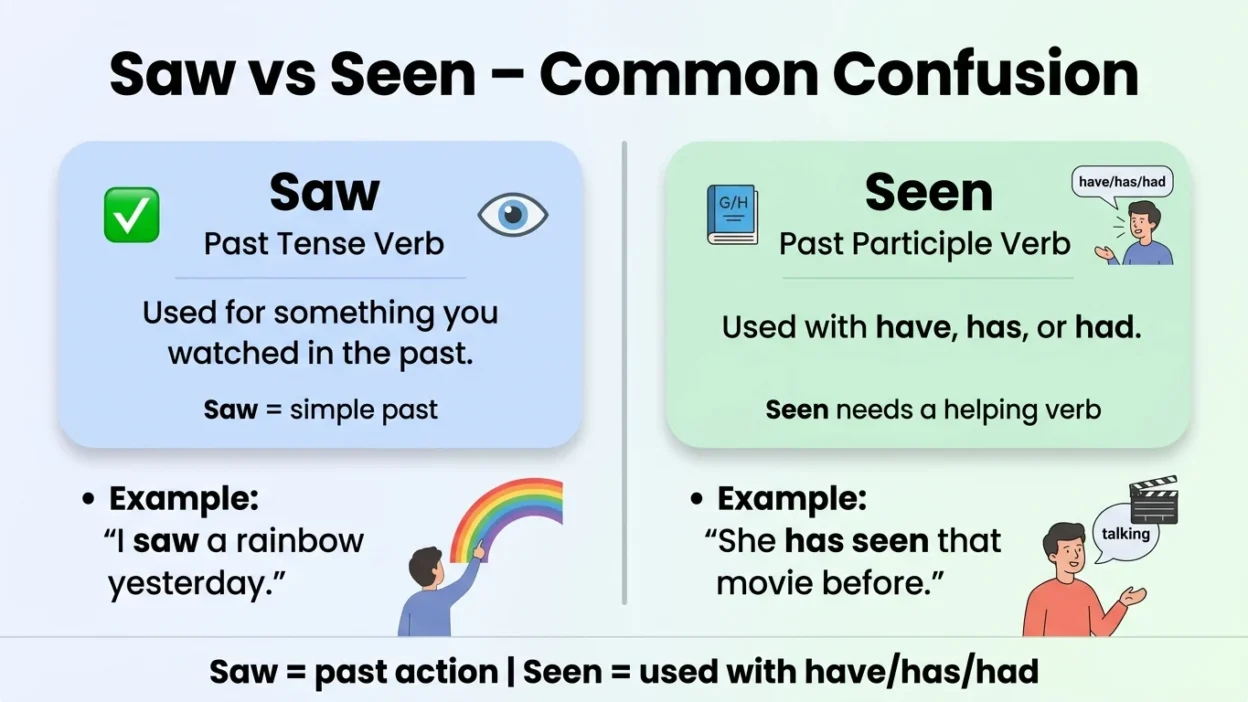
- Saw is the simple past tense of the verb “see.”
- Example: I saw a rainbow yesterday.
- Seen is the past participle of “see” and must be used with a helping verb like have, has, had, or been.
- Example: I have seen that movie before.
Incorrect:
- ❌ I seen him yesterday.
Correct:
- ✅ I saw him yesterday.
- ✅ I have seen him before.
What Does “Saw” Mean?
The word saw is the simple past form of the verb see. It describes something you viewed or noticed in the past.
You use saw when talking about a completed action without a helping verb.
Examples of “Saw”
- I saw a shooting star last night.
- She saw her teacher at the mall.
- We saw an amazing sunset on vacation.
- They saw the accident happen.
In all these examples, the action already happened in the past and does not require words like have or had.
What Does “Seen” Mean?
The word seen is the past participle form of see. Unlike saw, it cannot stand alone in a sentence. It must be paired with a helping verb.
Common helping verbs used with seen:
- Have
- Has
- Had
- Be
- Been
Examples of “Seen”
- I have seen this show before.
- She has seen that video online.
- They had seen the warning signs earlier.
- He was seen leaving the building.
Notice how every sentence includes a helping verb before seen.
Saw vs Seen: Key Difference
The main difference between saw vs seen is grammatical function.
| Word | Verb Form | Needs Helping Verb? | Example |
| Saw | Simple past tense | No | I saw a bird. |
| Seen | Past participle | Yes | I have seen a bird. |
A quick memory trick:
- If there is no helping verb, use saw.
- If there is have, has, had, or been, use seen.
Simple Trick to Remember Saw vs Seen
Here’s an easy way to avoid grammar mistakes:
Use “Saw” Alone
If the sentence works by itself in the past tense, use saw.
- ✅ I saw him yesterday.
- ✅ We saw the fireworks.
Use “Seen” With a Helper
If you use have, has, had, or been, use seen.
- ✅ I have seen him before.
- ✅ She had seen the message already.
Think of seen as a word that needs support.
Common Mistakes With Saw and Seen
Many English learners and even native speakers accidentally misuse these words in everyday speech.
Mistake #1: Using “Seen” Without a Helping Verb
Incorrect:
- ❌ I seen that movie.
Correct:
- ✅ I saw that movie.
- ✅ I have seen that movie.
Mistake #2: Using “Saw” After “Have”
Incorrect:
- ❌ I have saw it before.
Correct:
- ✅ I have seen it before.
Mistake #3: Confusing Verb Tenses
Incorrect:
- ❌ She seen him yesterday.
Correct:
- ✅ She saw him yesterday.
Because “yesterday” refers to a simple past action, saw is the correct choice.
Everyday Examples of Saw vs Seen
Here are more practical examples to help you understand the difference naturally.
Using “Saw”
- I saw your message this morning.
- He saw a snake in the garden.
- We saw our cousins during the holidays.
- The police officer saw the entire incident.
Using “Seen”
- I have seen your new profile picture.
- She has seen better days.
- They had seen the restaurant before moving nearby.
- The suspect was seen entering the building.
Why People Confuse Saw and Seen
The confusion often comes from casual speech patterns and regional dialects. In some communities, phrases like “I seen it” are commonly heard in informal conversation.
However, in standard English grammar, “I seen it” is considered incorrect.
If you’re writing professionally, studying English, preparing for exams, or improving communication skills, it’s important to use the correct form.
Saw vs Seen in Questions
Questions follow the same grammar rules.
Examples With “Saw”
- Did you saw him?
- ❌ Incorrect
- Did you see him?
- ✅ Correct
When using “did,” the main verb returns to its base form: see.
Examples With “Seen”
- Have you seen my keys?
- Has she seen the new episode?
- Had they seen this place before?
Saw vs Seen in American and British English
There is no major grammatical difference between American and British English when it comes to saw vs seen. Both follow the same standard grammar rules.
American English
- I saw him yesterday.
- I have seen that movie.
British English
- I saw him yesterday.
- I have seen that film.
The only noticeable variation may be vocabulary choices like “movie” versus “film,” but the grammar remains identical.
Related Grammar Forms of “See”
Understanding all forms of the verb can make things even easier.
| Verb Form | Word |
| Base Form | See |
| Present Tense | See / Sees |
| Past Tense | Saw |
| Past Participle | Seen |
| Present Participle | Seeing |
Example Sentences
- I see birds every morning.
- She sees everything clearly.
- We saw a fox yesterday.
- They have seen this before.
- He is seeing a doctor tomorrow.
Best Situations to Use “Saw”
Use saw when:
- Talking about a finished past event
- No helping verb is present
- Describing something witnessed directly
Examples
- I saw lightning last night.
- She saw her friend at school.
- We saw the announcement earlier.
Best Situations to Use “Seen”
Use seen when:
- A helping verb is included
- Talking about experiences
- Using perfect tenses or passive voice
Examples
- I have seen this happen before.
- The actor was seen at the airport.
- She had seen enough.
FAQs
Is “I seen” grammatically correct?
No. In standard English, “I seen” is incorrect unless it includes a helping verb.
- I saw it.
- I have seen it.
What is the difference between saw and seen?
Saw is the simple past tense, while seen is the past participle that requires a helping verb.
Can I say “have saw”?
No. The correct phrase is “have seen.”
- ❌ I have saw it.
- ✅ I have seen it.
Is “seen” ever used alone?
No. “Seen” usually needs a helping verb such as have, has, had, was, or been.
Why do people say “I seen”?
Some regional dialects and informal speech patterns use it conversationally, but it is not considered standard grammar.
Which is correct: “Did you see” or “Did you saw”?
“Did you see” is correct because the verb returns to its base form after “did.”
Is “saw” present tense?
No. “Saw” is the past tense of “see.”
How can I remember the difference quickly?
Remember this rule:
- No helper = saw
- Helper verb present = seen
Final Summary
Understanding saw vs seen becomes much easier once you know the role each word plays in a sentence. Saw is the simple past tense used alone for completed actions, while seen is the past participle that always needs a helping verb like have, has, or had.
Many people accidentally mix these words in casual conversation, but using them correctly can improve your writing, speaking, and overall English fluency. If you’re learning grammar, preparing for an exam, or creating professional content, mastering this small difference makes a big impact.
Actionable Takeaway
Before using saw or seen, quickly check your sentence:
- If there’s no helping verb, choose saw.
- If words like have, has, had, or been appear, choose seen.
Practice with real-life examples daily, and soon the correct choice will feel natural.

Noah Jacob is the administrator of SpellPeak, responsible for managing website operations, content coordination, and platform performance. He ensures smooth functionality, security, and reliability while supporting the team in delivering a seamless, user-focused experience and maintaining high standards of quality across the site.