
English can be confusing, especially when two words look and sound almost alike. One common mix-up is draws vs drawers. Many people accidentally use these words interchangeably in writing, social media posts, emails, and even school assignments. But despite their similar spelling, they have completely different meanings and uses.
If you’ve ever wondered whether to write “draws” or “drawers,” you’re not alone. This guide will explain the difference in simple language, show real-life examples, highlight common mistakes, and help you remember the correct usage with confidence.
Quick Answer
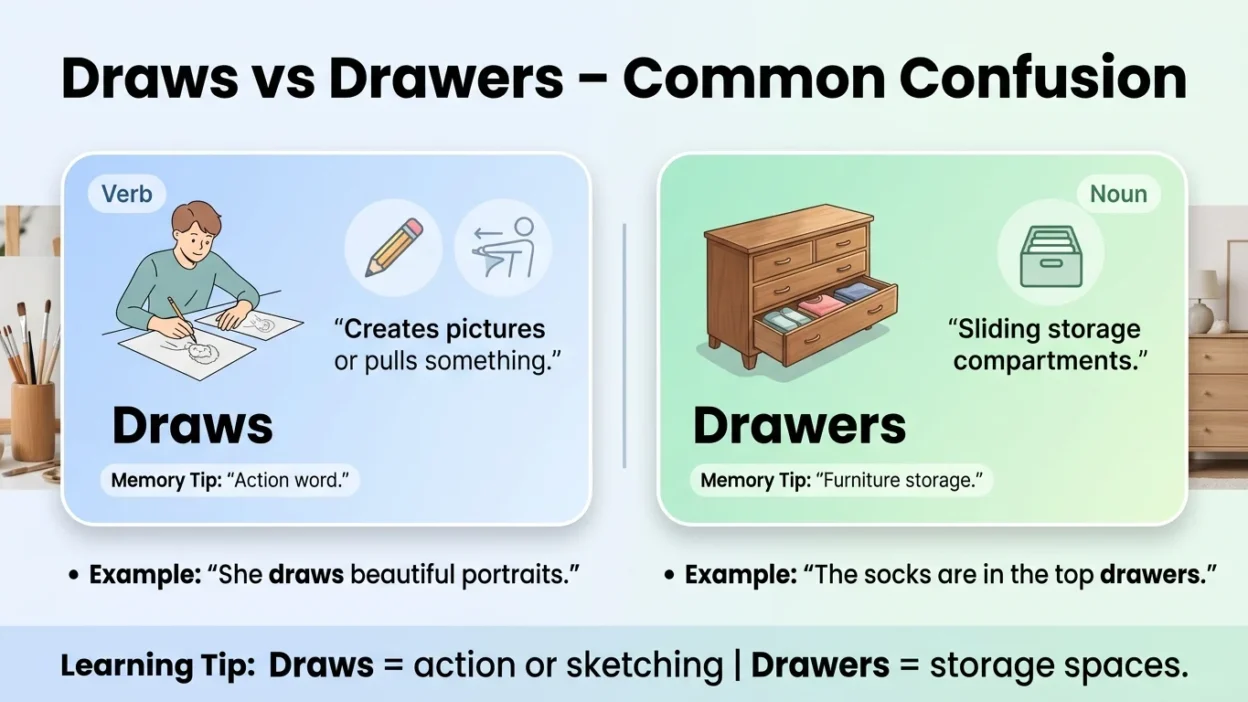
- Draws is usually a verb. It means to pull, attract, sketch, or create something.
- Drawers is a noun. It refers to sliding storage compartments in furniture like desks or dressers.
Example:
- She draws beautiful portraits.
- My socks are inside the top drawers.
What Does “Draws” Mean?
The word draws comes from the verb draw. It is the third-person singular form used with subjects like he, she, or it.
Depending on the context, “draws” can have several meanings.
Common Meanings of “Draws”
1. To Sketch or Create Art
This is one of the most common meanings.
Examples:
- He draws cartoons every weekend.
- Sarah draws flowers in her notebook.
2. To Pull or Move Something
It can also mean pulling something closer.
Examples:
- The horse draws the wagon.
- She draws the curtain every evening.
3. To Attract Attention or Interest
“Draws” is often used when talking about attracting people.
Examples:
- The festival draws thousands of visitors.
- Her speech draws a lot of applause.
4. To Take Out Something
Sometimes it means removing or taking out.
Examples:
- The player draws a card from the deck.
- He draws money from the bank weekly.
What Does “Drawers” Mean?
The word drawers is a plural noun. It refers to storage compartments that slide in and out of furniture.
Examples of “Drawers”
- The kitchen drawers are full of utensils.
- I organized my clothes in separate drawers.
- The desk has three wooden drawers.
In older British English, “drawers” could also refer to undergarments, but that usage is now less common and sounds old-fashioned.
Draws vs Drawers: Key Difference
Here’s the easiest way to remember the difference:
| Word | Part of Speech | Meaning | Example |
| Draws | Verb | Pulls, sketches, attracts | She draws amazing art. |
| Drawers | Noun | Storage compartments | The drawers are locked. |
The biggest difference is that draws is an action, while drawers is an object.
Why People Confuse Draws and Drawers
These words are commonly confused because:
- They look very similar in spelling
- They share the same root word “draw”
- Some accents pronounce them similarly
- Autocorrect may not catch the mistake
For example, someone might accidentally write:
- “He drawers cartoons.”
But the correct sentence is:
- “He draws cartoons.”
Common Mistakes With Draws and Drawers
Understanding typical errors can help you avoid them in your own writing.
Incorrect:
- She keeps her jewelry in the kitchen draws.
Correct:
- She keeps her jewelry in the kitchen drawers.
Why? Because the sentence refers to storage compartments, not an action.
Incorrect:
- My brother drawers very well.
Correct:
- My brother draws very well.
Why? Because “draws” is the verb showing the action of sketching.
Simple Trick to Remember the Difference
A quick memory tip can make these words easier to remember.
Draws = Does Something
The word draws contains action because it is a verb.
Drawers = Furniture Storage
The extra “-ers” can remind you of objects or containers.
Think:
- Drawers store things
- Draws shows action
American vs British English Differences
The meanings of draws and drawers are mostly the same in both American and British English. However, there is one interesting difference.
British English
In older or traditional British English, “drawers” could mean underwear or underpants.
Example:
- He washed his drawers.
American English
In American English, this meaning is uncommon and may sound humorous or outdated. Americans almost always use “drawers” to mean storage compartments.
Aside from that, both forms follow the same grammar rules in American and British usage.
When to Use “Draws”
Use draws when talking about:
- Sketching or illustrating
- Pulling something
- Attracting attention
- Taking out money or objects
- Moving something closer
More Examples
- The movie draws huge audiences.
- She draws with colored pencils.
- The magnet draws metal objects.
When to Use “Drawers”
Use drawers when referring to:
- Furniture storage spaces
- Compartments in desks, cabinets, or dressers
More Examples
- These drawers need cleaning.
- I found the keys inside the bottom drawers.
- The office drawers are locked after work.
Synonyms and Related Words
Using related vocabulary can improve your understanding and help with SEO-friendly writing.
Synonyms for “Draws”
- Pulls
- Attracts
- Sketches
- Creates
- Takes out
Synonyms for “Drawers”
- Compartments
- Storage units
- Cabinets
- Sections
- Containers
Related LSI Keywords
- draw or drawer difference
- common English word mistakes
- confusing English words
- grammar differences
- draws meaning
- drawers definition
- English vocabulary guide
- correct word usage
Examples in Everyday Sentences
Here are more practical examples to help you master these words naturally.
Using “Draws”
- The singer draws large crowds.
- My niece draws animals beautifully.
- The machine draws power from the battery.
Using “Drawers”
- Please put the forks back in the drawers.
- The bedroom drawers are made of oak.
- He opened all the drawers looking for documents.
How Context Changes the Meaning
Context is extremely important in English grammar.
Look at these two sentences:
- She draws every evening.
- She organizes her drawers every evening.
The first sentence describes an activity. The second describes furniture storage.
By identifying whether the sentence talks about an action or a thing, you can quickly choose the correct word.
FAQs
Is “draws” singular or plural?
“Draws” is singular because it matches singular subjects like he, she, or it.
Is “drawers” always plural?
Usually, yes. The singular form is “drawer.”
Can “draws” be a noun?
In some contexts, yes. For example, in sports, a “draw” can mean a tie. But “draws” is most commonly used as a verb.
Why do people spell drawers as draws?
People often shorten words in casual writing or become confused because the pronunciation sounds similar in some accents.
Which is correct: “desk draws” or “desk drawers”?
The correct phrase is “desk drawers.”
Is “drawers” old-fashioned slang for underwear?
Yes, mainly in older British English. Today, that meaning is uncommon.
How can I remember the difference quickly?
Remember:
- Draws = action
- Drawers = storage furniture
Are draws and drawers homophones?
Not exactly. They sound similar, but their pronunciations are slightly different in standard English.
Final Summary
The difference between draws vs drawers is simple once you understand their roles in a sentence. Draws is mainly a verb used for actions like sketching, pulling, or attracting. Drawers, on the other hand, is a noun referring to storage compartments in furniture. Even though the words look alike, their meanings are completely different.
To avoid mistakes, focus on the context of the sentence. If the sentence describes an action, use draws. If it refers to furniture storage, use drawers. Practicing with real examples and remembering the action-versus-object rule will help you use both words naturally and correctly in everyday English.
Actionable Takeaway
Before using “draws” or “drawers,” ask yourself one quick question:
- Is this sentence talking about an action or a storage object?
If it’s an action, choose draws.
If it’s furniture storage, choose drawers.
That simple habit can instantly improve your grammar and make your writing more polished and professional.

Noah Jacob is the administrator of SpellPeak, responsible for managing website operations, content coordination, and platform performance. He ensures smooth functionality, security, and reliability while supporting the team in delivering a seamless, user-focused experience and maintaining high standards of quality across the site.