
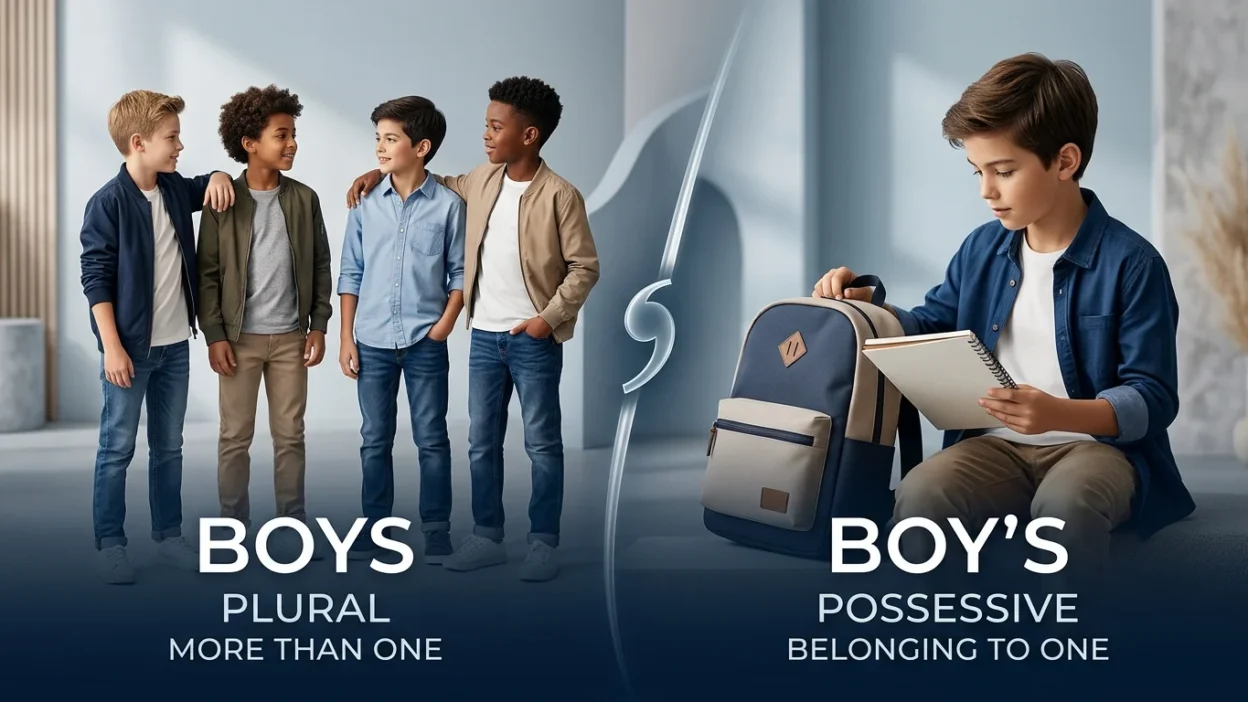
If you are confused about “boys” and “boy’s,” you are not alone. These words look almost identical, but they have different meanings and grammatical uses. “Boys” is the plural form of “boy,” while “boy’s” is the possessive form of the singular noun “boy.” There is also a third form, “boys’,” which shows possession by more than one boy.
Understanding the difference is important because a small apostrophe can completely change the meaning of a sentence. For example, “The boys are playing” means more than one boy is playing. In contrast, “The boy’s bag is blue” means the bag belongs to one boy. This guide explains the differences in simple English, gives practical examples, and shows you when to use each form correctly.
Quick Answer
“Boys” means more than one boy. “Boy’s” means something belongs to one boy. “Boys’” means something belongs to two or more boys. For example: “The boys are happy,” “The boy’s shoes are new,” and “The boys’ classroom is large.”
Why Do People Confuse It?
People often confuse boys, boy’s, and boys’ because all three forms come from the same word: boy.
The main difference is the apostrophe.
- boy = one male child
- boys = more than one male child
- boy’s = something belongs to one boy
- boys’ = something belongs to multiple boys
The apostrophe does not simply make a word plural. Instead, it usually shows possession or ownership.
For example:
- The boys are outside. → More than one boy is outside.
- The boy’s bicycle is red. → One boy owns or uses the bicycle.
- The boys’ bicycles are red. → More than one boy owns or uses the bicycles.
First Word: Boys
“Boys” is the plural form of “boy.”
Use boys when you are talking about two or more male children or young males.
Examples of “Boys”
- The boys are playing football.
- Three boys are waiting outside.
- The boys went to school together.
- Those boys are my classmates.
- The boys enjoyed the game.
Notice that boys does not have an apostrophe.
Boy → Boys
This follows the normal plural rule for many English nouns: add -s.
Second Word: Boy’s
“Boy’s” is the possessive form of the singular noun “boy.”
Use boy’s when something belongs to, is connected with, or is associated with one boy.
Examples of “Boy’s”
- The boy’s book is on the desk.
- I found the boy’s phone.
- The boy’s mother called the school.
- That is the boy’s bicycle.
- The boy’s name is Ahmed.
In each sentence, the apostrophe shows a relationship between one boy and another thing.
Boy → Boy’s
Boys vs Boy’s vs Boys’
| Word | Meaning | Use | Example |
| boy | One male child | Singular | The boy is here. |
| boys | More than one boy | Plural | The boys are here. |
| boy’s | Belonging to one boy | Singular possessive | The boy’s bag is here. |
| boys’ | Belonging to more than one boy | Plural possessive | The boys’ bags are here. |
When Should You Use Each One?
Use boys when you simply mean more than one boy.
The boys are playing cricket.
Use boy’s when something belongs to one boy.
The boy’s cricket bat is new.
Use boys’ when something belongs to two or more boys.
The boys’ cricket bats are new.
A useful question to ask is:
“Am I talking about more than one boy, or am I showing ownership?”
If you are talking about a group, use boys.
If you are showing ownership by one boy, use boy’s.
If you are showing ownership by multiple boys, use boys’.
10+ Examples of Boys and Boy’s
Examples with “Boys”
- The boys are running in the park.
- Five boys joined the team.
- The boys are studying English.
- Those boys live near my house.
- The boys played football yesterday.
- The teacher asked the boys to sit down.
Examples with “Boy’s”
- The boy’s shirt is dirty.
- I borrowed the boy’s pencil.
- The boy’s father is a doctor.
- The boy’s room is upstairs.
- The boy’s dog is very friendly.
- We found the boy’s wallet.
Examples with “Boys’”
- The boys’ shoes are outside.
- The boys’ classroom is on the second floor.
- The boys’ football team won the match.
- The boys’ parents attended the meeting.
- The boys’ bags were left at school.
Common Mistakes
Mistake 1: Using “boy’s” as the plural
Incorrect:
There are three boy’s in the room.
Correct:
There are three boys in the room.
“Boys” is the plural form. You do not need an apostrophe.
Mistake 2: Forgetting the apostrophe for possession
Incorrect:
The boys bicycle is broken.
Correct:
The boy’s bicycle is broken.
Here, the bicycle belongs to one boy.
Mistake 3: Using “boy’s” for multiple boys
Incorrect:
The boy’s uniforms are clean.
If the uniforms belong to several boys, write:
The boys’ uniforms are clean.
Mistake 4: Thinking an apostrophe always means plural
An apostrophe does not normally make boy plural.
- boy = one
- boys = several
- boy’s = belonging to one
- boys’ = belonging to several
Memory Trick
Remember this simple rule:
No apostrophe = plural
boys = many boys
Apostrophe before the “s” = one owner
boy’s = one boy owns something
Apostrophe after the “s” = several owners
boys’ = several boys own something
A quick memory sentence is:
“Boys are many, boy’s belongs to one, boys’ belongs to many.”
American vs British English
The use of boys, boy’s, and boys’ is essentially the same in American and British English.
For example, both varieties use:
- The boys are playing.
- The boy’s bag is missing.
- The boys’ bags are missing.
The main difference between American and British English may appear in other vocabulary, spelling, pronunciation, or punctuation conventions, but these three forms follow the same basic grammatical rules.
Similar Words
Several other words follow the same pattern as boy.
Girl
- girl = one
- girls = more than one
- girl’s = belonging to one girl
- girls’ = belonging to multiple girls
Student
- student = one student
- students = multiple students
- student’s = belonging to one student
- students’ = belonging to multiple students
Teacher
- teacher = one teacher
- teachers = multiple teachers
- teacher’s = belonging to one teacher
- teachers’ = belonging to multiple teachers
This pattern can help you understand possessive nouns throughout English.
Final Verdict
Use boys when you mean more than one boy.
Use boy’s when something belongs to one boy.
Use boys’ when something belongs to more than one boy.
The apostrophe is the key difference. If there is no apostrophe, boys is simply plural. If there is an apostrophe before the s, boy’s is singular possessive. If the apostrophe comes after the s, boys’ is plural possessive.
Frequently Asked Questions
Is “boys” correct?
Yes. “Boys” is the correct plural form of “boy.” Use it when referring to two or more boys.
Is “boy’s” grammatically correct?
Yes. “Boy’s” is correct when you are showing possession or a relationship involving one boy.
What is the difference between boys and boy’s?
Boys means more than one boy, while boy’s means something belongs to one boy.
What is the difference between boy’s and boys’?
Boy’s shows possession by one boy. Boys’ shows possession by multiple boys.
Is “boys’” correct English?
Yes. “Boys’” is the plural possessive form of “boy.” For example: “The boys’ room is clean.”
Which is correct: “the boys shoes” or “the boy’s shoes”?
If the shoes belong to one boy, use “the boy’s shoes.” If they belong to several boys, use “the boys’ shoes.”
Does an apostrophe make “boy” plural?
No. The plural form is boys, without an apostrophe. Apostrophes are used here to show possession, not simply to make the noun plural.
How can I remember the difference?
Remember: boys = many, boy’s = one owner, boys’ = many owners.
Remember This
Boys = more than one boy
Boy’s = belonging to one boy
Boys’ = belonging to more than one boy
Think about how many boys you mean and whether you are showing ownership. This simple check will help you choose the correct form.
Conclusion:
The difference between boys and boy’s is small in spelling but important in meaning. Boys is the plural form of “boy,” while boy’s is the singular possessive form. The related form boys’ is used when several boys possess or are connected to something.
Once you remember where the apostrophe goes, these forms become much easier. When you mean several boys, write boys. When one boy owns something, write boy’s. When several boys own something, write boys’.

Noah Jacob is the administrator of SpellPeak, responsible for managing website operations, content coordination, and platform performance. He ensures smooth functionality, security, and reliability while supporting the team in delivering a seamless, user-focused experience and maintaining high standards of quality across the site.