If you’ve ever paused while writing and wondered whether to use wholistic or holistic, you’re not alone. These two words look similar, sound almost identical, and often appear in the same contexts especially in health, wellness, and personal development.
But here’s the good news: the confusion is easier to clear up than you might think. In this guide, you’ll learn the exact difference between wholistic vs holistic, when to use each, and how to avoid common mistakes so your writing feels confident, clear, and correct.
Quick Answer
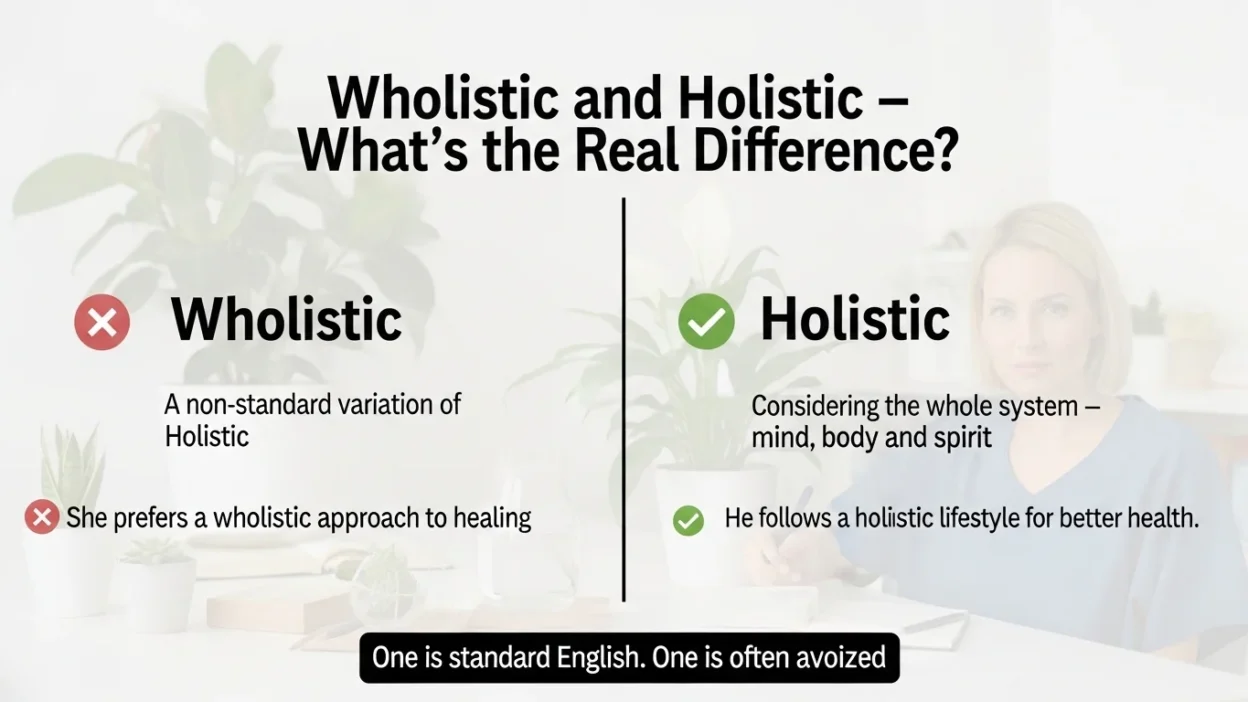
- Holistic is the standard, widely accepted spelling.
- Wholistic is a less common variant, emphasizing the word “whole.”
- In most cases, you should use holistic especially in formal or professional writing.
What Does “Holistic” Mean?
The word holistic comes from the idea of the whole. It describes an approach that considers all parts of something, rather than focusing on just one aspect.
Common meanings:
- Treating the whole person (mind, body, and spirit)
- Looking at a complete system, not isolated parts
- Understanding how different elements are connected
Examples:
- She prefers a holistic approach to health, combining diet, exercise, and mental wellness.
- The teacher used a holistic method to evaluate students, not just test scores.
What Does “Wholistic” Mean?
Wholistic means essentially the same thing as holistic, but it places extra emphasis on the word “whole.”
It’s often used in:
- Alternative medicine
- Spiritual or wellness communities
- Informal writing
Examples:
- The retreat offers wholistic healing through meditation and nutrition.
- He follows a wholistic lifestyle focused on balance and harmony.
Wholistic vs Holistic: Key Differences
Although both words share the same meaning, their usage and acceptance differ.
| Feature | Holistic | Wholistic |
| Spelling status | Standard and widely accepted | Less common variant |
| Usage | Academic, professional, general | Informal, niche contexts |
| Popularity | Very common | Rare |
| Tone | Neutral, formal | Slightly alternative or spiritual |
👉 Bottom line: Use holistic in almost all situations unless you intentionally want a stylistic or niche tone.
Why Do People Confuse Wholistic and Holistic?
There are a few simple reasons:
- Both words sound identical
- “Whole” makes wholistic feel more intuitive
- Some industries promote wholistic for branding
However, dictionaries and style guides overwhelmingly prefer holistic, making it the safer choice.
Common Mistakes to Avoid
Here are some typical errors and how to fix them:
1. Using “wholistic” in formal writing
❌ Incorrect: The study recommends a wholistic treatment plan.
✔️ Correct: The study recommends a holistic treatment plan.
2. Assuming they have different meanings
❌ Incorrect: Holistic and wholistic mean different things.
✔️ Correct: They have the same meaning, but different usage frequency.
3. Overusing niche spelling
If you’re writing for a general audience, using wholistic may confuse readers.
When Should You Use “Holistic”?
Use holistic when:
- Writing professionally (blogs, articles, academic work)
- Communicating with a broad audience
- You want clarity and standard usage
Examples:
- Holistic health care focuses on prevention and lifestyle.
- A holistic strategy improves long-term business growth.
When Can You Use “Wholistic”?
Use wholistic when:
- Writing for a specific wellness or spiritual audience
- Branding or stylistic preference calls for it
- You want to emphasize the idea of “wholeness”
Tip:
Even in these cases, consider your audience holistic is still more widely recognized.
American vs British English Differences
Here’s an interesting point:
There is no major difference between American and British English when it comes to holistic vs wholistic.
- Holistic is standard in both US and UK English.
- Wholistic is uncommon in both varieties.
So regardless of where your audience is, holistic remains the preferred spelling.
Related Terms and Synonyms (LSI Keywords)
To strengthen your understanding (and your SEO), here are related words often used alongside holistic:
- Whole-person approach
- Integrated care
- Mind-body connection
- Natural healing
- Comprehensive method
- Wellness approach
- Preventive care
Using these naturally in your writing improves readability and search relevance.
Real-Life Usage Examples
Let’s look at how these words appear in real contexts:
Health & Wellness
- Holistic therapy considers emotional and physical well-being.
- A holistic diet includes balanced nutrition and mindful eating.
Education
- Teachers use holistic assessment to evaluate overall student performance.
Business
- A holistic marketing strategy aligns branding, content, and customer experience.
FAQs
1. Is “wholistic” a real word?
Yes, wholistic is a recognized variant, but it’s much less common than holistic.
2. Which spelling is correct?
Both are technically correct, but holistic is the standard and preferred spelling.
3. Is “wholistic” outdated?
Not exactly outdated, but it’s considered nonstandard or niche in most contexts.
4. Why do some people prefer “wholistic”?
Because it visually emphasizes the word “whole,” which aligns with its meaning.
5. Should I use “wholistic” in SEO content?
Generally no holistic performs better because it’s more widely searched and recognized.
6. Are they pronounced differently?
No, both are pronounced the same: hoh-LIS-tik.
7. Is “holistic” more professional?
Yes, holistic is widely accepted in academic, medical, and professional writing.
8. Can using “wholistic” hurt readability?
It can confuse readers unfamiliar with the variant, especially in general audiences.
Final Summary
The debate around wholistic vs holistic comes down to usage, not meaning. Both words describe an approach that considers the whole system rather than isolated parts. However, holistic is the standard spelling used across industries, making it the safer and more effective choice in most situations.
While wholistic isn’t wrong, it’s best reserved for niche contexts where tone or branding matters. If your goal is clarity, professionalism, and SEO performance, sticking with holistic will serve you well.
Actionable Takeaway
- Always default to holistic in writing
- Use wholistic only if you have a specific stylistic reason
- Focus on clarity and audience understanding above all
By making this small but important distinction, you’ll write with more confidence and your content will connect better with readers.

Matthew Benjamin is a contributing author at SpellPeak, dedicated to clear, engaging, and purposeful writing. He focuses on creating informative content that helps readers understand complex ideas with ease. His work emphasizes accuracy, creativity, and practical value, supporting better communication and thoughtful digital learning for a global audience.