If you’ve ever paused mid-sentence wondering whether to write “suger” or “sugar,” you’re definitely not alone. It’s a common spelling confusion that trips up students, writers, and even native English speakers. One small letter can make a big difference but knowing the right form is easier than you think.
In this guide, we’ll clear up the confusion once and for all. You’ll learn the correct spelling, understand why the mistake happens, and see real examples so you never second-guess yourself again.
Quick Answer
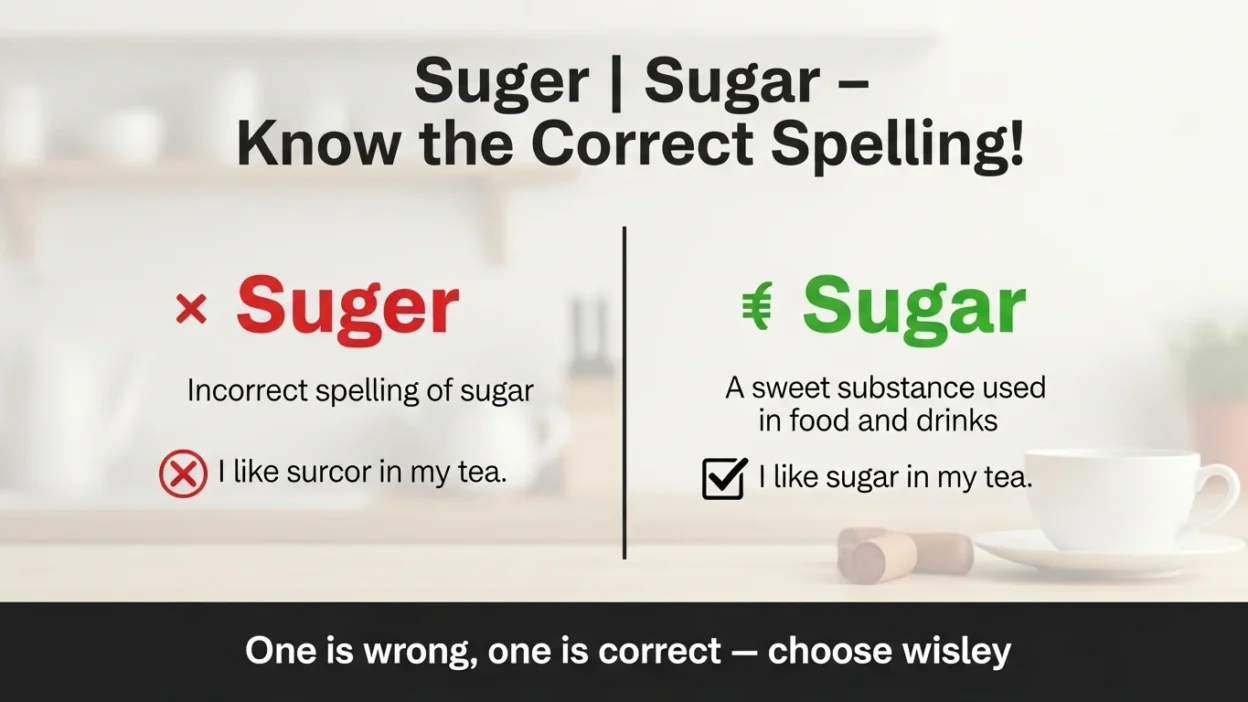
- “Sugar” is the correct spelling.
- “Suger” is a misspelling and should be avoided in standard English.
What Does “Sugar” Mean?
The word “sugar” refers to a sweet substance commonly used in food and drinks. It can also be used figuratively to describe something pleasant or kind.
Common meanings:
- A natural sweetener found in foods like fruits
- A refined ingredient added to tea, coffee, and desserts
- A term of affection (e.g., “Hey, sugar!”)
Example sentences:
- She added two spoons of sugar to her tea.
- Too much sugar can affect your health.
- Don’t sugarcoat the truth just be honest.
What About “Suger”?
“Suger” is simply a misspelling of “sugar.” It has no meaning in standard English and should not be used in formal or informal writing.
Why do people write “suger”?
- The pronunciation of “sugar” can sound like “shoo-ger” or “shug-er”
- People often spell words based on how they sound
- Typing errors or lack of familiarity
Suger vs Sugar: Key Differences
Here’s a simple comparison to make things crystal clear:
| Feature | Suger ❌ | Sugar ✅ |
| Correct spelling | No | Yes |
| Meaning | None | Sweet substance |
| Usage | Incorrect | Standard English |
| Dictionary entry | Not listed | Official word |
Why “Sugar” Is the Correct Form
The spelling “sugar” comes from historical linguistic roots, including Old French sucre and Arabic sukkar. Over time, English adopted the spelling we use today.
Even though the pronunciation doesn’t perfectly match the spelling, English often keeps traditional forms rather than phonetic ones.
Common Mistakes to Avoid
Spelling errors like “suger” are easy to make but also easy to fix once you’re aware.
Mistake #1: Writing phonetically
- ❌ Suger
- ✅ Sugar
Tip: English words don’t always match their pronunciation.
Mistake #2: Ignoring spell check
Many tools catch “suger,” but it’s still important to know the correct spelling yourself.
Mistake #3: Confusing similar words
Some learners mix “sugar” with other similar-sounding words, leading to confusion.
Examples in Real-Life Context
Seeing words in context helps you remember them better.
Correct usage:
- I prefer coffee without sugar.
- This recipe calls for brown sugar.
- He has a sweet tooth and loves sugary snacks.
Incorrect usage:
- ❌ I need some suger for baking.
- ❌ Too much suger is unhealthy.
Tips to Remember the Correct Spelling
Here are a few simple tricks to lock it into memory:
- Think of “sugar” as “u + g + a” in the middle
- Remember the phrase: “Sweet things use ‘sugar,’ not ‘suger’”
- Practice writing it in sentences
American vs British English
Good news there’s no difference between American and British English for this word.
- 🇺🇸 American English: Sugar
- 🇬🇧 British English: Sugar
Unlike words such as “color” vs “colour,” this spelling stays consistent across both versions of English.
Related Words and Variations
Expanding your vocabulary can also help reinforce correct spelling.
Common related words:
- Sugary (sweet or containing sugar)
- Sugar-free (without sugar)
- Sugarcane (a plant used to produce sugar)
- Sugarcoat (to make something sound more pleasant)
FAQs
1. Is “suger” ever correct?
No, “suger” is always incorrect in standard English.
2. Why do people confuse “suger” and “sugar”?
Because English pronunciation doesn’t always match spelling, leading to phonetic mistakes.
3. How can I remember the correct spelling?
Practice writing “sugar” and associate it with food or sweetness to reinforce memory.
4. Is “sugar” a noun or verb?
Primarily a noun, but it can also be used as a verb (e.g., “to sugar the tea”).
5. Does “sugar” have slang meanings?
Yes, it can be used as a term of affection or to describe something pleasing.
6. Are there similar spelling mistakes like this?
Yes, examples include:
- “Definately” vs “Definitely”
- “Seperate” vs “Separate”
7. Is “sugar” used in formal writing?
Yes, it’s a standard English word used in both formal and informal contexts.
Final Summary
To sum it up, “sugar” is the correct spelling, while “suger” is a common but incorrect variation. The confusion usually comes from pronunciation, but once you understand the correct form, it becomes easy to remember and use confidently.
Spelling may seem like a small detail, but it plays a big role in clear communication. Using the correct word not only improves your writing but also builds trust with your readers.
Actionable Takeaway
Next time you write about something sweet, pause for a second and choose “sugar” not “suger.” Save this guide, practice the spelling, and rely on tools like spell check when needed. Over time, it’ll become second nature.

Noah Jacob is the administrator of SpellPeak, responsible for managing website operations, content coordination, and platform performance. He ensures smooth functionality, security, and reliability while supporting the team in delivering a seamless, user-focused experience and maintaining high standards of quality across the site.