If you’ve ever written “reoccurrence” or “recurrence” and wondered which one is correct, you’re not alone. Many writers, students, bloggers, and professionals get confused by these two similar-looking words. They both relate to something happening again, but their usage and acceptance in English can differ.
Understanding reoccurrence vs recurrence is important for clear and professional writing. In this guide, we’ll explain the meaning of each word, show practical examples, highlight common mistakes, and help you confidently choose the right term in any situation.
Quick Answer
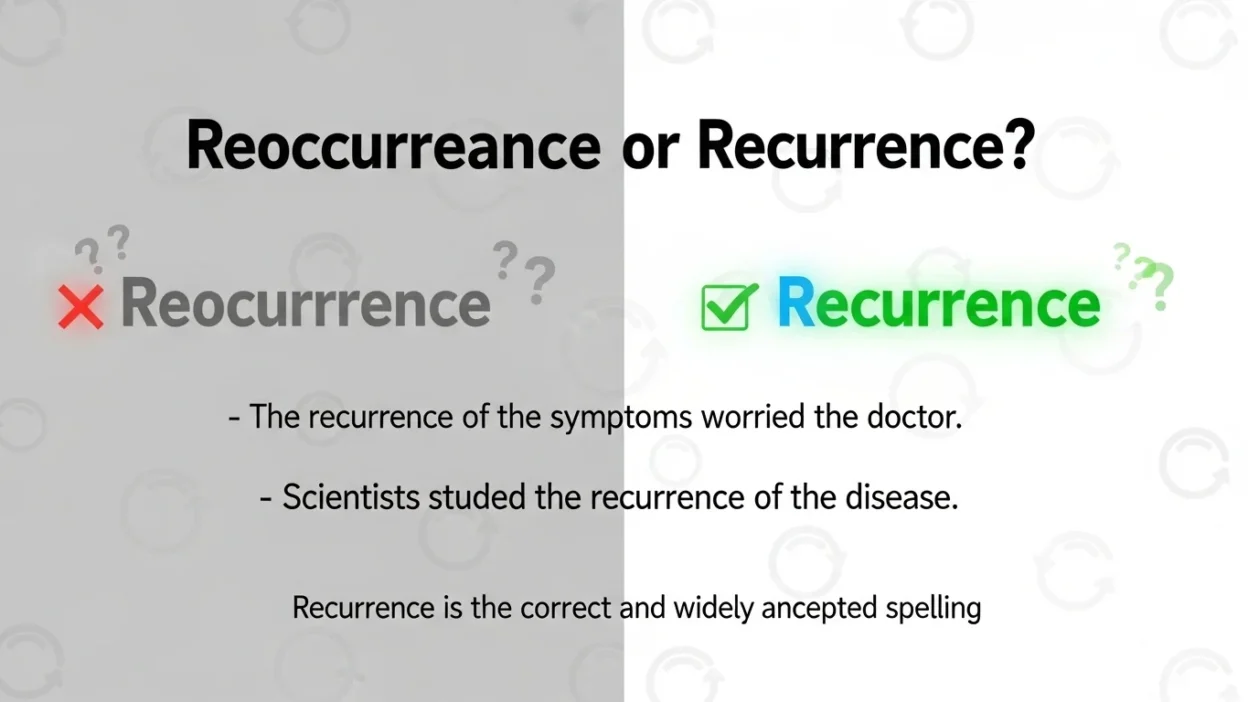
Recurrence is the standard and widely accepted word for something that happens again or repeatedly.
Reoccurrence technically means the same thing but is rarely used and often considered unnecessary or incorrect in modern writing.
In most cases, recurrence is the preferred and recommended word in both everyday and professional English.
Meaning of Recurrence
Recurrence refers to the act of something happening again, especially repeatedly or after a period of time.
It is commonly used in academic writing, medicine, science, and everyday communication.
Examples of recurrence:
- The recurrence of the problem caused delays in the project.
- Doctors monitored the recurrence of the illness after treatment.
- The recurrence of traffic jams during rush hour frustrates commuters.
In simple terms, recurrence means repetition or happening again.
Related phrases and LSI keywords:
- repeated occurrence
- happening again
- repeating event
- recurring issue
- cycle or pattern
Because of its clarity and simplicity, recurrence is the word most dictionaries and style guides recommend.
Meaning of Reoccurrence
Reoccurrence also refers to something happening again or appearing again.
However, the word is rarely used in modern English because it is considered redundant.
The term combines:
- re- (again)
- occurrence (an event happening)
Since occurrence already means something that happens, adding re- can feel unnecessary to many writers and editors.
Examples of reoccurrence:
- The reoccurrence of the error surprised the developers.
- Scientists studied the reoccurrence of the natural phenomenon.
Although these sentences are understandable, most editors would replace reoccurrence with recurrence for smoother writing.
Reoccurrence vs Recurrence: Key Differences
Here is a simple comparison to understand the difference clearly.
| Feature | Recurrence | Reoccurrence |
| Meaning | Something happening again | Something happening again |
| Usage frequency | Very common | Rare |
| Preferred in writing | Yes | Usually avoided |
| Simplicity | Short and clear | Longer and redundant |
| Recommended by editors | Yes | Often replaced |
Conclusion:
Both words technically mean the same thing, but recurrence is the standard and preferred term.
Why “Recurrence” Is Preferred
There are several reasons why writers choose recurrence instead of reoccurrence.
1. Simpler structure
Recurrence is shorter and easier to read.
Example:
- The recurrence of the issue caused concern.
Instead of:
- The reoccurrence of the issue caused concern.
2. Stronger acceptance in professional writing
Fields such as medicine, research, and journalism almost always use recurrence.
Example:
- Doctors are monitoring the recurrence of symptoms.
3. Avoiding redundancy
Because occurrence already describes an event, adding re- can feel unnecessary.
Using recurrence keeps the sentence concise.
Real-Life Examples
Let’s look at everyday examples where recurrence is commonly used.
Health and medicine
- The doctor warned about the recurrence of the infection.
- Treatment reduces the risk of cancer recurrence.
Daily life
- The recurrence of power outages frustrated residents.
- Seasonal allergies often show a recurrence each spring.
Work and business
- The company is trying to prevent the recurrence of system failures.
- Training programs help avoid the recurrence of mistakes.
These examples show how recurrence fits naturally in many contexts.
Common Mistakes Writers Make
Many writers accidentally misuse these words. Here are some common mistakes.
1. Using reoccurrence unnecessarily
Incorrect or less preferred:
- The reoccurrence of the problem slowed progress.
Better:
- The recurrence of the problem slowed progress.
2. Assuming both words are equally common
While both words exist, recurrence is used far more frequently in professional and everyday writing.
3. Overcomplicating sentences
Choosing longer words like reoccurrence can make writing less clear.
Clear writing usually favors shorter and more widely accepted terms.
American vs British English
When comparing American English and British English, both varieties strongly prefer recurrence.
You will see recurrence in:
- academic journals
- medical reports
- news articles
- everyday writing
Reoccurrence appears occasionally, but it is still considered uncommon in both language styles.
So regardless of whether you are writing for American or British readers, recurrence is the safer choice.
When Can You Use Reoccurrence?
Although uncommon, reoccurrence is not technically wrong.
You might see it in:
- older texts
- very formal writing
- rare stylistic choices
However, modern editors usually recommend replacing it with recurrence for clarity and simplicity.
Simple Trick to Remember the Difference
Here is an easy rule:
If something happens again, use “recurrence.”
Since recurrence already means repeating, there’s usually no need for reoccurrence.
Think of it like this:
Recurrence = repeat
Short, simple, and correct.
FAQs
1. Is reoccurrence a real word?
Yes, reoccurrence is a real word, but it is rarely used. Most writers prefer recurrence because it is simpler and more widely accepted.
2. Which is correct: reoccurrence or recurrence?
Both words technically exist, but recurrence is the correct and preferred choice in most writing situations.
3. Why do people avoid reoccurrence?
Many editors avoid reoccurrence because it sounds redundant and unnecessarily long compared to recurrence.
4. Is recurrence used in medical terminology?
Yes. Recurrence is widely used in medicine, especially when discussing the return of symptoms or diseases.
Example: cancer recurrence.
5. Do recurrence and reoccurrence mean different things?
Not really. Both words describe something happening again, but recurrence is the commonly accepted term.
6. Is reoccurrence incorrect?
It is not technically incorrect, but most style guides recommend using recurrence instead.
7. Which word is more common in English writing?
Recurrence is far more common in books, articles, academic writing, and professional communication.
Summary
Understanding reoccurrence vs recurrence is simpler than it first appears. Both words describe something happening again, but they are not used equally in modern English.
Recurrence is the standard, shorter, and widely accepted term, while reoccurrence is rare and often considered unnecessary.
For clear and professional writing, choosing recurrence will almost always be the best option. It avoids redundancy, improves readability, and aligns with common usage in academic, professional, and everyday contexts.
Actionable Takeaway
Whenever you want to describe something happening again, use “recurrence.” It’s the word most readers expect and understand.
If you ever feel unsure, remember this simple rule:
Recurrence is correct. Reoccurrence is rarely needed.

Noah Jacob is the administrator of SpellPeak, responsible for managing website operations, content coordination, and platform performance. He ensures smooth functionality, security, and reliability while supporting the team in delivering a seamless, user-focused experience and maintaining high standards of quality across the site.