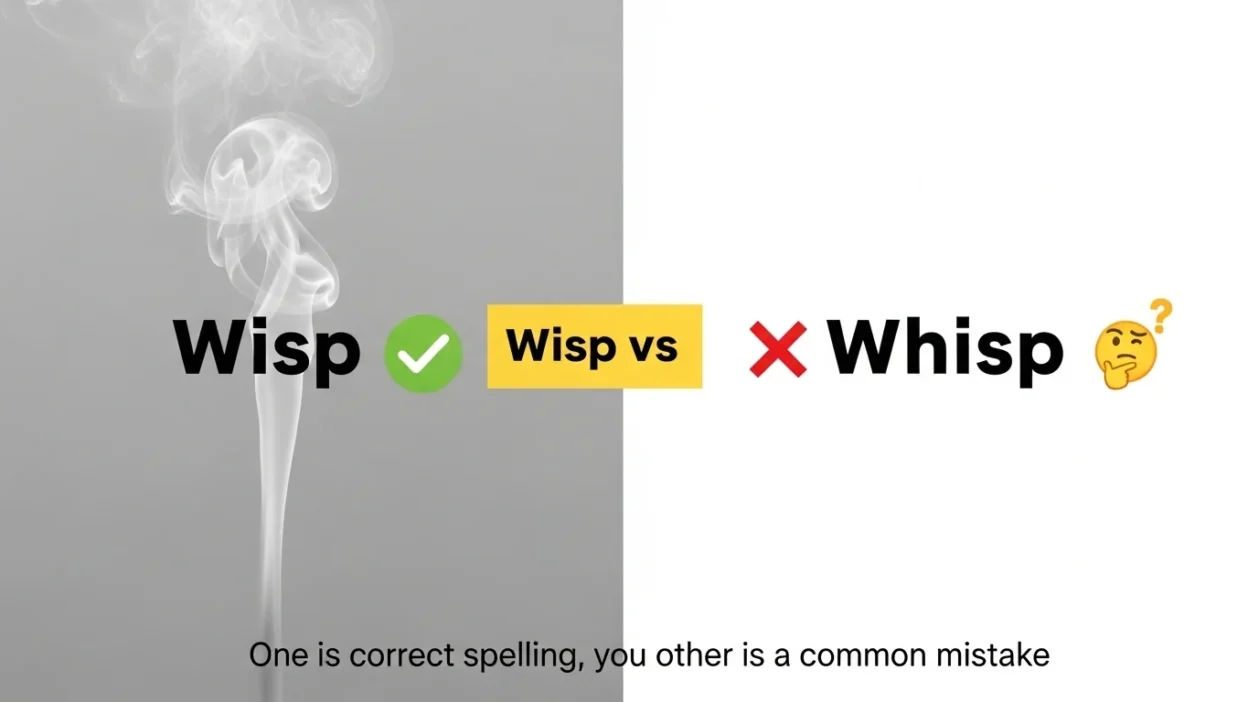
English spelling can sometimes be confusing, especially when two words look almost identical. One such pair that often raises questions is wisp vs whisp. Many people wonder which spelling is correct, whether both words exist, or if one is simply a misspelling.
If you’ve ever typed “whisp” and seen a red underline appear, you’re not alone. In most cases, “wisp” is the correct English word, while “whisp” is generally considered a misspelling. Understanding this difference helps improve writing clarity, grammar accuracy, and overall communication.
Quick Answer
“Wisp” is the correct English word.
It refers to a small, thin, delicate piece or amount of something, such as smoke, hair, or cloud.
“Whisp” is not recognized as a standard English word and is usually a spelling mistake for “wisp.”
Example:
- Correct: A wisp of smoke drifted through the air.
- Incorrect: A whisp of smoke drifted through the air.
What Does “Wisp” Mean?
The word wisp describes something thin, light, or delicate. It is often used to talk about small strands or faint traces of something.
Common meanings of “wisp”
- A small thin piece of something (hair, smoke, cloud)
- A delicate or fragile amount
- A faint trace or suggestion
Example sentences
- A wisp of smoke rose from the candle.
- She brushed a wisp of hair away from her face.
- The mountain was hidden behind a wisp of cloud.
In literature and descriptive writing, “wisp” helps create vivid imagery because it emphasizes something soft, light, and fleeting.
Is “Whisp” a Real Word?
In modern English dictionaries, “whisp” is not recognized as a standard word. It is usually just a misspelling of “wisp.”
Many writers accidentally type whisp because:
- It resembles the spelling of whisper
- English contains many “wh” words (what, when, where, why)
- Pronunciation confusion
However, when writing formally, academically, or professionally, “wisp” is the correct spelling.
Why People Confuse Wisp and Whisp
Several factors contribute to the confusion between wisp vs whisp.
1. Influence of the word “whisper”
Because whisper begins with “wh,” people sometimes assume that wisp follows the same pattern.
Example confusion:
- whisper
- whispering
- whisp (incorrect assumption)
2. Pronunciation similarity
In many accents, the pronunciation of wisp can sound slightly breathy, which might lead someone to think a “wh” spelling is correct.
3. Typing habits
Fast typing and autocorrect errors can cause accidental spelling variations like whisp, wispp, or wips.
Wisp vs Whisp Comparison Table
| Feature | Wisp | Whisp |
| Correct spelling | Yes | No |
| Dictionary recognized | Yes | No |
| Meaning | Small thin amount or strand | None |
| Example | Wisp of smoke | Not standard usage |
| Recommended for writing | Yes | No |
Common Phrases Using “Wisp”
The word wisp often appears in descriptive phrases. These are common in storytelling, journalism, and everyday English.
Popular expressions
- Wisp of smoke
- Wisp of cloud
- Wisp of hair
- Wisp of fog
- Wisp of steam
Example sentences
- A wisp of fog rolled across the lake.
- He noticed a wisp of steam rising from the coffee cup.
- A wisp of cloud floated across the blue sky.
These phrases highlight something light, delicate, and barely visible.
Wisp in Literature and Descriptive Writing
Writers often use wisp to create vivid sensory imagery.
Examples of descriptive usage:
- A wisp of mist curled around the trees.
- A wisp of laughter escaped from the room.
- A pale wisp of moonlight slipped through the window.
Because the word suggests something fleeting and soft, it works well in poetry, storytelling, and atmospheric writing.
American vs British English Usage
When comparing American English and British English, the spelling remains the same.
Both dialects use “wisp” as the correct spelling.
Examples:
- American English: A wisp of smoke rose from the chimney.
- British English: A wisp of smoke rose from the chimney.
There is no accepted British variant spelled “whisp.”
Common Mistakes with Wisp
Many English learners and even native speakers make small mistakes when using this word.
1. Writing “whisp”
Incorrect: A whisp of smoke appeared.
Correct: A wisp of smoke appeared.
2. Using “wisp” for large amounts
Incorrect: A wisp of thick clouds covered the entire sky.
The word wisp implies a small amount, not something large.
Better sentence:
A few wisps of cloud drifted across the sky.
3. Confusing wisp with whisper
These words have very different meanings.
- Wisp → small thin piece
- Whisper → speak very quietly
Example:
- She spoke in a whisper.
- A wisp of smoke rose from the fire.
Related Words and Synonyms
If you’re writing creatively or descriptively, several words can replace or support the meaning of wisp.
Synonyms
- Trace
- Hint
- Strand
- Thread
- Curl
- Tendril
- Fragment
Example:
A faint trace of smoke lingered in the air.
These alternatives can help avoid repetition while keeping the same idea.
Tips to Remember the Correct Spelling
Here are simple tricks to avoid confusing wisp vs whisp.
Think of the phrase “wisp of smoke.”
This expression appears frequently in books and everyday language.
Helpful memory tip:
- Wisp = Wispy smoke
Another trick:
- If the word relates to something thin or delicate, it’s almost always wisp, not whisp.
FAQs
1. Is “whisp” ever correct?
No. “Whisp” is generally considered a misspelling of “wisp.” Standard dictionaries do not recognize it as a correct word.
2. What does “wisp” mean?
A wisp refers to a small, thin, delicate amount of something, such as smoke, hair, or cloud.
3. How do you use “wisp” in a sentence?
Example:
A wisp of smoke curled upward from the candle.
4. Is “wisp” used in both American and British English?
Yes. The spelling “wisp” is correct in both American and British English.
5. What is the plural of wisp?
The plural form is wisps.
Example:
Wisps of fog covered the valley.
6. Can “wisp” describe a person?
Sometimes in literature, “a wisp of a person” describes someone very thin or delicate.
Example:
She looked like a wisp in the oversized coat.
7. Is “wispy” related to “wisp”?
Yes. Wispy is an adjective meaning thin, delicate, or feathery.
Example:
She had wispy bangs across her forehead.
8. Why do spell checkers flag “whisp”?
Because whisp is not a recognized English word, most spell check tools automatically mark it as incorrect.
Summary
Understanding the difference between wisp vs whisp is simple once you know the rule. “Wisp” is the correct and widely accepted English word, used to describe a small, thin, delicate amount of something like smoke, cloud, hair, or fog.
On the other hand, “whisp” is typically just a spelling mistake and does not appear in standard dictionaries.
Using the correct spelling helps improve clarity, professionalism, and credibility in your writing.
If you’re writing creatively, academically, or professionally, remembering that “wisp” is the correct form will help you avoid a common English spelling error.
Actionable takeaway
Whenever you’re describing something light, thin, or delicate, use “wisp.” If you ever type “whisp,” double-check and correct it to maintain accurate and polished writing.

Matthew Benjamin is a contributing author at SpellPeak, dedicated to clear, engaging, and purposeful writing. He focuses on creating informative content that helps readers understand complex ideas with ease. His work emphasizes accuracy, creativity, and practical value, supporting better communication and thoughtful digital learning for a global audience.