If you’ve ever paused mid-sentence wondering whether to write whos or whose, you’re not alone.
This tiny grammar detail confuses even confident English writers. It looks simple but one small apostrophe can completely change the meaning of your sentence.
In this complete guide, you’ll finally understand whos vs whose, when to use each, common mistakes to avoid, and easy memory tricks that make it stick.
If you’re writing emails, blog posts, essays, or social media captions, this article will help you write with clarity and confidence.
Quick Answer:
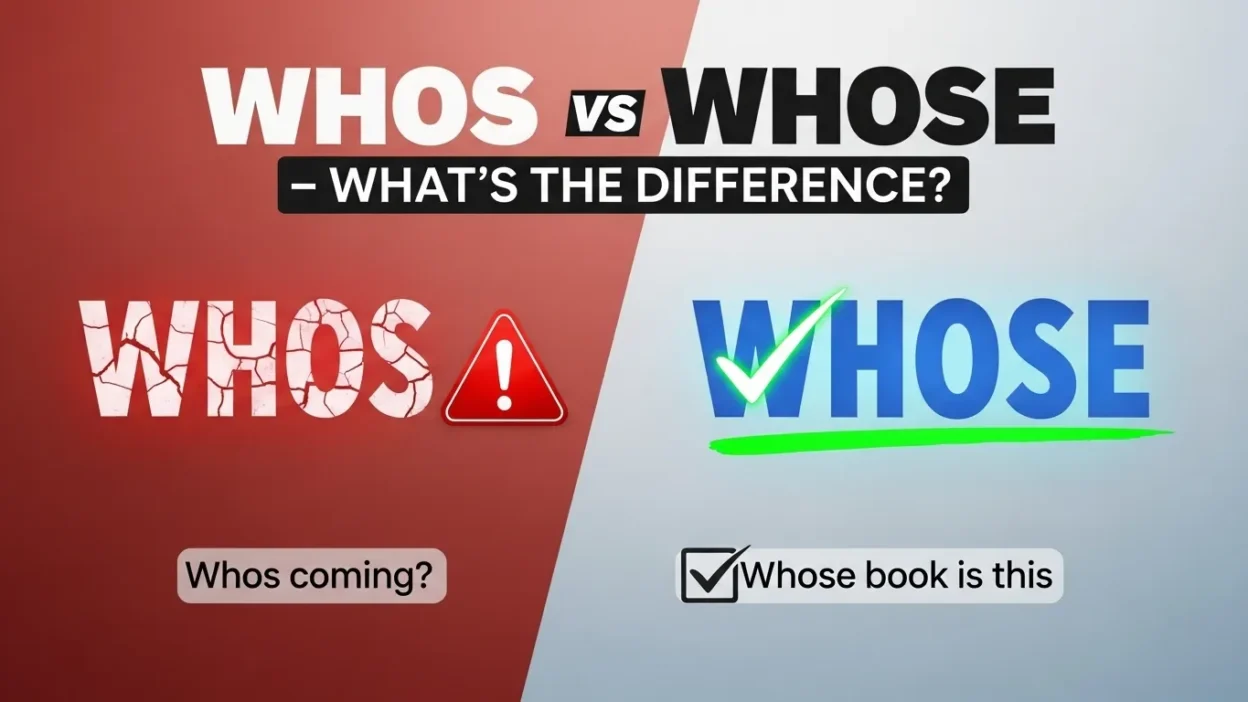
- Whose is correct. It shows possession (ownership).
- Whos is incorrect in standard English.
- If you mean “who is” or “who has,” the correct spelling is who’s (with an apostrophe).
Simple rule:
👉 If you can replace the word with who is or who has, use who’s.
👉 If you are showing ownership, use whose.
👉 Never use whos.
What Does “Whose” Mean?
Whose is a possessive pronoun. It shows that something belongs to someone.
Think of it like:
- his
- her
- their
- its
- whose
Examples of “Whose”
- Whose book is this?
- She’s the teacher whose class I attend.
- Do you know whose phone is ringing?
- The student whose project won received a prize.
In each case, whose indicates ownership or relationship.
What Does “Whos” Mean?
The short answer? Nothing in standard English.
“Whos” without an apostrophe is a common spelling mistake. It is not grammatically correct in American English or British English.
Writers often mean one of two things:
- Who’s (who is / who has)
- Whose (possessive form)
But “whos” by itself is always incorrect.
What About “Who’s”?
Since many people confuse whos vs whose, it’s important to briefly clarify who’s.
Who’s is a contraction of:
- Who is
- Who has
Examples of “Who’s”
- Who’s coming to dinner? (Who is coming)
- Who’s finished the assignment? (Who has finished)
- Do you know who’s at the door?
If you can expand it into “who is” or “who has,” then who’s is correct.
Whos vs Whose: Key Differences
Here’s a clear comparison to make things easier:
| Word | Meaning | Grammar Type | Correct? | Example |
| Whos | No meaning | ❌ Incorrect | ||
| Whose | Shows possession | Possessive pronoun | ✅ Correct | Whose jacket is this? |
| Who’s | Who is / Who has | Contraction | ✅ Correct | Who’s ready? |
This simple table clears up most confusion around the difference between whose and who’s.
Why Is “Whose” Possessive Without an Apostrophe?
This is where many learners get confused.
Most possessive nouns use an apostrophe:
- John’s car
- The dog’s toy
But possessive pronouns do NOT use apostrophes:
- his
- hers
- theirs
- ours
- yours
- whose
So although it feels like “whose” should have an apostrophe, it doesn’t.
The apostrophe in who’s signals a contraction, not possession.
Common Mistakes with Whos vs Whose
Let’s look at typical grammar mistakes people make.
Mistake 1: Using “whos” instead of “whose”
❌ Whos shoes are these?
✅ Whose shoes are these?
Mistake 2: Mixing up “who’s” and “whose”
❌ Who’s car is parked outside?
✅ Whose car is parked outside?
Remember:
- If it shows ownership → whose
- If it means “who is” → who’s
Mistake 3: Overthinking it
Sometimes writers avoid using the word entirely because they feel unsure. That can make writing awkward. It’s better to understand the rule clearly and use it confidently.
Easy Memory Trick to Remember the Difference
Here’s a simple trick that works every time:
👉 Replace the word with “who is.”
If the sentence still makes sense, use who’s.
If it doesn’t, use whose.
Example:
- Who’s going to the party?
(Who is going → makes sense ✔) - Whose bag is this?
(Who is bag is this → doesn’t make sense ✘)
So the correct answer is whose.
This substitution method is one of the easiest grammar checks you can use in everyday writing.
Whose in Questions vs Relative Clauses
“Whose” appears in two main ways:
1. In Direct Questions
- Whose keys are these?
- Whose idea was this?
2. In Relative Clauses
- The author whose book I read is famous.
- She met a girl whose brother lives in London.
In both cases, whose connects a person to something they own or are associated with.
American vs British English Differences
Good news: there is no difference between American and British English when it comes to whos vs whose.
In both:
- Whose is correct for possession.
- Who’s is correct for “who is” or “who has.”
- Whos is incorrect.
This rule is consistent across formal writing, academic English, business communication, and conversational usage worldwide.
Why This Mistake Is So Common
Even experienced writers sometimes confuse whose and who’s. Here’s why:
- They sound identical (homophones).
- Apostrophes often signal possession in other cases.
- Spell check may not always catch contextual mistakes.
- Fast typing leads to skipped apostrophes.
Because they sound the same, this is called a homophone confusion similar to:
- their vs there vs they’re
- your vs you’re
- its vs it’s
Understanding this pattern helps you avoid similar grammar errors.
Real-Life Usage Examples
Here are practical examples in different contexts:
In Emails
- Whose responsibility is this task?
- Do you know who’s leading the meeting?
In Academic Writing
- The researcher whose theory changed psychology.
- Who’s responsible for the results?
In Casual Conversation
- Who’s calling me?
- Whose turn is it?
Seeing them in context makes the difference clearer and easier to remember.
FAQs
1. Is “whos” ever correct?
No. “Whos” without an apostrophe is always incorrect in standard English grammar.
2. How do I quickly check if I should use whose or who’s?
Replace it with “who is.” If it works, use who’s. If not, use whose.
3. Can “whose” refer to things, not just people?
Yes. Modern English allows “whose” for things:
- A company whose profits increased.
- A house whose roof collapsed.
4. Why doesn’t “whose” have an apostrophe?
Because it’s a possessive pronoun. Possessive pronouns never use apostrophes.
5. Is this mistake common in professional writing?
Yes. Even native speakers mix them up because they sound the same.
6. Does autocorrect fix this error?
Not always. Since “who’s” and “whose” are both real words, spell check may not detect incorrect usage.
7. Is this important in exams?
Absolutely. Grammar exams, standardized tests, and academic writing often test this distinction.
8. Can I avoid using “whose” completely?
You could rephrase, but it’s better to learn the rule. Avoiding it may make your writing awkward.
Summary:
The confusion around whos vs whose comes down to one simple truth: “whos” is never correct. If you’re showing ownership, use whose. If you mean “who is” or “who has,” use who’s.”
This small grammar detail makes a big difference in polished writing. Mastering it improves clarity, credibility, and confidence in everything from professional emails to academic essays.
Actionable Takeaway
Next time you hesitate:
- Ask yourself: Is this possession?
- Try replacing it with “who is.”
- If it doesn’t fit, choose whose.
Practice this check a few times, and the rule will become automatic. Clear writing isn’t about being perfect it’s about understanding the basics well. And now, you do.

Noah Jacob is the administrator of SpellPeak, responsible for managing website operations, content coordination, and platform performance. He ensures smooth functionality, security, and reliability while supporting the team in delivering a seamless, user-focused experience and maintaining high standards of quality across the site.