
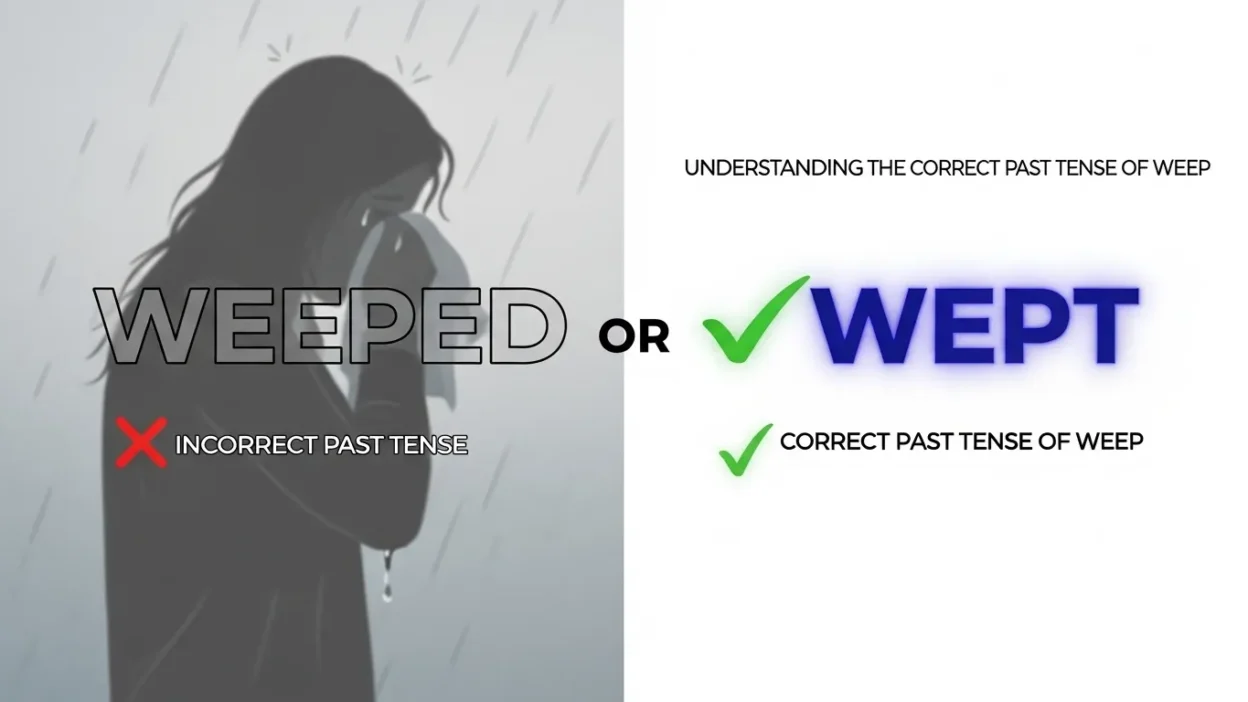
Have you ever paused mid-sentence and wondered: is it “weeped” or “wept”? You’re not alone. English is full of tricky past tense forms, and even confident writers sometimes second-guess themselves.
In this guide, we’ll clearly explain the difference between weeped or wept, show real examples, highlight common mistakes, and help you feel completely confident using the correct form in everyday writing.
Quick Answer
The correct past tense of “weep” is “wept.”
“Weeped” is not standard English and is considered grammatically incorrect.
- Present: weep
- Past: wept
- Past participle: wept
Example:
✔ She wept when she heard the news.
✘ She weeped when she heard the news.
What Does “Weep” Mean?
The verb weep means to cry, often quietly or with deep emotion. It suggests stronger, more heartfelt sadness than simply “cry.”
Synonyms of Weep
- Cry
- Sob
- Mourn
- Lament
- Shed tears
- Grieve
- Wail (stronger emotional tone)
“Weep” is often used in formal writing, literature, emotional storytelling, and religious or poetic language.
Example:
- He wept in silence.
- The mother wept for her lost child.
- She wept tears of joy.
Why Is It “Wept” and Not “Weeped”?
The confusion between weeped or wept comes from how English forms past tense verbs.
Most verbs follow a regular pattern:
- Walk → Walked
- Talk → Talked
- Jump → Jumped
But “weep” is an irregular verb. That means it does not follow the typical “-ed” rule.
Instead, it changes form:
- Keep → Kept
- Sleep → Slept
- Sweep → Swept
- Weep → Wept
Notice the pattern? Many verbs ending in “-eep” change to “-ept” in the past tense.
That’s why “wept” is correct and “weeped” is wrong.
Examples of “Wept” in Sentences
Here are practical examples to make it clear:
Past Tense Examples
- She wept after watching the emotional movie.
- He wept openly at the funeral.
- They wept with happiness when their child was born.
- The nation wept for its fallen hero.
Present Perfect Examples
- She has wept many times this year.
- He had wept before anyone noticed.
Literary Style Example
- She wept bitter tears under the moonlight.
“Wept” often appears in storytelling, novels, religious texts, and dramatic writing.
Common Mistakes With Weeped or Wept
Let’s look at where people often go wrong.
1. Adding “-ed” Automatically
Many learners assume all verbs take “-ed” in the past tense. This works for regular verbs — but not irregular ones like “weep.”
Incorrect:
- She weeped loudly.
Correct:
- She wept loudly.
2. Confusing It With “Cried”
“Wept” is stronger and more emotional than “cried.” They are similar, but not always interchangeable.
- She cried because she was frustrated.
- She wept because she was heartbroken.
3. Using “Weeped” in Formal Writing
In essays, blog posts, books, or professional communication, “weeped” will immediately look incorrect.
Always use wept.
Comparison Table: Weeped vs Wept
| Word | Correct? | Usage in Standard English | Example |
| Weeped | ❌ No | Not grammatically correct | She weeped loudly. |
| Wept | ✅ Yes | Correct past tense of weep | She wept loudly. |
There is no situation in modern standard English where “weeped” is correct.
American vs British English: Is There a Difference?
Good news — there is no difference between American and British English for this word.
Both use:
- Weep (present)
- Wept (past tense)
- Wept (past participle)
Unlike words such as “learned/learnt” or “dreamed/dreamt,” there is no alternative spelling or variation here.
In:
- American English → wept
- British English → wept
“Weeped” is incorrect in both versions.
Why Irregular Verbs Exist in English
English has many irregular verbs because of its Germanic roots. Over time, some verbs kept their older past tense forms.
Examples:
- Go → Went
- Come → Came
- Take → Took
- Speak → Spoke
- Weep → Wept
These verbs don’t follow the modern “add -ed” rule because they evolved differently.
Understanding this helps you avoid common grammar mistakes.
When Should You Use “Wept”?
Use “wept” when:
- You want to express deep sadness
- Writing emotional storytelling
- Writing poetry or literature
- Describing intense grief
- Writing religious or dramatic contexts
Example:
- She wept over the loss of her beloved pet.
- He wept quietly in the hospital corridor.
It sounds more powerful and emotional than simply “cried.”
Wept vs Cried: What’s the Difference?
Though related, these words carry slightly different tones.
| Word | Tone | Strength of Emotion | Common Use |
| Cried | Neutral | Mild to strong | Everyday speech |
| Wept | Formal/Emotional | Strong/Deep | Literature, dramatic writing |
“She cried” sounds natural in conversation.
“She wept” sounds more intense and emotional.
FAQs
1. Is “weeped” ever correct?
No. “Weeped” is not correct in standard English grammar.
2. What is the past tense of weep?
The correct past tense of “weep” is “wept.”
3. Why do people say “weeped”?
Because most English verbs take “-ed” in the past tense. Learners often apply that rule automatically.
4. Is “wept” used in American English?
Yes. Both American and British English use “wept.”
5. Is “wept” formal?
It is slightly more formal and emotional than “cried,” but it can be used in everyday writing too.
6. What is the past participle of weep?
The past participle is also “wept.”
Example:
- She has wept many times.
7. Is weeping stronger than crying?
Yes, it often suggests deeper emotion or sorrow.
8. How can I remember the correct form?
Remember this pattern:
- Keep → Kept
- Sleep → Slept
- Sweep → Swept
- Weep → Wept
If you remember one, you’ll remember them all.
Final Summary
When deciding between weeped or wept, the answer is simple: “wept” is correct, and “weeped” is incorrect. “Weep” is an irregular verb, which means it does not follow the usual “-ed” rule.
Just like “sleep” becomes “slept,” “weep” becomes “wept.” Using the correct form improves your grammar, strengthens your writing, and builds credibility.
IF you’re writing a blog, story, essay, or social media post, choosing “wept” shows attention to detail and confidence in English.
Actionable Takeaway
Whenever you’re unsure about a verb, check if it’s irregular. If it ends in “-eep,” there’s a strong chance it changes to “-ept” in the past tense. Save this pattern, practice with example sentences, and you’ll never confuse “weeped or wept” again.

Mia Elizabeth is a contributing author at SpellPeak, passionate about thoughtful writing and clear communication. She creates engaging, well-researched content that helps readers learn and connect with ideas easily. Her work emphasizes clarity, creativity, and practical value, supporting meaningful digital experiences and accessible knowledge sharing worldwide.