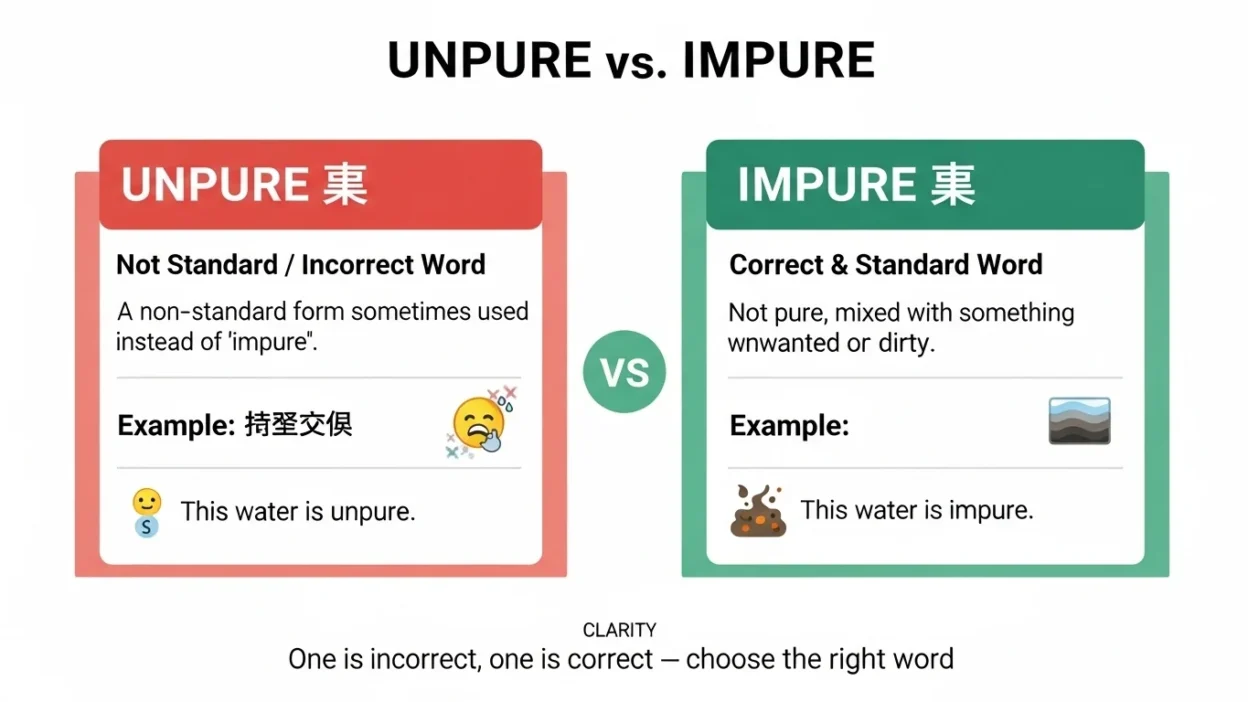
Many English learners and writers get confused between unpure vs impure. Both words seem similar and appear to have the same meaning, but in correct English usage, only one of them is widely accepted and commonly used.
Understanding the difference will help you write more clearly, avoid common mistakes, and sound more natural in both speaking and writing.
In this article, you’ll learn the meaning of unpure and impure, see examples, understand common mistakes, and learn when to use the correct word. By the end, you’ll never confuse these two words again.
Quick Answer
Impure is the correct and commonly used word in English.
Unpure is very rare and mostly considered incorrect or outdated in modern English.
Use impure in almost all situations.
Meaning of Unpure vs Impure
Impure Meaning
Impure means something that is not pure, mixed with something else, or contaminated. It can be used for physical things, chemicals, metals, water, or even abstract ideas like thoughts or intentions.
Examples:
- The water is impure and not safe to drink.
- This gold is impure because it contains other metals.
- He had impure intentions.
Unpure Meaning
Unpure technically also means not pure, but it is very rarely used in modern English. Most native speakers do not use this word in daily conversation or writing.
Example (rare usage):
- The air in the city is unpure. (Better: impure)
Unpure vs Impure: Comparison Table
| Word | Meaning | Usage | Correct in Modern English |
| Unpure | Not pure | Very rare | Not recommended |
| Impure | Not pure / contaminated | Common | Yes |
Conclusion: Always use impure instead of unpure.
Why “Impure” Is Correct and “Unpure” Sounds Wrong
In English, we often use prefixes like un-, in-, im-, il-, and ir- to mean “not.”
But the prefix depends on the root word.
Examples:
- Pure → Impure (correct)
- Possible → Impossible
- Legal → Illegal
- Regular → Irregular
- Happy → Unhappy
So grammatically, impure is the correct form because English uses im- before words starting with p.
Examples of Impure in Sentences
Here are some real-life examples to help you understand better:
- Impure water can cause diseases.
- This metal is impure and needs to be refined.
- The laboratory rejected the impure sample.
- His motives were impure.
- Impure air can harm your lungs.
Common Mistakes People Make
Many learners make these mistakes:
Mistake 1: Using Unpure in Formal Writing
❌ The water is unpure.
✔ The water is impure.
Mistake 2: Thinking Both Words Are Equally Correct
They are not equal. Impure is correct and common.
Mistake 3: Translating Directly
Some languages use a direct translation of “not pure,” which becomes unpure, but English uses impure.
American vs British English
Good news:
There is no difference between American and British English for this word.
| American English | British English |
| Impure | Impure |
Both use impure, and unpure is uncommon in both varieties.
Synonyms of Impure (LSI Keywords)
Using synonyms can improve your writing and SEO:
- Contaminated
- Polluted
- Dirty
- Adulterated
- Tainted
- Infected
- Unclean
- Mixed
- Corrupted
- Unsafe
Example:
Impure water = Contaminated water = Polluted water
When to Use Impure
Use impure when talking about:
1. Water
- Impure water
- Impure drinking water
2. Metals
- Impure gold
- Impure silver
3. Air
- Impure air
- Impure environment
4. Chemicals
- Impure substance
- Impure solution
5. Thoughts or Intentions
- Impure thoughts
- Impure motives
FAQs
1. Is unpure a real word?
Yes, but it is very rare and mostly outdated. Modern English prefers impure.
2. Which is correct: unpure or impure?
Impure is correct and commonly used.
3. Why do people say unpure?
Usually because they think adding un- makes the opposite, but English uses im- with the word pure.
4. Can I use unpure in writing?
It is not recommended. Use impure instead.
5. What is the noun form of impure?
The noun form is impurity.
Example:
- The water contains impurities.
6. What is the opposite of impure?
The opposite is pure.
7. Is impure used for people?
Yes, but usually for thoughts, intentions, or actions, not the person directly.
8. Is impure a negative word?
Yes, it usually has a negative meaning because it means contaminated or not clean.
Summary
Understanding the difference between unpure vs impure is actually simple once you know the rule. While both words may seem correct, impure is the standard, correct, and widely used word in modern English. Unpure exists but is extremely rare and not recommended for everyday writing or speaking.
If you want to write correct English, especially for essays, blogs, SEO articles, or exams, you should always choose impure. Remember that English uses different negative prefixes, and in this case, im- is the correct prefix for the word pure.
Actionable Takeaway
Here is a simple trick to remember:
- Pure → Impure ✅
- Not Pure → Impure ✅
- Unpure → ❌ Avoid this word
Quick memory tip:
Words starting with P often use IM → Possible → Impossible, Pure → Impure.
If you remember this rule, you will never make this mistake again.

Ethan William is the author behind SpellPeak, passionate about clear communication and meaningful language. He writes to help readers express ideas with confidence, simplicity, and impact. His work focuses on clarity, learning, and empowering individuals and businesses through thoughtful, practical content. He values creativity, consistency, and ethical digital publishing worldwide.