If you’ve ever paused mid-sentence wondering whether to write undecisive or indecisive, you’re not alone. These two words look similar and even sound like they should mean the same thing but only one is actually correct in standard English.
In this guide, you’ll get a clear, friendly explanation of undecisive vs indecisive, with real-life examples, common mistakes to avoid, and easy tips to remember the right usage every time.
Quick Answer
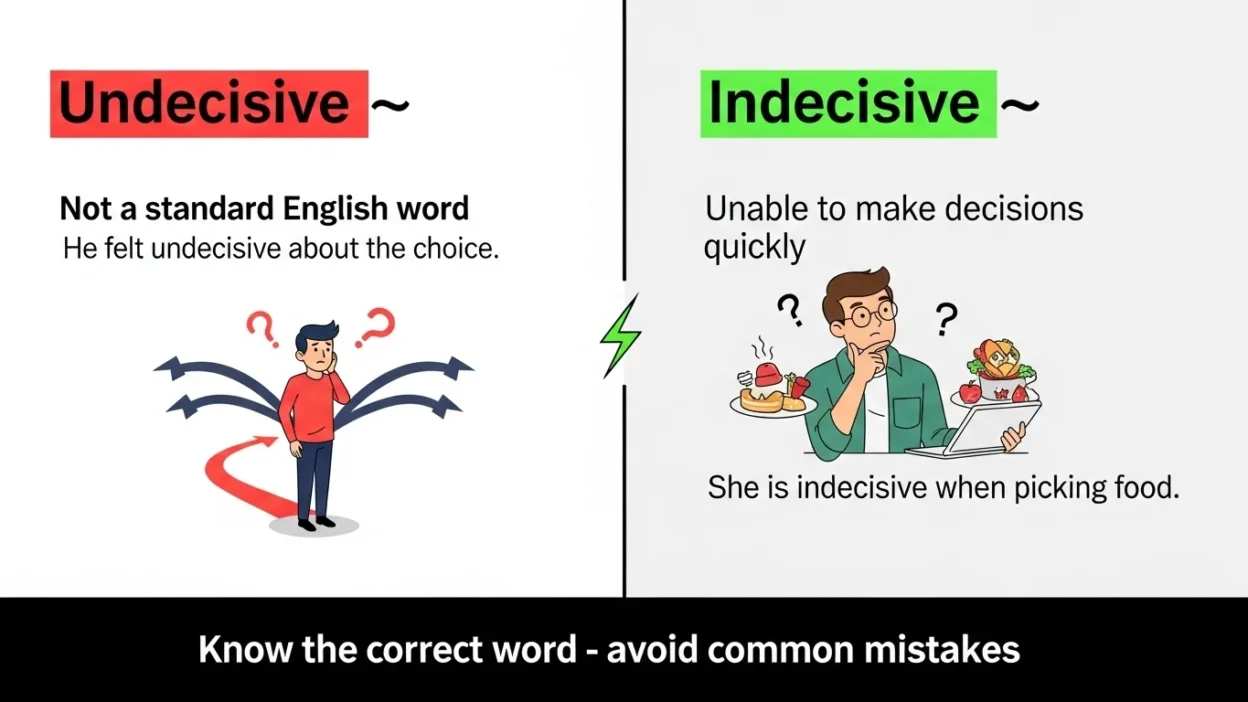
- ✅ Indecisive = Correct word (means unable to make decisions)
- ❌ Undecisive = Incorrect or nonstandard (not accepted in formal English)
👉 Always use indecisive in writing and speech.
What Does “Indecisive” Mean?
Indecisive is an adjective used to describe someone who struggles to make decisions or frequently changes their mind.
Simple Meaning:
- Unable to decide
- Hesitant or uncertain
- Lacking confidence in choices
Examples:
- She is indecisive when choosing what to wear.
- His indecisive nature makes meetings longer.
- I felt indecisive about accepting the job offer.
Related Words (LSI Keywords):
- hesitant
- uncertain
- wavering
- unsure
- vacillating
These words carry similar meanings and can help enrich your writing.
What About “Undecisive”?
Here’s the truth: undecisive is not considered a correct English word.
While it may seem logical (since “un-” often means “not”), it’s not how English forms this particular adjective. Instead, the correct prefix is “in-”, making the proper word indecisive.
Why People Use “Undecisive”:
- Confusion with words like uncertain or unhappy
- Assumption that “un-” works with every adjective
- Habit or informal speech mistakes
Important Note:
You might occasionally see undecisive online, but it’s widely viewed as a spelling mistake or nonstandard usage. Avoid using it in professional, academic, or SEO writing.
Undecisive vs Indecisive: Key Differences
| Feature | Indecisive ✅ | Undecisive ❌ |
| Correct Usage | Yes | No |
| Meaning | Unable to decide | Not recognized |
| Dictionary Status | Standard English | Nonstandard |
| Formal Writing | Acceptable | Not acceptable |
| Common Usage | Very common | Rare/mistaken |
Common Mistakes to Avoid
1. Using “Undecisive” in Writing
❌ Incorrect: He is very undecisive about everything.
✅ Correct: He is very indecisive about everything.
2. Mixing Prefix Rules
Not all adjectives use “un-” for negation. Some use:
- in- (indecisive, incorrect)
- im- (impossible)
- ir- (irregular)
3. Assuming Both Words Are Acceptable
Unlike some word pairs, this is not a stylistic choice only indecisive is correct.
Why “Indecisive” Is the Right Form
The word indecisive comes from:
- in- (not) + decisive
English has specific rules for prefixes, and “in-” is the correct negative prefix for words starting with certain letters. That’s why:
- decisive → indecisive ✔
- not “undecisive” ✘
American vs British English
Good news there’s no difference here.
- 🇺🇸 American English: indecisive
- 🇬🇧 British English: indecisive
Both varieties use the same spelling and reject “undecisive.”
Real-Life Usage Examples
In Daily Conversation:
- I’m too indecisive to pick a restaurant.
- Stop being indecisive and just choose!
In Professional Context:
- An indecisive leader can slow down team progress.
- Her indecisive behavior affected the project timeline.
In Writing:
- The character is portrayed as emotionally indecisive.
- Being indecisive can lead to missed opportunities.
Easy Memory Trick
👉 Think:
“Decisive → Indecisive (not undecisive)”
Or remember:
- If the base word starts with “d” → use in-, not un-
FAQs
1. Is “undecisive” ever correct?
No, undecisive is not a standard English word. It’s considered incorrect in formal and informal writing.
2. Why do people say “undecisive”?
It’s usually due to confusion with other “un-” words like uncertain or unhappy.
3. What is the correct spelling?
The correct spelling is indecisive.
4. Can I use “undecisive” in casual writing?
It’s best to avoid it entirely, even in casual contexts, to maintain clarity and correctness.
5. What’s a synonym for indecisive?
Some good alternatives include:
- hesitant
- unsure
- wavering
- uncertain
6. Is “indecisive” a negative trait?
It can be, especially in leadership or decision-making roles, but it may also reflect careful thinking.
7. How do I stop being indecisive?
- Set clear priorities
- Limit choices
- Trust your instincts
- Practice quick decision-making
8. Is indecisiveness the same as being thoughtful?
Not always. Thoughtfulness involves careful consideration, while indecisiveness often includes hesitation and difficulty choosing.
Summary
When it comes to undecisive vs indecisive, the answer is simple: only “indecisive” is correct. While “undecisive” might seem logical, it’s not accepted in standard English and should be avoided in all types of writing.
Understanding this small but important difference can instantly improve your grammar and make your writing more professional. If you’re writing blog posts, emails, or academic content, choosing the right word builds credibility and clarity.
Actionable Takeaway
✔ Always use indecisive when describing someone who struggles to make decisions
✔ Avoid undecisive completely it’s a common mistake
✔ Use synonyms like hesitant or uncertain to diversify your writing
Mastering small distinctions like this helps you write with confidence and authority.

Matthew Benjamin is a contributing author at SpellPeak, dedicated to clear, engaging, and purposeful writing. He focuses on creating informative content that helps readers understand complex ideas with ease. His work emphasizes accuracy, creativity, and practical value, supporting better communication and thoughtful digital learning for a global audience.